
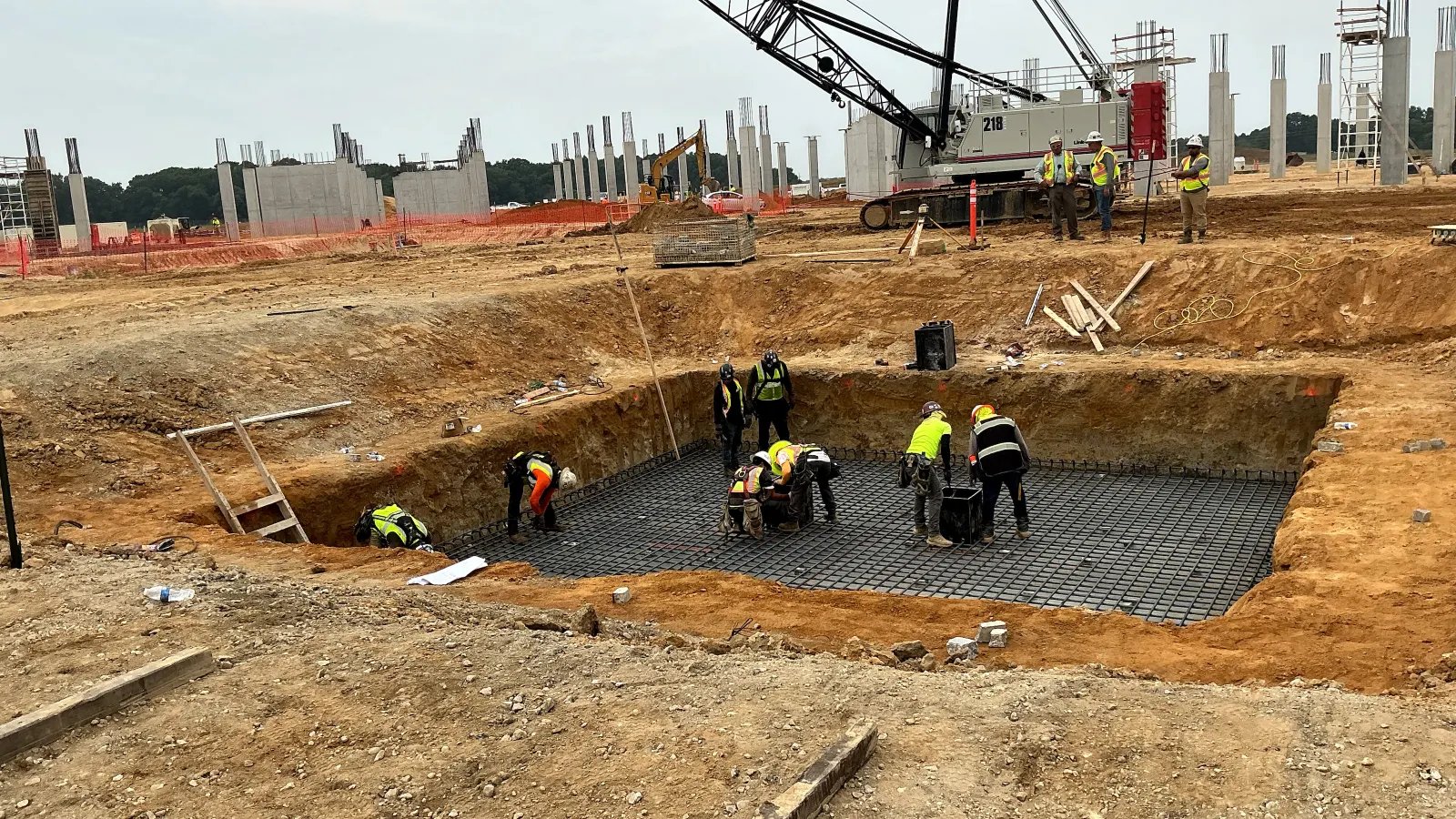

Subcontract packages go sideways at the seams: the grader finishes a pad that the slab crew then has to rework, or the utility trench is backfilled before anyone has tested the pipe. General contractors and construction managers who hire us for concrete, site utilities and earthwork get one firm responsible for all three, which removes the handoffs where schedule and cost leak out.
We work under the prime on public bids, negotiated GMP projects and design-build teams across Texas. Our estimators price from the drawings, the geotechnical report and the specification sections that govern testing, and they list exclusions plainly so your bid leveling sheet is accurate. Our superintendents join the preconstruction meeting, not just the kickoff, so the logistics plan reflects how we build.
The sections below describe what we coordinate, how we plan around Texas soils and codes, and what a CM should expect from us on safety, schedule and coordination with the vertical trades.
What a prime can hand us in one package
A typical package includes clearing and stripping, mass and fine grading, building pad preparation, underground water, sewer and storm drainage, foundations, slab on grade, exterior flatwork, curb and gutter, and parking. We will also take elevated slabs or tilt-up panel work when the structure calls for it. If your scope is smaller, we price the pieces individually and say where a split package creates interface risk.
Subcontractors on either side of us matter. Electrical duct banks, fiber trenching and fire lines often share a trench corridor, and we coordinate those so the sequence is excavate, install, inspect and backfill in one visit. Review our site utilities and concrete foundations pages for the scope boundaries we usually propose.
Crews and equipment you can count on
We coordinate finishing, formwork, rebar, grading, excavation, compaction and pipe trade partners. Coordinating these scopes means the superintendent who sets the grade stakes is the same person who directs the pour, so the answer to a field question comes from someone who owns both sides of the decision. We rent only what is not economic to own, such as a long-boom concrete pump on a particular morning.
Quality control is built into the work: proof rolling before pad acceptance, third-party compaction and cylinder testing, documented rebar inspections, and a closeout binder with test results ready for your owner. For projects with demanding floors, such as industrial concrete floors, we review floor flatness criteria with the owner's representative before the first placement.
Soil, water and weather you have to plan around
Texas does not have one geotechnical problem. A University of Texas research report prepared with TxDOT and the Federal Highway Administration describes three separate methods for calculating Potential Vertical Rise in expansive clay, which is why two engineers can recommend different remedies for the same site. When the report calls for lime or cement treatment, over-excavation or a stiffened slab, we help the team compare the cost and the schedule impact of each before the contract is awarded.
Rain is the other variable. A pad that has been proof rolled and approved can fail again after a wet week in clay country, so we price a contingency day for re-rolling and tell you early when a forecast threatens a pour. We also adjust mixes, retarders and curing for the hot, windy afternoons that dry out fresh slab edges in the west and the Panhandle.
Safety and compliance on a shared site
We submit a site-specific safety plan before mobilization, run daily task briefings and keep trench protection, traffic control and spoil setbacks in place wherever excavations are open. Utility locating and potholing happen before we dig, and we mark and protect what we find. Cold, heat and wind each have their own procedures for crews and for fresh concrete.
Texas energy code adds paperwork to the building side of the job. The State Energy Conservation Office continues to use the International Energy Conservation Code for commercial and industrial construction, and we coordinate slab edge insulation and vapor barrier details with the envelope subcontractor accordingly. Our concrete testing and quality control reporting keeps your closeout clean.
Schedules that respect the critical path
On a fast-track job the site package is the first item on the critical path and the last place a delay gets noticed. We submit a three-week lookahead with the actual hauling, pouring and testing dates, and we update it when the concrete plant or the inspector shifts. If a hold-up is outside our scope, such as a utility owner's tie-in date, we flag it in writing the day we find it.
Large owners are pushing schedules harder. One semiconductor wafer fab near Sherman opened in May 2025 as the first of three planned there, and the follow-on phases mean site contractors are being asked to keep crews, equipment and material suppliers mobilized for a multi-year sequence. We plan labor and mix design capacity the same way for multi-phase campuses, and we show the same flexibility to a manufacturing owner that you would expect on a single building.
Where we mobilize for your projects
We bid across the state, from the Dallas-Fort Worth metroplex and Central Texas to the Gulf Coast, the Rio Grande Valley, the Permian Basin and the Panhandle. A 1,900-acre campus on San Antonio's West Side that serves aircraft maintenance, rail and industrial users shows the scale of site that CM firms are managing, and our trade partners are built to work at that size.
If your next bid is on a public work, our municipal and public works page explains how we handle procurement forms and bonding questions. For distribution programs, see our logistics and warehouse developers page.
Put our estimator on your bid list
Send the bid documents and the geotechnical report and we will return a priced scope with exclusions and unit rates. We are glad to join a preconstruction call.
Common Questions
Will you hold a price through bid leveling?
We hold the number for the period stated in our proposal, usually the owner's award window. Our proposal lists quantities, unit prices for adds and deducts, and the assumptions behind each, so the leveling team can compare us line by line.
Can you take the geotechnical risk?
We take the means and methods risk of building to the report. Differing subsurface conditions are usually carried by the owner, and we define the trigger, such as rock or groundwater outside the boring data, in the contract so a change order is a measured event rather than a dispute.
Do you work under a CM at risk with open-book pricing?
Yes. We will provide a cost breakdown by scope, quantities and subcontractor quotes, and we participate in value engineering sessions. We would rather share the numbers than have the CM hide them in a single line.
How do you handle concrete testing and special inspection?
The owner's testing laboratory samples our concrete, and we coordinate the schedule so inspectors are on site before placement. We keep our own records for slump, temperature and cure so we can answer a low break quickly.
What if the design changes after we award?
We price changes quickly and in writing with quantities, labor and equipment. We will also tell you when a change in one area affects another, such as moving a storm line that now crosses a footing, before the crew finds it in the field.