
Heavy-duty paving and reclaimed ground define most of the concrete we do in Fort Worth, from truck courts beside the I-820 beltway to equipment pads on land that has carried natural gas infrastructure. Owners here move freight, assemble aircraft and run rail operations, so the slabs have to take wheel loads that a typical commercial lot never sees.
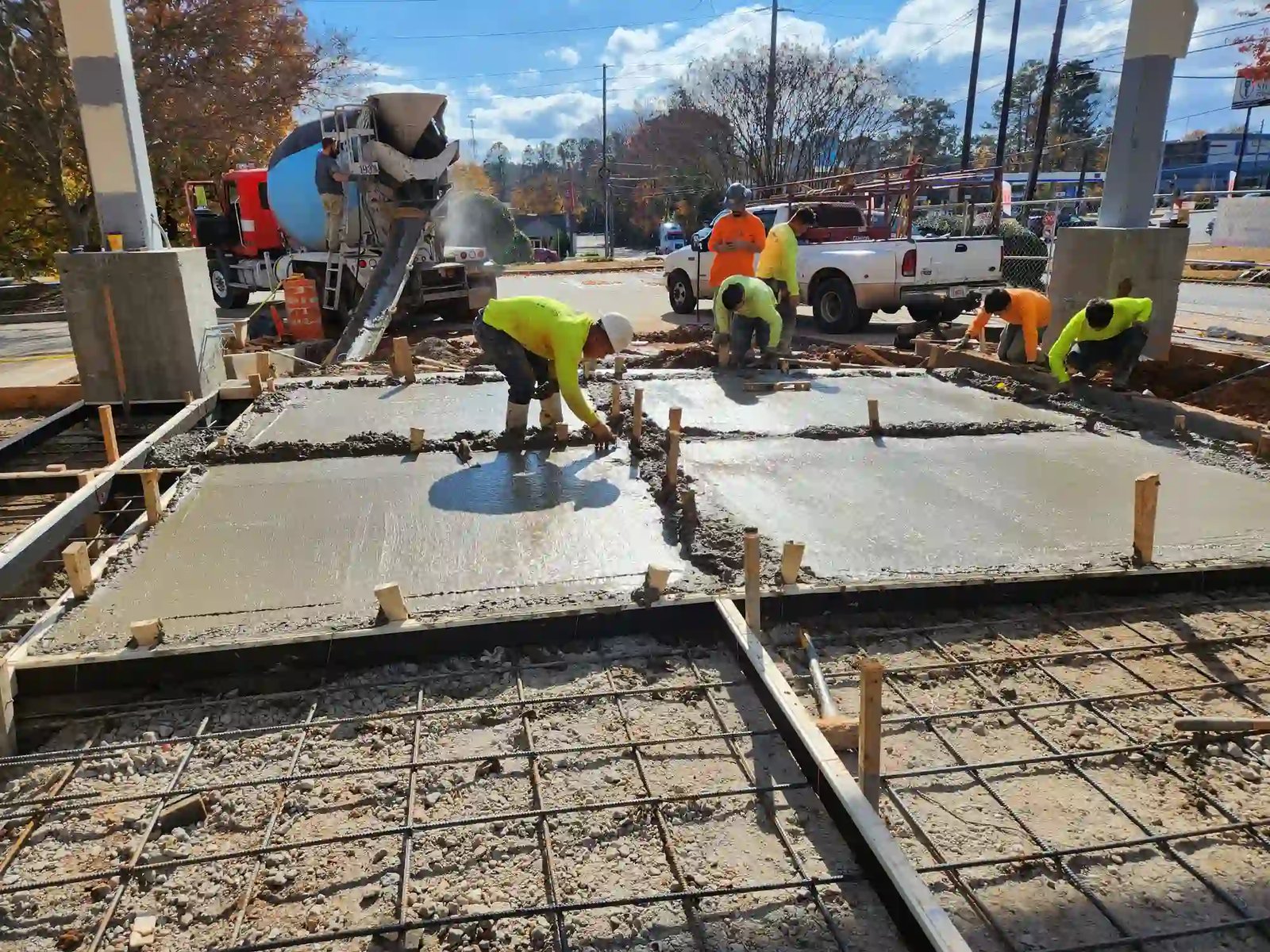
We manage the pieces that decide whether a Fort Worth pavement lasts: subgrade preparation, lime or cement treatment where the soil calls for it, rebar placement, jointing and curing. The same crews cut the trench for a storm line or a fire main before the paving starts, which keeps one foreman accountable for the grade from the pipe up to the finished surface.
If you are a developer lining up a speculative building, an industrial owner adding a trailer yard, or a contractor who needs the concrete trade covered on a plant expansion, we begin with the geotechnical report and a walk of the ground. The report tells us what is under the topsoil, and the walk tells us what the report could not see.
A city built on trains, planes and gas wells
The Barnett Shale lies under Fort Worth, where over 1,000 natural gas wells were counted in December 2009 and each well site took up about 2 to 5 acres; the city also sits in the Cross Timbers region at 541 feet of elevation. For a site contractor that is a practical note, not a curiosity: a parcel that once held a well pad can have compacted gravel, buried flow lines and disturbed fill that must be located and either removed or documented before a building pad goes down.
Four airports lie within the city limits: Fort Worth Alliance Airport, Meacham International, Spinks and Naval Air Station Joint Reserve Base Fort Worth. Aviation drives a steady demand for ramp concrete, hangar floors and tenant improvements on airport-adjacent land, and for the heavy trucking that follows. We cover the airport-side aprons and hangar pads in more detail under aircraft hangar construction.
What our trade partners place and finish
Our trade partners handle concrete paving, truck courts and dock aprons, loading dock pits, trench drains and the sawcutting that controls cracking. We do not hand the finishing to a stranger on pour day, because joint layout, curing compound timing and edge details are where a heavy pavement either performs or starts raveling.
Earthwork is part of the same crew. Fine grading to a tolerance a paving machine or a screed can use, proof rolling before the base goes down, and stormwater swales that actually drain are all coordinated up front, so the paving contractor does not inherit someone else's low spot.
Reinforcement and joints get the same attention as the mix. We set dowel baskets and tie bars to the engineer's layout, check cover before every placement and keep spacing consistent from one panel to the next, because uneven joints in a truck lane show up as spalled corners after the first hard winter or the first run of hot days.
Interstates, tollroads and the haul
Interstates 30, 20, 35W and 820 pass through the Fort Worth city limits, with U.S. routes 287, 377 and 81 and State Highways 114, 183 and 121 also serving the city. That grid is why the city works for distribution and manufacturing, and it is also why a pour day is a logistics problem. We check the ready-mix haul from the batch plant to your gate at the hour the pour will actually run, not at midnight on a map. A pour that runs through the afternoon peak on the freeway needs a different truck cadence than one that finishes by mid-morning.
Water and wind are the other variables. North Texas summers shorten the working time of a load, so we use retarders and cooler batch water when the forecast calls for it, and we set windbreaks or fog misting for flatwork so the surface does not skin over before the finishers reach it.
Delivery windows at active plants and rail-served sites are tight. We coordinate gate access, escort requirements and hot-work or lockout rules before mobilizing, and we keep trucks staged off the public road so a long placement does not back traffic into an intersection.
Fitting a pour into a working facility
Employers such as an airline group, a Class I railroad and a helicopter manufacturer are headquartered in the city, and published accounts note a significant defense contractor presence. Owners of that type often cannot shut a line down, so we work in phases: cut and cap a section, pour it, protect it and open it back up while the next section is demolished. The sequence is drawn on a plan the plant manager can read, with dates, so the people running the operation know which door or lane is closed on which day.
Weekend and night pours are routine for us on these jobs. We confirm the batch plant's off-hours capacity, line up lighting and traffic control, and set a curing plan that keeps forklifts and tugs off a slab until it reaches strength.
Who calls us in Fort Worth
Logistics and warehouse developers bring the largest paving quantities, usually truck courts and trailer parking. Industrial and manufacturing owners need machine foundations, process pits and heavy floors. Municipal and utility clients add water, sewer and storm work that has to be tested and accepted before it carries service.
Across all three, the pattern is the same: a clear scope, a unit price for the unknowns and a crew that shows up with the right equipment. We also build in neighboring markets such as Arlington and Alliance, which lets us move equipment between sites without long mobilizations.
Bring us the Fort Worth site plan
Send the drawings, the soil report and your target start date. We will mark the pad, paving and utility quantities, flag the ground questions and give you a price structure you can compare. For a logistics fulfillment center or a plant expansion, we can also start with a short site walk.
Common Questions
Do old gas well sites change how you build?
They can. We ask for the geotechnical report and any environmental or well-plugging records, then probe the pad area for buried pipe, gravel and disturbed fill. Depending on what we find, the options are removal and replacement with engineered fill, or a documented compaction plan reviewed by your engineer. We never pour over unknown fill without testing.
How thick should a truck court be?
The engineer sets thickness from the traffic count, axle loads and the subgrade strength, commonly with doweled joints at heavy-use areas. Our job is to build to that section and to get the subgrade uniform, because most early pavement failures start in weak, wet or poorly compacted soil under the slab.
Can you work near active runways or rail lines?
Yes, with owner coordination. Airport and rail work carries safety briefings, equipment height limits and flagging or escort requirements, and we plan the crew and the equipment around them from the first pre-construction meeting.
What is a typical sequence for a new trailer yard?
Clearing and stripping, mass grading, utilities and storm drainage, subgrade stabilization, base, rebar and forms, then the concrete placement and saw cutting. Joints are cut within hours of finishing, and the curing compound goes on immediately. The yard opens only after strength tests clear it, and we hand over the testing records with the closeout set.