
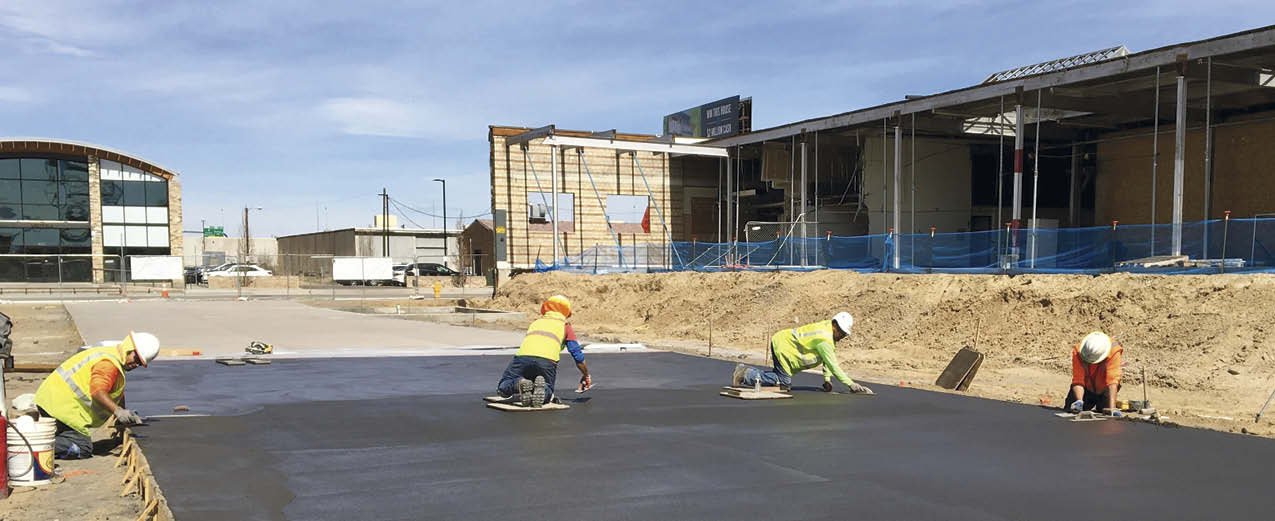

Clay in the north, gumbo on the coast, caliche in the west and sand in the south: a commercial concrete contractor working Texas has to treat those as four different jobs before a single form is set. We pour foundations, slabs, paving, dock aprons and structural frames for general contractors, developers, industrial owners and public agencies, and we begin each one with the soil report and end it with the cure. What changes from region to region is the middle: how the subgrade is prepared, how moisture is managed, how far the ready-mix haul runs and what the sky will do to a placement.
That approach matters because concrete is the one part of a commercial project that cannot be adjusted after the owner moves in. A slab that curls, a pad that settles or a drive lane that cracks at the joints turns into a punch-list fight months later. We try to remove those outcomes on paper first, with a clear scope agreed with the superintendent, a pour sequence that suits the building, testing arranged before the trucks roll and finishers who stay with a placement until the surface is closed and protected.
Why one Texas playbook does not work
A distribution slab in the Dallas area sits on expansive clay that swells and shrinks with the seasons, so we plan moisture conditioning and joint spacing around that movement. On the Gulf Coast the same slab is a flood-elevation and drainage problem as much as a structural one. In the Permian and across much of the west, caliche and hard ground change the excavation, and summer heat shortens the finishing window to a few hours. In South Texas, sandy soils drain quickly but need compaction proofing, and cross-border freight pushes owners toward heavier pavement sections.
Because the same company may bid a warehouse in Fort Worth, a plant pad near the coast and a dock apron in the Valley, we keep regional notes on mix designs, haul distances and curing practice rather than treating each bid as new. The method is the same whether the job is in Dallas or on the coast, but the numbers on the plan set never are, and we price them that way.
The scope we price and pour
Commercial concrete for us means everything from the first footing to the last control joint: spread footings and grade beams, structural slabs, slab on grade for warehouses and plants, truck courts, parking, sidewalks, curb and gutter, equipment pads and tilt panel casting beds. We also place cast-in-place columns, walls and elevated decks where the design calls for them, and we coordinate the embeds, sleeves and block-outs that other trades depend on.
We bid the scope as a whole when the owner prefers one concrete subcontractor, or in pieces when a general contractor wants to split foundations from paving. Either way the quantities are built from the drawings and the geotechnical report, not from a rule of thumb, and the exclusions are written down so nobody discovers a missing line item at the third pour.
Crews and equipment we put on the pour
Coordinating the concrete means the forming, rebar, placing and finishing trade partners work to one schedule, with one foreman answering for the quality of the surface. We run laser screeds, power trowels, saw cutting equipment and pump trucks suited to the placement, and we choose a boom pump over a conveyor or a direct chute based on access, not habit.
Quality control is part of that crew model. Slump and air checks, cylinder casting and temperature logs are taken at the truck, and we coordinate with the owner's testing agency through concrete testing and quality control so that break results reach the superintendent in time to schedule stripping, stressing or saw cutting.
Codes, accessibility review and permits
Texas does not enforce a single commercial building code on every city. State law makes the International Building Code the municipal baseline, and each city may adopt amendments or newer editions by ordinance after a public hearing, so Dallas, for example, lists the codes with its own amendments. We confirm the adopted edition and local amendments with the building department before pricing structural concrete, because reinforcement, cover and special inspection requirements can differ between one city and the next.
Accessibility is a second review layer. The Texas Department of Licensing and Regulation runs the accessibility program under the Texas Accessibility Standards, and projects estimated at $50,000 or more must be registered and reviewed before inspection. Ramps, curb ramps and accessible routes built in concrete are therefore detailed and checked to those standards, and we keep slope and cross-slope readings at the form stage, before concrete is placed.
Buildings and sites we pour for
Most of our commercial work sits under a handful of building types: warehouses and distribution centers, manufacturing and food plants, medical and office buildings, retail centers, schools and municipal facilities. Each puts a different load on the slab. A rack-supported warehouse needs flat, jointed floors with heavy point loads, while a medical office wants a tighter finish, vapor control under flooring and accessible routes at every entry.
Owner type matters as much as building type. A developer building speculative space wants a simple, repeatable pour sequence and fast turnover, while a city or school district wants formal documentation and a clear inspection trail. We adjust the paperwork and the pace to match.
Procurement, sequencing and delivery
Public owners buy through formal channels. The state comptroller maintains the Electronic State Business Daily, a centralized master bidders list and a statewide ordering system, and cities, counties and districts run their own solicitations, so we watch the bid notices for municipal and public works concrete and prepare submittals that match the way each agency scores them.
Schedule risk in concrete is usually upstream of the pour: a late geotechnical release, an unresolved drawing conflict or a utility that has not been tied in. We sequence site utilities ahead of slabs wherever the design allows, hold the pour calendar against ready-mix plant capacity in the area and keep a weather day or two in the baseline. General contractors and construction managers get a three-week look-ahead that shows pour dates, test dates and the date the area is released to the next trade.
Send us the plans and the soil report
Tell us where the project sits, what the geotechnical report recommends and when the first pour needs to happen. We will respond with a scope, a sequence and the questions that could move the price, so your concrete budget rests on something firmer than a square-foot guess.
Common Questions
How early should a concrete contractor be involved on a Texas commercial project?
As soon as the geotechnical report exists. Soil classification, bearing capacity and moisture recommendations decide slab thickness, subgrade treatment and the pour calendar, and each of those has a price. Early involvement lets us flag unusual items, such as lime treatment or over-excavation, while they are still alternates and not change orders.
Do we need a different concrete mix for different regions of the state?
Often yes. Aggregate sources, cement supply, haul time and temperature all change by region, so mixes are tuned locally with the ready-mix supplier. In hot, dry parts of the state we plan for retarders and evaporation control, and where hauls run long we watch slump loss before the truck reaches the site.
Who pays for testing and special inspection on a commercial pour?
The contract documents decide, but owners typically retain an independent testing agency and the contractor coordinates access and curing of the cylinders. We build testing intervals into the schedule so that results arrive before stripping, sawing or loading decisions are made.
How do you handle accessible routes in concrete?
We work from the registered drawings, set curb ramp and sidewalk forms to the specified slopes and check them with a level before concrete is placed. A pour that misses a slope is expensive to fix, so the form check is where accessibility is actually won or lost.
Can you work with our general contractor, or do you prefer to bid direct?
Both. We are comfortable as a subcontractor under a general contractor or construction manager, and we also quote directly to owners and developers who want a single concrete scope.