
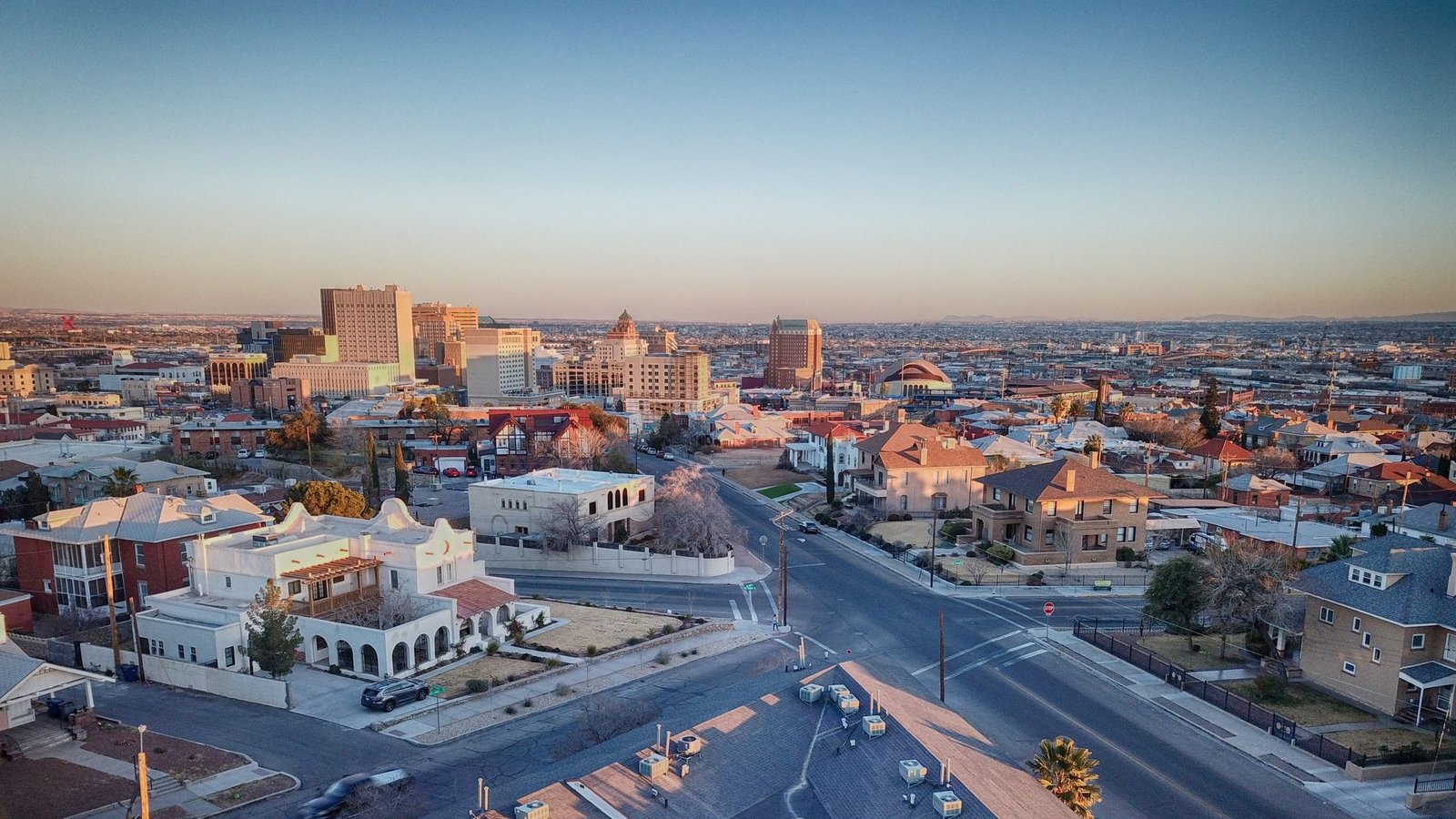

Moving earth for a 1.2 million square foot building on roughly 1,039 acres is a different sport from pouring a warehouse floor, and El Paso is now home to a plan of that scale. A company announced in October 2025 an estimated $1.5 billion AI data center in northeast El Paso along Stan Roberts Sr. Avenue near U.S. Highway 54, with 1,800 construction jobs at peak, and a separate news report says the campus is expected to reach 1 gigawatt of capacity and come online in 2028. We are not the contractor of record on that campus. We describe it because owners of nearby land and suppliers to it need the kind of site contractor we are: heavy grading, durable pavement and reliable utility work.
Other work surrounds it. El Paso International Airport reports an air cargo complex of 288,000 square feet in two 144,000 square foot buildings with over 34 acres of aircraft parking on a $60 million investment, and the Texas Comptroller reports that Fort Bliss had 41,527 direct employees in 2025. All of that sits on desert terrain with caliche, rock outcrops and arroyos that carry violent water after a storm.
The concrete, earthwork and utility trade crews we coordinate work to the soil report and the drainage study, and we start there on every El Paso job.
Caliche, rock and desert soils
Under the thin desert topsoil in much of El Paso is caliche, a cemented calcium carbonate layer that ranges from soft and rippable to hard enough to need hammering or blasting. It affects trenching rate, compaction methods and the choice of backfill. We investigate with the boring logs and sometimes with test pits, then price excavation by material class so the owner pays for what is found.
Native soils are often low in moisture, and fills compact best when they are watered to the right content. In the dry months we run water trucks constantly, which controls dust and gets compaction right. Wind is a factor in placement and finishing, too, so we use windbreaks, fogging and quick curing on flatwork.
Big sites, big haul numbers
On a campus-sized site, the cost of earthwork depends on balance. If cut and fill are close to equal, the job moves fast and haul costs stay low. If the site must import select fill or export spoil, the haul distance and the available disposal sites can dominate the budget. Cut and fill earthwork planning starts with survey data, and we model the quantities before bid so surprises are fewer.
Power and water capacity are also cost drivers. A large load customer needs substation pads, duct banks and heavy conduit trench, and the utility may require specific separations and backfill. We price electrical duct banks with the encasement, rebar and warning tape detailed on the drawings.
Mass grading, then pavement, then pipe in the right order
We stage the work to match the building contractor's needs. Rough grading and drainage come first. Then deep utilities are installed, followed by base and building pads. Concrete paving and curbs are placed after structural steel erection and heavy deliveries are done, so trucks do not damage new pavement. Mass grading with GPS-guided equipment lets us hit design grades with fewer passes.
We document every step with survey checks, density tests and daily reports. If a plan appears to conflict with field conditions, we write it up and ask for direction rather than guessing.
Drainage that works when it rains hard
El Paso Water states that a 2006 storm dropped a year's worth of rain on the city in two days, causing more than $200 million in damage to businesses and homes and $115 million to the stormwater system, after which the city established a stormwater utility in 2008. It is a reminder that the arroyos and low spots shape site design. We build detention and retention ponds, channels and concrete drainage structures to the engineer's design, and we protect them from silting during construction.
Drainage structures need correct compaction around culverts and headwalls, steady inverts and clean joints. Those details are inexpensive during construction and very costly to repair after a storm.
Interchanges, loops and the roads trucks use
Highway work shapes access to many El Paso sites. The Camino Real Regional Mobility Authority describes the Americas Interchange at Loop 375 and I-10 as an eight direct-connector project, with a third phase still awaiting funding, and a federal profile describes the Border West Expressway on Loop 375 as about 7.4 miles at a total cost of $639.5 million, with construction beginning in March 2015. These are completed or partly completed roads, and they influence where truck-oriented developments are practical.
When we plan haul routes, we look at clearances, weight limits and construction closures. A site close to a major interchange can be easy to supply, but its driveway needs a permit, and access may be limited to certain turning movements. We confirm these points during preconstruction.
Dust, heat and working near live roads
Dust control is a daily task on an El Paso site, and permits often require it. We water haul roads, cover stockpiles when needed and keep track-out off public streets with rumble pads and sweepers. Heat is the other constant. Crews follow water, rest and shade routines, and we shift concrete work to the cooler hours so people and product are protected.
On driveway tie-ins along a freeway frontage road, where work sits next to live traffic, we follow the approved traffic control plan, use trained flaggers and keep lane closures as short as the work allows. Safety records, training and site rules are available for owners who need them for their own prequalification.
Utilities, developers and public agencies
Utilities and energy companies need duct banks, vault pads and heavy substation foundations, while commercial developers want pads and parking. Public agencies need predictable bids and clean closeouts.
We also serve owners in Amarillo and Lubbock, so a company with sites in several parts of the state can ask for a coordinated bid.
Send the survey and soil report
We will model quantities, price the earthwork and concrete, and list the unknowns. Learn more about our site utilities work.
Common Questions
Can you build for a data center owner or its general contractor?
Yes. We can do mass grading, duct banks, equipment pads and paving as a subcontractor or prime. We need the geotechnical report, the utility plan and the schedule. We do not claim any relationship with specific campuses.
How do you price excavation in caliche?
By material class. Soft caliche is priced like common excavation, hard caliche as rock. The classification is spelled out in the contract.
What if wind stops the pour?
We adjust start times, use windbreaks and evaporation retarders and, if conditions are beyond limits, we postpone. We do not pour in conditions that will harm the slab.
Do you work with arroyos and flood channels?
Yes. We build channels, culverts and detention structures to the engineer's design and protect them during construction.
Who handles testing?
An independent lab, scheduled by us and reported to the owner and engineer.