
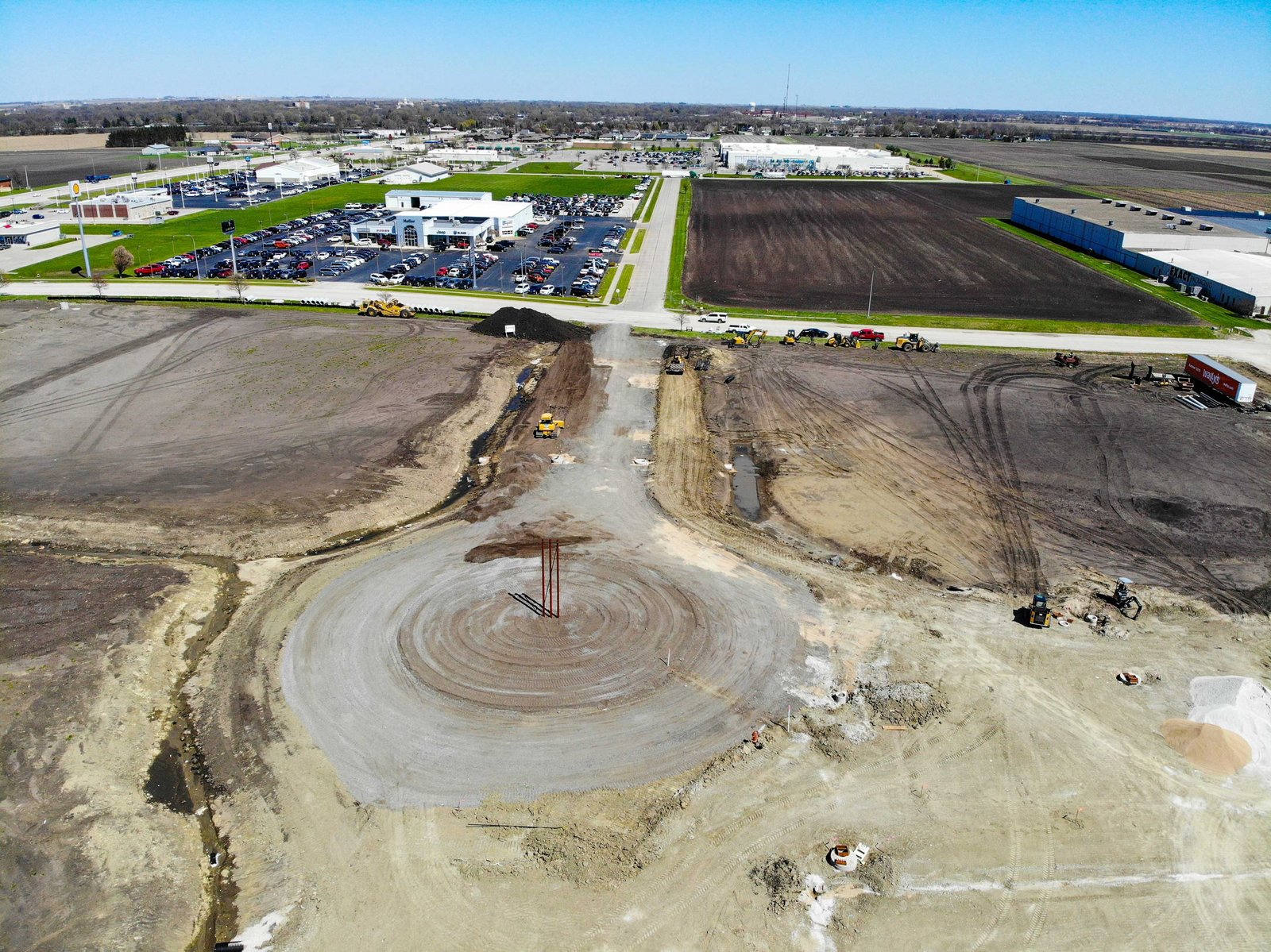

A 3,314-acre industrial park at I-35 and State Highway 255 in Laredo, with about 1,900 acres planned to be rail-served by a 2.6-mile short-line connecting to the Union Pacific, is the kind of site where mass grading is not a phase of the project but the project's first year. The Surface Transportation Board authorized that rail connection in June 2026, and the earthwork to make rail, truck courts, building pads and drainage fit together will move more soil than most buildings ever see. Mass grading is the large-scale reshaping of land: cutting high ground, filling low ground, and building a set of benches and slopes that the rest of the work sits on.
We perform mass grading for industrial parks, distribution campuses, subdivisions and plants with scrapers, dozers, excavators, compactors and haul trucks guided by GPS machine control. The aim is a balanced site, where the soil cut from one area fills another without importing or exporting large volumes, and where every pad, road and basin ends up at the elevation the civil plans require within a small tolerance.
Balance the earthwork, then build to the model
Our approach begins with the earthwork quantity takeoff from the grading plan, followed by a haul plan that shows how soil will move from cut to fill. We look for ways to shorten the haul distance, to avoid double handling and to put the heaviest cut where the fill is needed. Where the numbers do not balance, we price the import or export up front, with the tonnage and the haul route visible, instead of hiding the gap in a lump sum.
In the field, the dozers and scrapers run from a digital terrain model loaded into GPS machine control, so operators see the cut or fill needed at the blade. Staking is reduced to control points and checks. Fill is placed in thin lifts at the moisture content the geotechnical report specifies, compacted with sheepsfoot or smooth drum rollers, and tested by a lab at the frequency the plan requires. The finished surface is checked against the model so the pad is ready for building pad preparation, and the process is the same whether the pad is an acre or fifty.
Strip, cut, fill, compact and finish
A typical scope starts after site clearing and grubbing, with topsoil stripped and stockpiled. Cut areas are excavated and the soil is hauled to fill zones, where it is placed in lifts and compacted. Unsuitable material, such as organic soil or wet clay, is removed and replaced with approved fill, and weak subgrade is stabilized with lime or cement where the plan calls for it.
The same crews form the shapes the drainage design depends on: swales, ditches, pond and basin excavations, berms and embankments. Roads and truck courts are brought to subgrade elevation, and building pads are brought to the pad elevation plus an allowance for the slab and base. Slopes are trimmed, seeded or covered with erosion control, and the finished grades are surveyed and documented so the next trades start from a known surface.
Large parks and ports drive the volume
Texas has a lot of large-scale land development. In Lubbock, Reese Technology Center began construction in 2025 on a 90-acre East 90 Business Park across Research Boulevard from its campus, with the first phase covering about a third of the property. In Laredo and Lubbock, parks like these are built in phases, so the mass grading is also phased, and the first phase has to leave the next one a workable surface.
On the Gulf, the Port of Brownsville is reported to cover 40,000 acres, described as the largest land-owning public port authority in the country, with a first business park of 118 acres. Flat coastal ground, which is what a port site usually is, often needs imported fill to lift pads, which turns the earthwork balance into a trucking problem. Port work at Brownsville is a case where the haul plan carries as much weight as the grading plan. Different markets create different problems: clay in the north, sand and coastal clays in the south, and caliche in the west.
Earthwork sets the calendar
Mass grading is the longest early activity on a large site, and it is the most weather-dependent. Rain stops fill placement, and a cut in clay can be unworkable for days after a heavy storm. We schedule the work so that fill areas are sealed with a smooth roller at the end of each day and drained so water does not collect, and we have equipment ready to restart as soon as the surface firms up.
Phasing matters. If a building must be started in the first phase, we grade its pad and the access road first, then move to the later areas. Utility crews often follow close behind, and conflicts arise if pads are rough-graded and then cut for sewer or storm lines. We coordinate with the utility contractor, and with the storm drain team, so trenches are cut once and the compaction is not redone.
Where the dollars go on an earthwork job
Quantity and distance are the main factors. The cubic yards to be moved, multiplied by the haul distance, give a rough measure of the cost. Soil quality is next: clean, compactable fill is cheap to place, while wet or expansive material may need drying, mixing with lime or replacement. Rock and caliche slow production and wear equipment.
Testing and rework are quieter costs. A fill that fails compaction has to be reworked, and a pad out of tolerance has to be trimmed. Machine control cuts those costs by keeping grades tight. We provide a unit-price schedule for cut, fill, import and export so a change in quantities is a matter of arithmetic instead of a negotiation, and so owners and commercial developers can compare bids on a common basis.
Site questions to settle before bidding
Start with the geotechnical report. It tells us how deep the soft layers run, how much shrink or swell to expect in the fill, and whether the groundwater is a problem. A soil that is excavated and then recompacted does not occupy the same volume, so the earthwork balance depends on a shrink factor that the engineer sets and that we check against test results during the work.
Next are the neighbors and the drainage. Graded sites change how water leaves the property, and the plan has to show it safely reaching a creek, a pond or a storm system. Erosion controls must be in place before the first cut, and they need maintenance through every rain. If the site needs a basin, we begin with the detention and retention excavation so it serves as a sediment trap during the rest of the grading.
Pads for every kind of building
The size and flatness of the pad vary by building. A distribution center needs a large, level pad with a slight fall for drainage and a truck court on the same plane, while a manufacturing plant may need several pad elevations for process areas and equipment foundations. Data centers, cold storage and tilt wall buildings all put particular demands on the subgrade, so we tailor compaction and moisture conditioning to the foundation type.
We coordinate with the foundation crews so the pad is released at the right elevation and in the right condition, and we repair any areas disturbed by weather before the slab or footings begin. A well-graded pad speeds up everything after it.
Balance your earthwork with us
Send the grading plan and the geotechnical report and we will review the cut and fill balance, the haul and the schedule before a bid is requested.
Common Questions
How much earthwork should I expect on a typical industrial site?
It varies enormously. A flat coastal site may need fill imported to raise pads above flood levels, while a rolling site may have substantial cut. The grading plan and the geotechnical report give the quantities, and the best sites are designed so cut and fill roughly balance.
What is GPS machine control and why does it matter?
Machine control uses satellite positioning and a digital terrain model so the equipment knows its position relative to the design surface. Operators see cut and fill on a display, which reduces stakes, rework and over-excavation, and speeds production.
How do you handle wet soil during grading?
We dry it by spreading and discing, blend it with drier soil, treat it with lime or cement where approved, or replace it with better material. The method depends on how wet it is, how much there is and what the geotechnical report allows.
Can you grade in the rain?
Light rain can be tolerable, but heavy rain stops fill placement and compaction. Wet soil cannot be compacted properly, and trying to do so creates rework. We seal and drain the surface at the end of each day to limit the delay.
Who tests the compaction?
An independent testing laboratory usually tests density and moisture, at frequencies set by the plan. We coordinate with them so tests are done before the next lift and so failures are fixed immediately.