
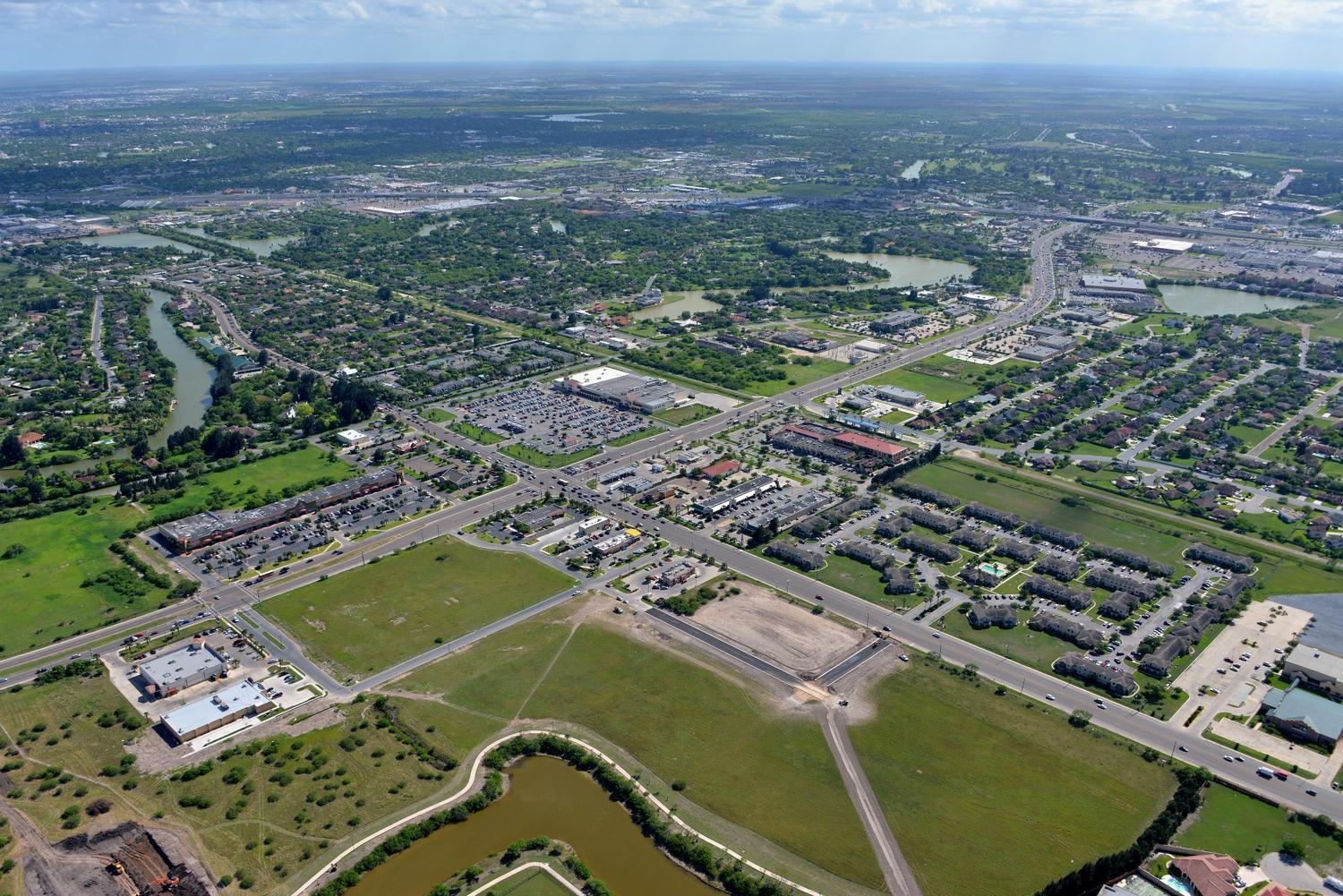

Heavy equipment staging, module laydown and plant foundations at the Port of Brownsville all begin with low, wet coastal ground, and a contractor who treats that ground like ordinary building soil will pay for it later. We build concrete pads, pavements and underground utilities for industrial owners at and around the port, starting with a plan for coastal clay, shallow groundwater and the weather that comes with a Gulf location. The groundwork decides whether a heavy foundation settles evenly or not.
The scale of what is happening there is visible in public documents. A liquefied natural gas export project describes itself as occupying approximately 1,000 acres at the port, with a first phase final investment decision in July 2023, two more trains in September and October 2025, and a peak of about 7,500 construction and trade workers. A freight trade publication reported in June 2026 that the roughly $295.2 million Brazos Island Harbor project is complete, deepening the main route of the ship channel from 42 to 52 feet. A port of this size creates demand for work that is smaller and less visible than a liquefaction train: contractor yards, parking, access roads, utility corridors, laydown pads and support buildings.
We aim at that support layer, and at the owners and general contractors who need it done correctly and on time.
What the port and its land base mean for site contractors
A 2025 maritime trade article reports that the Port of Brownsville covers 40,000 acres, making it the largest land-owning public port authority in the country, and that its first business park is 118 acres. Another profile describes the port as 13 miles by rail and 7 miles by truck from international crossings, served by a short-line railroad operated by a regional carrier that connects to Class 1 lines, and as Foreign Trade Zone No. 62. In practical terms, tenants arrive with a need for rail, road and utility connections that were not on the site when they signed a lease.
We therefore begin each port project by asking who owns the ground, who owns the utilities and who permits the work. Port authority requirements, state and federal permits and the tenant's own insurance rules can each affect a trench, a pour or a stockpile. We carry that coordination as a cost line in the bid, and we send questions early rather than finding out in week six. Port tenants often also ask how soon a laydown yard can be usable, and the honest answer depends on the fill: a yard built on well-draining select material can be graded and topped with base in a few weeks, while one that needs preloading or lime treatment needs a longer curing and testing window that should be on the master schedule from the start.
Coastal clay, groundwater and settlement
Near the ship channel the ground is soft and wet. A pad that will carry a transformer, a compressor skid or a trailer-mounted unit has to be designed for bearing capacity and total settlement, and an engineer may call for over-excavation, geotextile, select fill or lime-treated subgrade. The over-excavation and recompaction and engineered fill and soil stabilization crews we coordinate build those sections lift by lift, with moisture and density testing at each stage so the report and the pad match.
Groundwater affects both trench work and slab placement. Where the water table sits near the surface, we plan dewatering with well points or sumps, and we discharge according to permit conditions. Concrete is not placed in standing water. Drainage and finished grade are set so storm surge or heavy rain leaves the pad quickly, and edges are thickened where the engineer wants protection against scour.
Pads, pavement and foundations for industrial users
Support work at a large energy or bulk-cargo site includes equipment foundations, pipe sleeper supports, containment curbs, tank pads and maintenance buildings. We handle equipment pads and machine foundations with the rebar, embeds and anchor bolt layouts the vendor drawings require, and we pour containment pads and secondary containment with sealed joints and sloped floors to sumps. Heavy-haul pavement for module transporters and cranes needs thicker sections than ordinary parking and is designed for concentrated wheel and outrigger loads.
Utilities are the other half. We install water, sewer, storm and electrical duct banks to serve those facilities, and we pothole existing lines before digging because pipe racks and legacy lines cross much of the land.
Hurricane season and construction calendars
Brownsville is on the Gulf, so the calendar includes a storm season. We keep a plan for securing equipment, stockpiles and open excavations when a tropical system approaches, and we avoid leaving deep trenches open over a forecast event. Fresh concrete needs protection from sudden rain, and we stage plastic sheeting and drainage pumps on site during the season.
Peak hiring on large projects can tighten the labor market, so owners of smaller jobs near the port should book crews early and be flexible on start dates. We give a clear mobilization date and a written look-ahead so a developer can coordinate with the general contractor and the equipment vendors.
Energy, manufacturing and agribusiness near the port
The port's land is attracting utilities and energy companies, bulk handlers and processors. A flour mill and a sunflower seed plant at the port's first business park were reported in 2025 as planning 120 jobs, and processing plants like them need washdown floors, grain-handling pits and rail loadout pads. Industrial and manufacturing owners who rely on rail should plan for short-line spurs and the concrete that supports them.
Owners in the Valley also move between sites, and our trade partners in Harlingen and McAllen can advise on cross-county logistics when a company has more than one location.
Bring us the soil report first
Share the geotechnical report and the tenant's drawings and we will tell you where the fill, groundwater and pavement design will matter before you finalize the schedule. Our grading and clearing trade partners are available to walk the land with you.
Common Questions
Can you build on soft coastal fill or spoil ground?
Yes, with the right testing and preparation. We review boring logs, probe for soft zones, and build pads in compacted lifts. The final design depends on the engineer, and we follow it, including surcharge or waiting periods when settlement predictions call for them.
How do you handle high groundwater during excavation?
We plan dewatering with well points, sumps or sheeted trenches depending on the soil and depth, and we obtain discharge permission before pumping. Excavations are kept as short as the schedule allows, and pipe is bedded in stable material.
What if we need a mobile crane pad or module laydown area?
These pads are designed for outrigger and wheel loads, usually with a thick reinforced slab on stabilized subgrade. We ask for crane charts, module weights and travel routes, then build to the engineer's design.
Do you work with port authority approvals?
We work with whoever controls the land, whether that is a public port authority, a tenant or a private owner. We submit the plans, method statements and insurance paperwork they require and schedule inspections around their rules.