
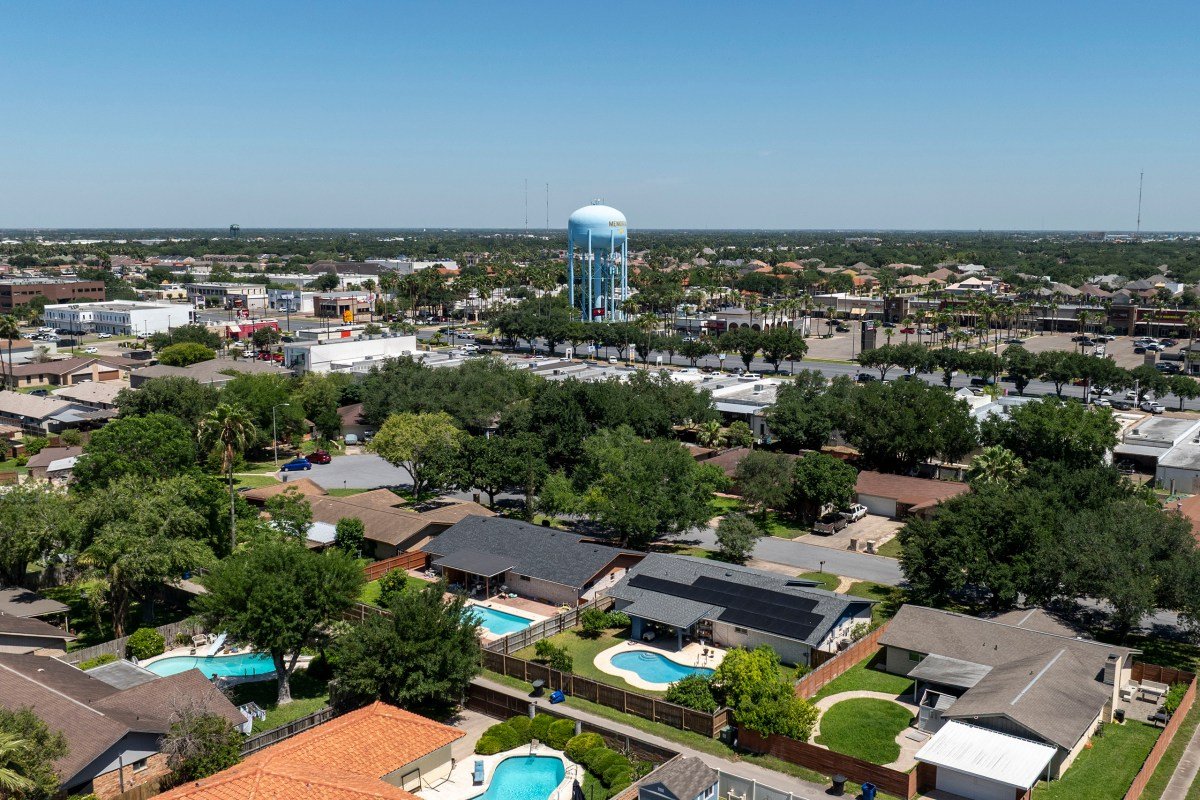

A tenant touring a McAllen industrial park wants to see paved yards, finished docks and drainage that works after a downpour, and a developer wants all of that built without disturbing the lots that are still for sale. We grade, pour and pipe for those developers and for the manufacturers and logistics firms that follow them, working lot by lot inside parks where roads, detention and utilities are shared. Our approach starts with how water leaves the site, because in the Rio Grande Valley drainage decides more than anything what a pad will cost.
The area is already full of parks. A local economic site says the McAllen metropolitan area has 16 industrial parks serving over 150 companies, and a 2023 trade report describes a newer nearshoring campus between Idela and Ware Road as a $120 million investment in phases on a 473,400 square meter plot. A commercial inspection expansion of the Anzalduas international crossing, an $83 million project that began in 2022 with a goal of serving commercial trucks, adds another reason for warehouse and yard capacity on the east side of the metro. Those figures come from chambers and trade outlets, so treat them as context, and confirm your own parcel and its status with the city.
Our job is to deliver ground that is ready for the building, with documented compaction and elevations.
Starting with drainage and the storm record
McAllen sits in a region that has taken direct tropical storm hits, and public references cite Hurricane Dolly in 2008 and Hurricane Hanna in 2020. Whatever the exact rainfall totals, the lesson for a site contractor is that flat Valley ground holds water, and a pad that is a few tenths too low can be ankle deep after a big storm. We review the drainage study, grade to the design flow lines, and verify finish elevations against benchmarks before any concrete is placed.
We also check the outfall, since the cheapest time to learn that a downstream pipe is undersized is before the pad is poured. A detention basin that drains slowly because a downstream culvert is undersized is a problem the owner does not want to discover in September. Detention and retention ponds and culverts and headwalls are part of our scope on many Valley parks, and we build them to design volumes with the side slopes and erosion protection the plans call for.
Pads, yards and docks for park tenants
A tenant building in a McAllen park usually has dock-high doors, a truck court, trailer parking and a small office. We pour the dock apron and drive lanes in concrete, finish the floor to the owner's flatness target and build the pits and ramps to the equipment drawings. Parking lot concrete for employees and visitors is often done in the same mobilization, with ADA ramps and striping coordinated with the final permit inspection.
Where a developer wants to attract tenants, we can prepare lots to an agreed graded pad, with compaction tests and a pad certificate, and leave a standard utility stub at the property line. That helps the owner market the lot because a tenant's contractor can start vertical construction faster. If you are building to a footprint you have not sold, tell us how flexible you want it to be.
Valley soils and the heat of a long pour season
Soils in the Valley are often silty or clayey, and the water table can be high near irrigation canals and low areas. We work from the geotechnical report, which often calls for removing the top layer of soft soil, replacing it with select fill and treating the rest with lime or cement. A wet winter slows the schedule, while a dry summer allows earthwork to move faster but increases dust control and watering costs.
Concrete placement in a long, hot season requires a plan. We start early, control mix temperature, apply curing compound or wet cure immediately and protect edges against drying wind. Large slabs are poured in sequence, with saw cuts made as soon as the slab can take them, so shrinkage cracks follow the joints instead of crossing a bay.
Utilities that follow the road and the lot line
Park infrastructure includes water mains, sanitary sewers, storm drains and conduit. We install water main installation and sanitary lines, pressure test and disinfect to the utility's procedures, and coordinate with the city on tie-ins. For tenants, we run fire lines, hydrants and private service laterals. Conduit and fiber trenching for communications and power can be placed in the same open trench schedule, saving mobilizations.
We keep as-built records of every run. A later tenant or utility that needs to tap a line should be able to find it without potholing blindly.
Buyers who build in the Valley
Commercial developers and park owners are our most frequent partners, followed by manufacturers and food processors that want a shell and a yard on the same schedule. Logistics and warehouse developers benefit from our experience with truck-heavy sites. Owners of agriculture-related facilities can ask for washdown floors, drains and containment details suited to their process.
Because the metro is part of a wider Valley economy, we also work in Pharr and Edinburg, which lets us offer a single bid package to a company with more than one site.
Walk the park with us
Send your lot number, the drainage report and the tenant program. We will respond with a site package price and a list of risks specific to the parcel. See our concrete paving page for more on yard design.
Common Questions
Can you build a lot ready for a tenant I have not signed yet?
Yes. We prepare a graded, compacted pad to a standard elevation, test it, and provide stubs and a pad certificate. The tenant's contractor can then start foundations without extra earthwork. We recommend leaving flexibility in the pad size when the tenant's requirements are unknown.
What is the biggest drainage mistake on a Valley industrial lot?
Setting the slab too low relative to the outfall, or assuming a neighbor's detention will handle your runoff. We confirm the flow path, the finished floor elevation and the outfall capacity before we pour. A small change in elevation is cheap early and very expensive after the slab is down.
Do you work on parks with cross-border freight customers?
We work wherever the tenant's yard needs to be built. Truck-heavy tenants need heavier pavement and more room to maneuver, and we design and price accordingly.
How long does a typical site package take?
Timing depends on size and weather, but a typical lot with a building pad, a truck court and utilities is a matter of weeks, not days. We give a written schedule with the weather risk identified.
Who handles permits and inspections?
The owner or general contractor holds the building permit; we handle the work that requires permits for our scope, such as grading, utilities and paving, and schedule the inspections. Texas accessibility registration is needed for projects of $50,000 or more, and we help with ramps and routes.