
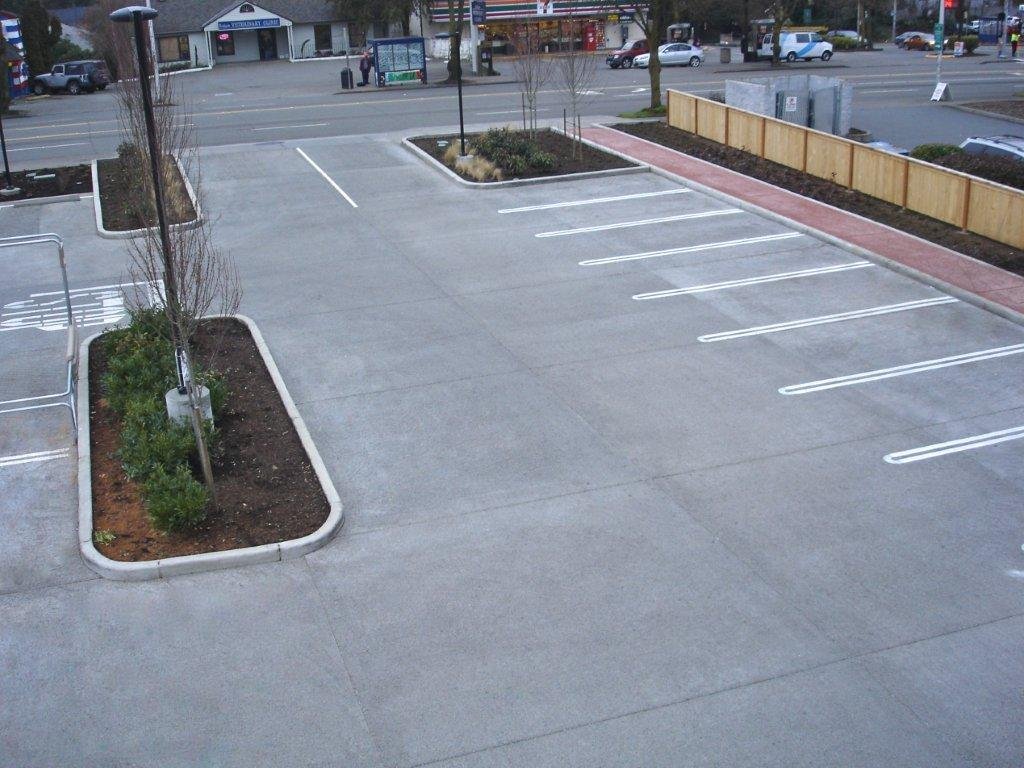
Parking lots look simple until the first heavy rain, the first loaded trash truck and the first accessible stall inspection. A lot has to drain to the right inlets, carry a dumpster truck at the corner without cracking, give wheelchair users level stalls and aisles, and still look good after years of sun and oil drips. Concrete does that well in Texas, where summer heat softens asphalt and storms leave seal coats and surface treatments to wear thin.
We build concrete parking lots for retail centers, offices, medical campuses, schools, churches and public facilities across the state. Each project starts with the civil plan and the geotechnical report, and the details come from how the lot will actually be used: where delivery trucks turn, where water collects, where people park and walk, and where the owner plans to add landscaping and lighting. Getting those answers early saves a surprising amount of rework.
Lots we pour and what each needs
A retail shopping center needs drive aisles that withstand turning delivery trucks, heavy-use entry drives and compactor pads, along with parking fields that can be striped and re-striped. An office building wants smooth surfaces, attractive finishes at walkways and minimal puddling. Medical and school sites add accessible routes, drop-off lanes and fire lanes, and public lots must follow city standard details.
Lots also differ in how they are used by a car-dependent community. In Allen, for example, the city notes that it is not a DART member and has no fixed-route public transit, so a visit to almost any commercial or civic site there starts in a parking lot. Where the lot is the only way in, it cannot be closed often for repair, and that favors a pavement that lasts.
Drainage, aquifers and the first storm
Concrete pavement is impervious, so a lot adds runoff the site has to handle. Civil engineers pitch the pavement toward inlets, valley gutters or curb openings, and we hold those grades in the field with laser checks. Standing water is the main enemy of a parking lot, because it softens the subgrade, accelerates joint deterioration and becomes a hazard for pedestrians in cold weather.
In San Antonio and the surrounding region, there is an additional step. The Texas Commission on Environmental Quality requires a plan for building on the recharge, transition or contributing zones of the Edwards Aquifer to be reviewed and approved first under its Edwards Aquifer Protection Program, and it states that technical review of an administratively complete application takes 90 days. That review period belongs in any San Antonio lot schedule, and we ask owners early whether a site falls in the zone.
Building the lot in the right order
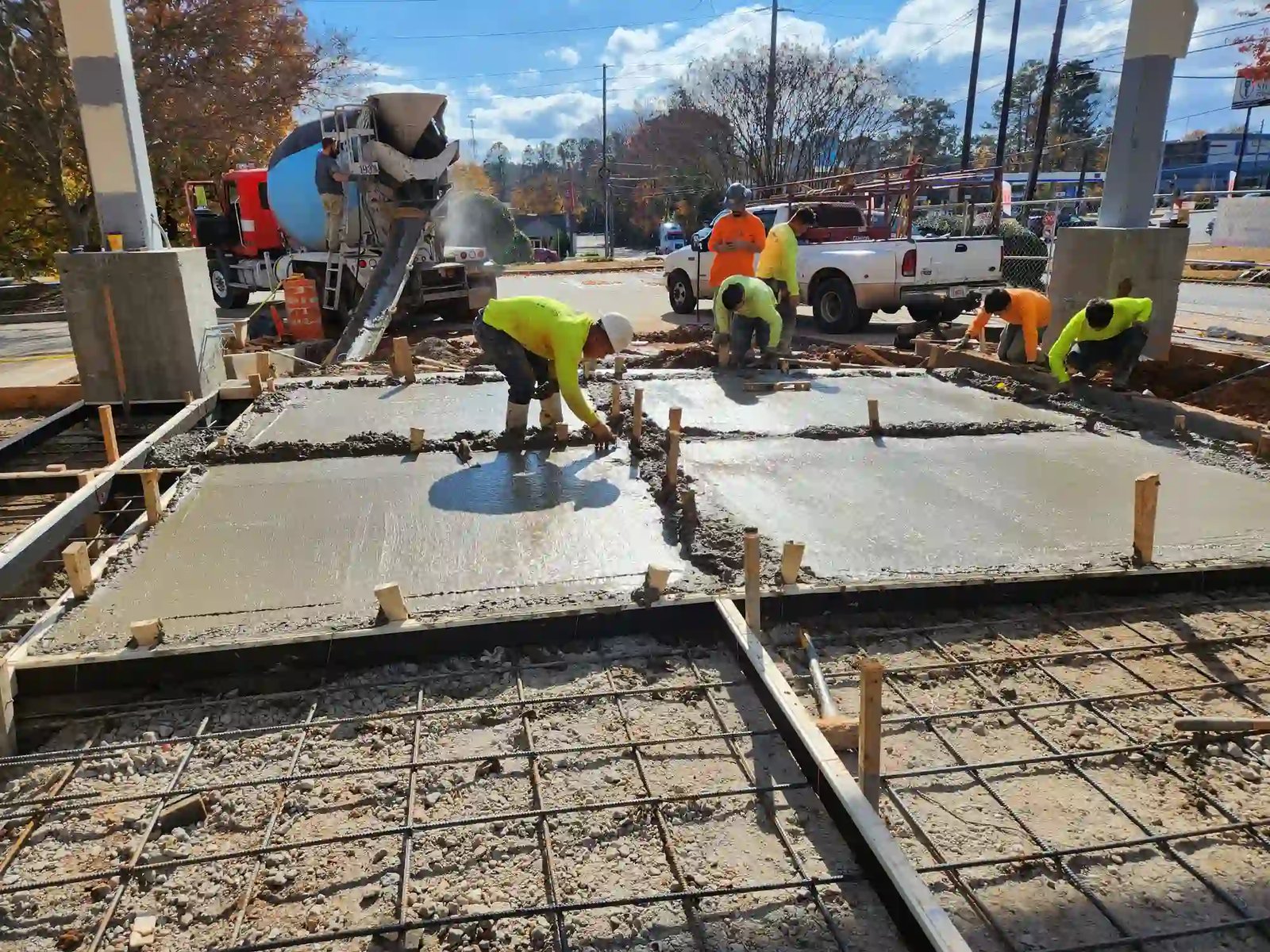
The lot is built from the ground up. Utilities and drainage structures are installed and tested first, the subgrade is shaped and proof-rolled, and any needed lime or cement stabilization is placed and cured. A compacted base follows, edge forms or a curb machine set the lines, and reinforcement or dowels are placed where the design calls for them. We then pour, finish, texture, cure and saw the joints on a schedule that matches the weather.
Layout is the part owners rarely see. We plan joint patterns so that they run parallel to stalls, meet at light pole bases and inlets, and avoid cutting through accessible stalls at awkward angles. After curing, we coordinate with the striping contractor and with curb and gutter crews to confirm that gutters flow properly before the lot is opened.
Why a concrete lot pays back
A concrete lot generally costs more to build than an asphalt lot of similar size, but the cost difference narrows once repairs, resurfacing and heat-related damage are counted. Texas hail is a case in point. The state led the nation with 878 hail events and 169 tornadoes in 2024, according to a market report, with insured losses above $47 billion. Concrete does not need replacing or coating after hail the way roofs and finishes do, and it does not lose a surface treatment to the sun.
The major price drivers are thickness, subgrade treatment, drainage structures and finishing. A lot designed for passenger cars is thinner than the truck lanes and dumpster pads, which are often thickened, and a lot on clay that needs stabilization costs more than one on stable soil. We present those items separately so owners can decide where to spend. A general contractor can then compare apples to apples.
Accessibility, fire lanes and inspections
Accessible parking is governed by the Texas Accessibility Standards, and a project of $50,000 or more is registered with the state's licensing agency and reviewed by a Registered Accessibility Specialist. Stalls, aisles and access routes are therefore laid out to specified slopes in all directions, and we verify them with a level at the form stage and again after finishing. Signs, striping and curb ramps follow the registered drawings.
Fire lanes, turning radii and drainage are checked by the city, and so is erosion control during construction. We install and maintain the controls described in erosion control and SWPPP and keep inspection records so the site is ready for city or state review at any point.
Have a lot to build or rebuild?
Send the civil drawings or a site plan and your timing. We will price the pavement, joints, subgrade work and striping, and show how the numbers change if you thicken the truck lanes only or phase the work around tenants.
Common Questions
How thick should a concrete parking lot be?
Passenger car areas are thinner than truck lanes and dumpster pads. The civil or geotechnical engineer sets thickness from the traffic and the subgrade, and we build to that. When trucks cross the lot, we recommend the thicker section in those lanes only to save cost.
Do concrete parking lots need joints?
Yes. Joints allow the slab to shrink and move without random cracking, and they are laid out to line up with stalls, inlets and light bases. We saw them soon after finishing and fill them later if the design requires it.
Can a lot stay open while it is rebuilt?
In phases, yes. We pour half or a section at a time, keep an access route open and use traffic control to guide customers around work areas. Opening depends on concrete strength, so we plan sections with the break results in mind.
Is concrete harder to stripe than asphalt?
No. Paint and thermoplastic marking adhere well, and the lighter surface gives high contrast. We coordinate with the striping contractor after curing, and some owners choose colored or sealed surfaces for special stalls.
Does concrete help with Texas heat?
The lighter surface absorbs less heat than dark asphalt, and it does not soften in summer. Owners often notice that the lot is more comfortable and that wear from turning tires is lower.