
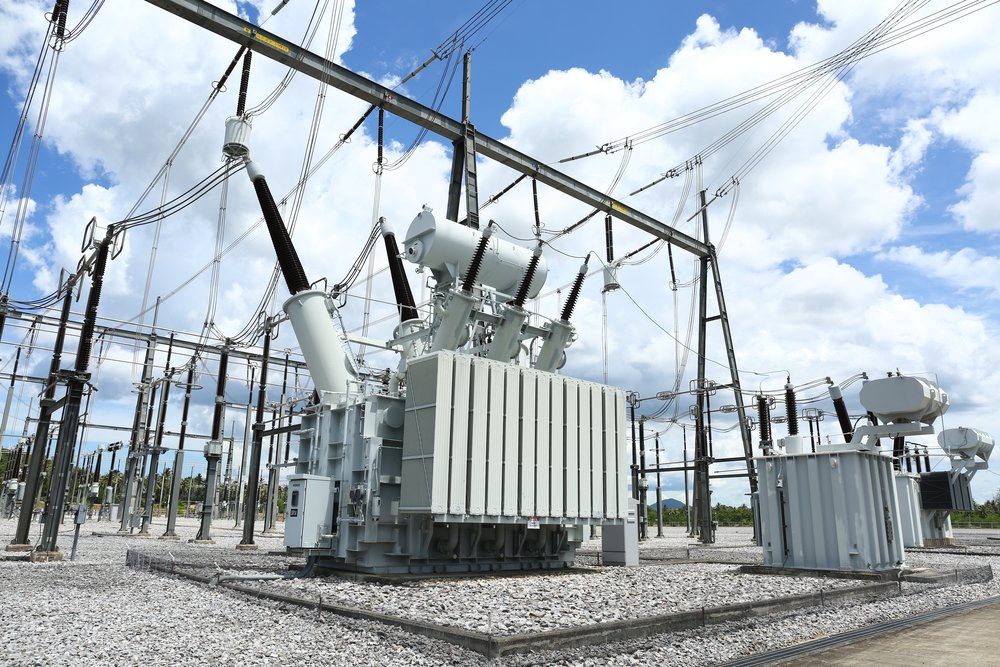

Substations rarely get built where the road is. They go where the transmission corridor, the load and the easement meet, which often means a pasture, a floodplain or a rock shelf with a gravel lease road for access. Utilities and energy companies in Texas hire us for the civil and concrete work that makes those sites buildable: grading, drainage, foundations for transformers and control houses, duct banks and the all-weather access that crews need on the day equipment arrives.
The market is moving fast. ERCOT describes its system as reaching about 90 percent of the state's electric load, serving more than 27 million customers over more than 55,000 miles of transmission lines, and every new generation, storage or large-load interconnection adds civil work to that network. We build for investor-owned utilities, cooperatives, independent power developers and the engineering firms that serve them.
Below is how we approach energy sites, what the interconnection rules mean for your schedule, and what we coordinate.
A grid that is changing in size and shape
Senate Bill 6 directs the Public Utility Commission to adopt interconnection standards for large loads of 75 megawatts or more in ERCOT. Under the legislature's bill analysis, those customers must show site control, pay a study fee of at least $100,000 for initial transmission screening, meet financial commitments, and, for transmission-voltage loads connecting after 2025, install equipment that lets them be curtailed during firm load shed. The effect is that only sites with real control, real money and real engineering get into the queue, and those owners need their civil contractor ready early.
Demand is very large and not fully settled. Utility Dive reported in August 2026 that ERCOT interconnection requests total about 474 gigawatts, roughly 90 percent of them data centers, and that the governor called for a moratorium on new data center interconnections and a community impact review of facilities of 25 megawatts and above. Because policy may change, we price civil work with phased options so your site work does not depend on a single outcome.
Foundations, duct banks and trenching we manage
Our trade partners pour transformer pads, control house slabs, drilled pier foundations for structures, equipment pads, cable trench and vault bases. We excavate and backfill duct banks with controlled-density backfill or concrete encasement as the design requires, and we pull and test conduit where the owner's specification permits. The same crews handle fiber trenching along transmission and distribution routes.
Heavy equipment also needs a road. We build and maintain access roads with geotextile and compacted base, pad the laydown yards and grade the drainage so transformer delivery trucks do not sink on the day they arrive. Read more on our electrical duct banks and drilled pier foundations pages.
Where our scope meets yours
The usual split is that the utility or the EPC contractor supplies the electrical equipment and the controls, while we supply the site: clearing, stormwater controls, grading, foundations, trenching, conduit, ground grid excavation, fencing foundations and finish rock. We read the electrical drawings alongside the civil set to catch embeds, grounding and conduit stub-ups that must be set in the concrete.
Large campuses, such as a planned 17-gigawatt private power and technology campus in the Panhandle, show what happens when a single owner needs power generation, transmission, roads and buildings in one site. The developer's website describes about 6 gigawatts as already permitted, and while that is an owner's own claim, it shows the scale of civil work now being planned in the region. See also our oil, gas and midstream page.
Working near energized lines and in the field
We follow the utility owner's clearance rules, hold pre-job briefings, use spotters for equipment near overhead lines, and verify buried lines through locating and potholing before excavating. Lockout, grounding and work-clearance procedures are the owner's, and our supervisors learn the specifics at the orientation.
Remote sites bring weather and emergency planning issues. West and Panhandle crews expect wind and dust. Gulf sites expect lightning and flood. We have a plan for each, and we keep first aid, water and communication with the crew on every site. For related work, see utility potholing and locating.
Outage windows and long-lead equipment
Outage windows are fixed and expensive, so the civil work is completed ahead of the day the line is de-energized. We target completed foundations, conduit and grounding a week or two before equipment set, then stand by for crane and equipment deliveries. If long-lead transformers arrive early, we advance the pad. If they arrive late, we hold crews and re-sequence.
Rain is the schedule enemy on a clay site, so we pour in dry spells and protect trenches and subgrade. In hot weather we manage mass concrete pours with cooling, placement temperature controls and curing methods to limit thermal cracking. Our mass concrete pours page explains how.
Environmental and local permits
Substation and generation projects need stormwater permits, wetland and floodplain review where applicable, county road and driveway permits and sometimes local site plan review. We prepare the stormwater pollution prevention plan, install the erosion controls and maintain inspection reports. Building code applies to control houses and enclosures, with local amendments to the International Building Code baseline.
We coordinate with the owner's environmental consultant so that clearing, soil handling and spoil disposal match permit conditions. Our erosion control and SWPPP page describes our process.
Beyond the fence line
Utilities also serve data centers, factories and municipal customers whose construction has civil requirements of its own. Our industrial and manufacturing owners page covers plant work, and the data center page covers hyperscale sites.
Where a utility needs a pad ready for a customer's service entrance, we coordinate with both parties to avoid rework.
Share the one-line and the site list
Send the one-line diagram, civil drawings and outage windows and we will return a foundation, trenching and grading package with a mobilization plan.
Common Questions
Can you build in rock or caliche?
Yes. We use hydraulic hammers, rippers and trenching equipment suited to the ground, and we price rock separately so the owner pays only for what we find. A test pit or additional borings at the foundation locations usually removes most of the doubt.
How do you handle a site that floods?
We design and construct temporary diversion, keep pumps available, and sequence work around forecast storms. If the design puts equipment in a flood zone, we review elevations with the engineer before forming.
Do you take on small cooperative projects?
Yes. A small substation or line extension is the same civil package at a smaller size. We run mobilization costs lean and group nearby sites to share crews.
Will you coordinate with the EPC and the electrical contractor?
We attend the weekly coordination meetings, supply as-built survey data for foundations and conduit, and verify anchor bolt layout with the electrical contractor before the pour.
Is the large-load interconnection schedule a risk to civil work?
It can be. Queue and policy changes, including a possible pause on data center interconnections discussed in 2026, can move owners' start dates. We build flexibility into proposals with options for early works that hold up regardless of timing.