
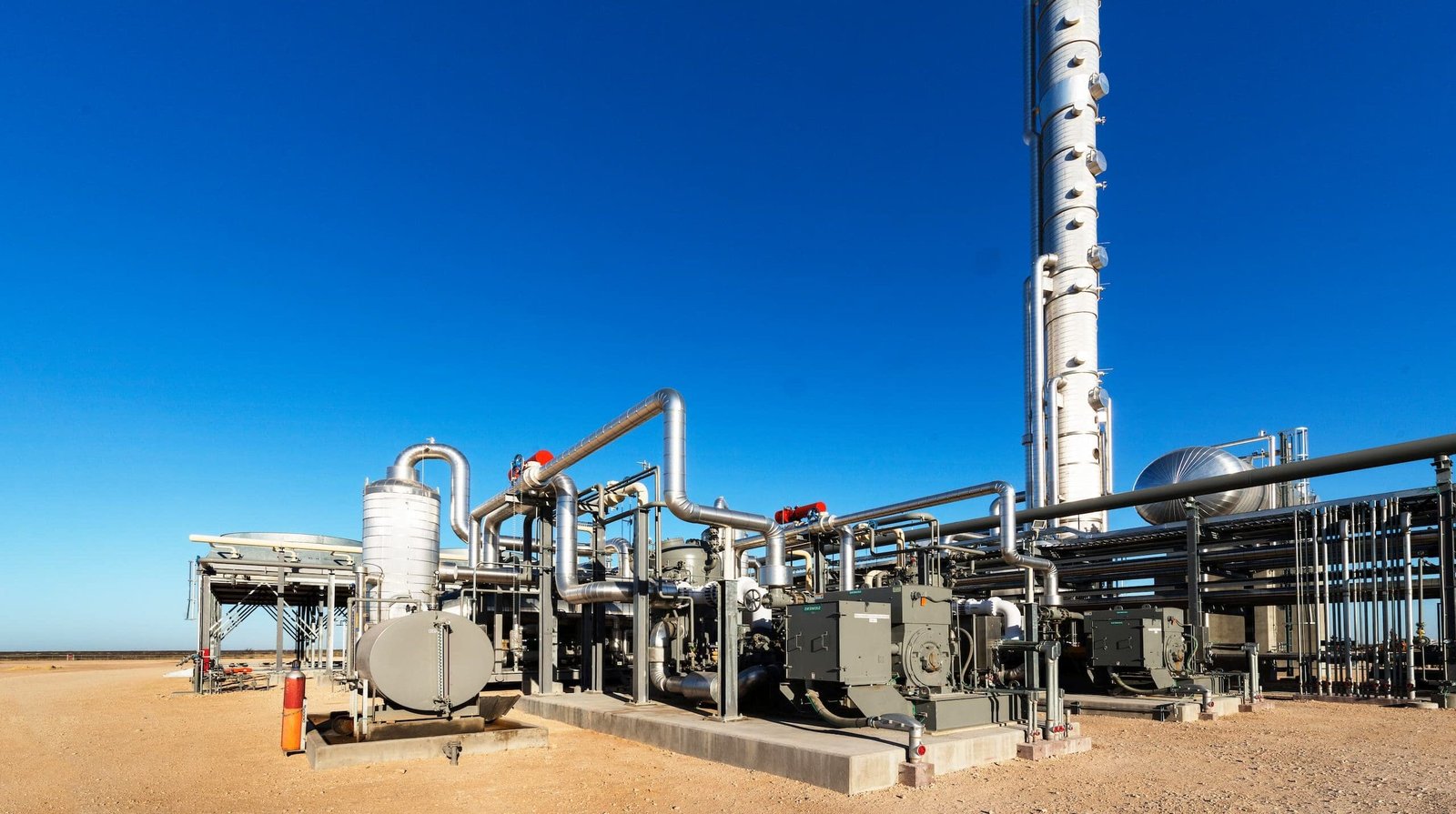

Produced water, caliche ledges, lease roads that turn to soup in a wet week and rigs that need a pad by Monday: oil, gas and midstream work in Texas is civil work done fast, in remote places, under a regulator that is watching the ground. We build the concrete, earthwork and underground infrastructure behind wells, compressor stations, processing plants, terminals and the refining and export facilities on the coast.
Operators and EPC firms come to us for the pieces that determine whether a facility runs: compressor and pump foundations, containment, load-out pads, pipe racks, drainage and the access roads that let crews get there. We bid lump sum or unit price, and we staff for fast mobilization where a lease or a pipeline schedule demands it.
This page describes the regions we work, the conditions that shape the price and the safety standards we bring to a hydrocarbon site.
From the Permian to the Gulf
The Permian Basin covers more than 86,000 square miles, averaged 4.2 million barrels of crude oil per day in 2019 according to a public reference source, and relies on Midland, Odessa and San Angelo as bases for much of the oil activity. East of there, the Dallas Federal Reserve reports Eagle Ford counties produced about 1.2 million barrels of oil per day in the fourth quarter of 2024, roughly 6 percent of U.S. oil output, and that Karnes, De Witt and La Salle counties produced 46 percent of the oil. Each basin has its own soil, water and haul problems.
On the coast, the industry changes character. Two midscale liquefaction trains near Corpus Christi reached a final investment decision in June 2025, with the site expected to exceed 30 million tons per year later this decade, and the federal energy agency lists the Port Arthur refinery with the largest crude capacity in the country at 656,400 barrels per calendar day. Our Permian Basin and Gulf Coast LNG and petrochemical corridor pages describe our field approach.
Seismic rules, disposal wells and what they do to site plans
Produced water handling has become a site planning issue. After a magnitude 5.4 earthquake in Reeves County on November 16, 2022, the Railroad Commission expanded a seismic response area from 2,366 to 2,601 square miles and operators agreed to reduce deep-well disposal from 298,000 to 162,000 barrels per day by mid-2023. Later, TexNet recorded seven earthquakes in northern Culberson and Reeves Counties between November 8 and December 17, 2023, and the commission suspended deep disposal permits covering 23 wells, effective January 12, 2024.
Those rules push operators toward surface handling, recycling, storage and pipeline infrastructure, and each of those is concrete and earthwork: lined pits, tank berms, containment pads, truck unloading areas and pipeline crossings. A December 2023 commission notice also requires new and amended disposal permits in several districts to report bottomhole pressure measurements and daily injection data. We build the surface facilities and the access roads that support them, and we coordinate with your engineers on how drainage and spill control tie in.
Working in hydrocarbon service
Safety on a production or midstream site means site orientation, gas monitoring where required, hot work permits and strict rules for where vehicles and equipment can go. Our trade partners carry the training that site owners ask for, and our supervisors manage spotters, traffic and exclusion zones. Before we dig, we pothole to verify the location of foreign pipelines, flowlines and cables and respect the owner's marked lines.
Spill prevention is the other piece. Containment pads, curbs and sumps must hold the volume the plan specifies and must be crack-free where fluids are stored. We pay attention to joint sealing and surface cure, and we leave a record of dimensions and tests. See our containment pads and secondary containment page.
Mobilizing for remote and fast-moving work
We bring the pieces for a remote pour: portable batching supply arrangements through local ready-mix plants, water trucks, fuel, compaction equipment and survey. When ready-mix plants are far away, we plan pour size and mix retardation to suit the haul. Caliche and hard rock are common, so we bring hammers, rippers and a plan for disposal of spoil.
For earthwork, we build pads and roads from locally sourced caliche or imported base, compact in lifts, and test. Well pad work moves quickly and then the rig leaves. We keep an eye on what stays after the rig is gone: stormwater, reclamation, and permanent equipment pads. Review our equipment pads and machine foundations page for the details.
What changes a field price
Distance and ground are the large variables. A pad 60 miles from the nearest batch plant needs more trucks, more retarder and more crew time than one beside the highway, and a ledge that requires hammer work is billed differently from loose fill. We state rock and standby assumptions clearly in the proposal and offer unit rates for what we find in the field.
Commodity cycles also affect crew availability and equipment rates. When rig counts rise, everyone wants the same crews, so we hold our price in the proposal for a stated period and ask owners to commit early. Related work in the refinery and plant world is covered under our industrial and manufacturing owners page.
Pipelines, terminals and export growth
Export growth continues to produce midstream projects. Compression, treating, storage tanks and loading facilities require stable foundations, and the ports near them need paved yards and heavy-haul roads. For utilities that feed these facilities, see our utilities and energy companies page.
Where a project needs land development, roads and utilities for a new processing campus, we handle the site work and coordinate with the process contractor on the foundations they will build.
Send us the pad list and the date
Send location coordinates, the foundation drawings and your target dates. We will respond with a mobilization plan and a unit-priced proposal.
Common Questions
Can you build a containment pad that passes inspection the first time?
Yes, if the design is clear about volume, slope and joint treatment. We pour with controlled joints, cure thoroughly, and test for leaks when the engineer specifies it. Most failures result from shrinkage cracks and poorly sealed joints, so we spend effort on both.
How do you handle caliche?
Caliche can be an excellent road base and a difficult excavation. We rip or hammer it, screen it where needed, and use it for pads when the geotechnical engineer approves. We separate it from topsoil so reclamation is straightforward.
What is the timeline for a compressor foundation?
Excavation, forming, rebar and embedded anchor bolts take several days for typical equipment. Concrete must cure before the compressor is set. We commonly coordinate with the vendor's foundation drawing and templates to hold bolt tolerances.
Do seismic response area rules affect your work?
They affect the operator's disposal strategy more than our methods, but they change what is built. Surface storage, recycle and pipeline projects have increased where deep injection is limited, and we prepare pads and containment for them.
Do you work on both upstream and midstream sites?
Yes. Well pads, gathering lines, compressor stations and processing plants share many of the same civil needs. We scale crew size to the job and use the same safety and quality procedures on each.