
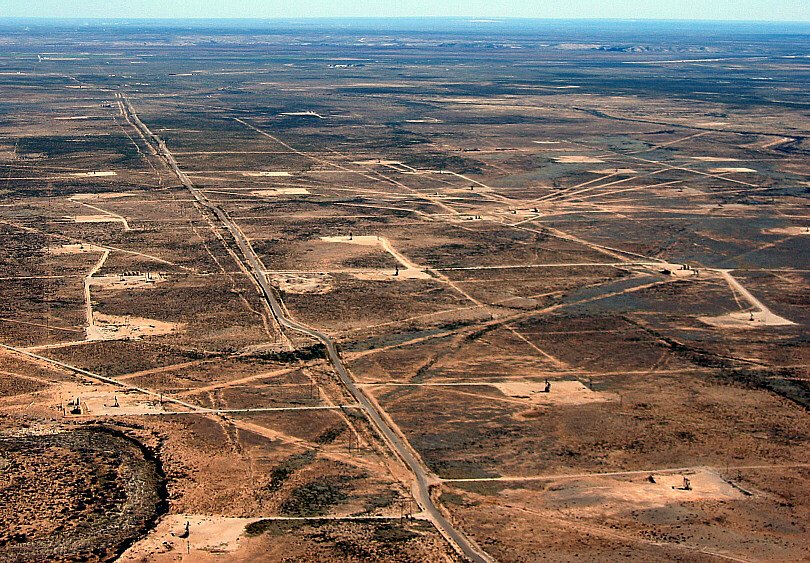

Disposal well rules shape where fluids go, how much a site must store and what kind of containment a pad has to provide, and any contractor building in the Permian Basin has to understand them before pouring a containment slab. We build compressor and equipment foundations, caliche roads, yards, shop floors and underground utilities across the basin, and we start each job by asking what the operator's water handling plan is and what the regulator has recently required nearby.
The basin is large. A public reference describes it as covering more than 86,000 square miles and averaging 4.2 million barrels of crude oil a day in 2019, with Midland, Odessa and San Angelo as headquarters for much of the activity. That scale means long drives between sites, remote supply lines and widely varying ground, from the sandy soil near the interstate to hard caliche on the higher ground. We plan mobilization, equipment and material supply for those distances and keep a record of the conditions we find.
The sections below describe how we build for operators, midstream companies and the service contractors who work around them.
Seismic response areas and what they mean on the ground
Following a magnitude 5.4 earthquake in Reeves County on November 16, 2022, the Railroad Commission enlarged the Northern Culberson-Reeves Seismic Response Area from 2,366 to 2,601 square miles, covering 78 active disposal wells, and operators committed to reduce deep-well disposal from 298,000 to 162,000 barrels per day by June 30, 2023. The agency reported seven earthquakes in northern Culberson and Reeves Counties from November 8 through December 17, 2023, with magnitudes 3.6 to 5.2, and suspended deep disposal permits covering 23 wells starting January 12, 2024.
These actions affect operators more than contractors, but they change project demand. Operators may need more surface storage, more pipelines or more trucking for produced water, and each of those needs pads, roads and containment. We design our work to the engineer's drawings and do not make claims about earthquake performance beyond them.
Equipment pads, containment and tank farms
A compressor station needs reinforced foundations for the compressors, coolers and skids. We pour equipment pads and machine foundations with the rebar cage, anchor bolts and sleeves in the positions shown on the vendor drawings, survey them before the pour and re-check them after. Tank batteries and water handling sites need containment pads and secondary containment with curbs, sumps and sealed joints.
We build caliche access roads and pad surfaces that carry heavy trucks in all weather, with crowned sections and culverts at drainage crossings. Where a company wants concrete aprons at driveways or at loading areas, we pour them with enough thickness and reinforcement to resist the turning loads.
Along I-20: Big Spring to Pecos
A public reference describes Big Spring as sitting at the crossroads of US Highway 87 and Interstate 20, with I-20 running 40 miles west to Midland and 108 miles east to Abilene, and notes that a refinery and several correctional facilities are located there. Pecos, the Reeves County seat, is described as a semiarid to desert city on I-20 and US 80 with average annual precipitation of about 10.48 inches and a record high of 118 degrees Fahrenheit. These sources are general references, and local conditions can differ, but they show the kind of distances and climate a contractor deals with.
The distance between towns means crews, equipment and testing technicians travel. We schedule field work in blocks to reduce trips, rent local equipment where it makes sense and carry spare parts for our own machines. Our work in Midland and Odessa gives us a base from which to serve the rest of the basin.
Heat, remote locations and hydrocarbon sites
Heat is the leading hazard for people. We provide shade, water, rest breaks and heat illness training, and schedule concrete work for early hours. At active oil and gas facilities, we follow the operator's safety rules, which can include gas monitoring, permits for hot work, vehicle restrictions and site orientation. We attend orientations, complete required training and keep records.
Remote sites also raise emergency response questions. We confirm the nearest medical facility, set a meeting point and keep communications equipment that works where cell coverage does not.
What changes the price of field work
Haul distance for caliche, aggregate and concrete is the largest swing item. A pad 80 miles from the batch plant requires extra time, retarders for the mix and sometimes a portable plant. Mobilization and travel for crews also matter. Hard ground can add to excavation costs, and an unexpected ledge can slow a trench for days.
We give operators a base price with clear unit rates for rock, extra haul and extra thickness. That makes it easier to compare bids and avoid disputes. We show material movement as its own line so the operator can see it.
Moving crews and concrete across long distances
Field schedules in the basin are driven by drilling and completion calendars, which can move on a few days' notice. We keep crews and equipment ready for short-notice pads, and we sequence work so the roads and the pad base go in first and the concrete follows when the operator confirms equipment delivery. When a delivery slips, we hold the finished base and protect it instead of pouring early.
Concrete for remote sites is ordered with a clear window. We tell the batch plant the haul time, the mix temperature we need and the number of trucks, and we send a confirmation the day before. Cylinders are cast on site and sent to a lab, and results go to the operator and engineer. If a test falls short, we report it the same day and work out a fix with the engineer.
Operators, midstream and service companies
Oil, gas and midstream companies are the center of the work, along with utilities and energy companies that build substations and transmission support. Service companies need yards and shops, and we build those on shorter timelines.
Companies with sites near Lubbock and San Angelo can coordinate with us for work on the edges of the basin.
Tell us the county and the scope
We will price the pad, road and utilities with haul and mobilization shown.
Common Questions
Do you build containment for produced water facilities?
Yes. We pour curbed slabs with sealed joints and sumps to the engineer's drawings. We recommend asking the engineer to specify the sealant and the test.
How do you handle caliche roads?
We build crowned sections with compacted base, culverts at crossings and enough thickness for the expected truck loads. Maintenance plans are the operator's decision, and we can advise.
What if the batch plant is far from the site?
We order retarders, schedule early starts and, for large pours, consider a portable plant. The mix design accounts for the haul time.
Can you work on active sites?
Yes. We follow the operator's safety program, complete orientation and coordinate with operations to avoid conflicts.
Do seismic rules change your work?
They change owner demand and sometimes design requirements. We follow the engineer's design and the operator's specifications.