

A compressor, a generator or a press does not care what the drawings say about its foundation. It cares whether the bolts hold, the base stays level and the vibration goes into the ground instead of into the building. Equipment pads look like simple blocks of concrete, yet they are one of the few pours where the supplier's drawing, the structural drawing and the field survey all have to agree to a fraction of an inch.
We build pads for pumps, chillers, transformers, generators, air handlers, tanks and heavier machine foundations, from thin housekeeping slabs to thick inertia blocks that are isolated from the surrounding floor. Our work centers on three questions that get answered before concrete is ordered. What is the load, static and dynamic? Where do the anchor bolts sit, and who holds the template? And how will the owner level, grout and align the machine once it arrives?
Texas industry gives these questions plenty of practice. A refinery retrofit in Pasadena was reported to have lifted throughput by almost 15 percent, with phased start-up running into 2025. One of the largest advanced recycling facilities in North America started up at the Baytown complex in December 2022. And in Odessa, a $50 million oilfield services headquarters broke ground with a 42-bay maintenance shop, a six-bay truck wash and a warehouse. Each of those sites runs on rotating or heavy equipment that needs a pad built to a vendor's template.
Owners who need pads
Most of our equipment foundations are for oil, gas and midstream operators, plant maintenance groups, and manufacturers adding a line or replacing an aging unit. Midstream facilities need pump and compressor skids, flare knockout bases and metering pads that can be poured quickly in a live plant. Manufacturers need machine foundations that match a vendor's installation guide, often within a shutdown window of a few days.
We also work with industrial and manufacturing owners who are building around a single large machine: a stamping press, a roll former or a furnace. Those pours are usually specified by the machine's supplier, and we make sure the pad's mass, isolation joint and embedded steel follow what was approved.
From survey to turnover
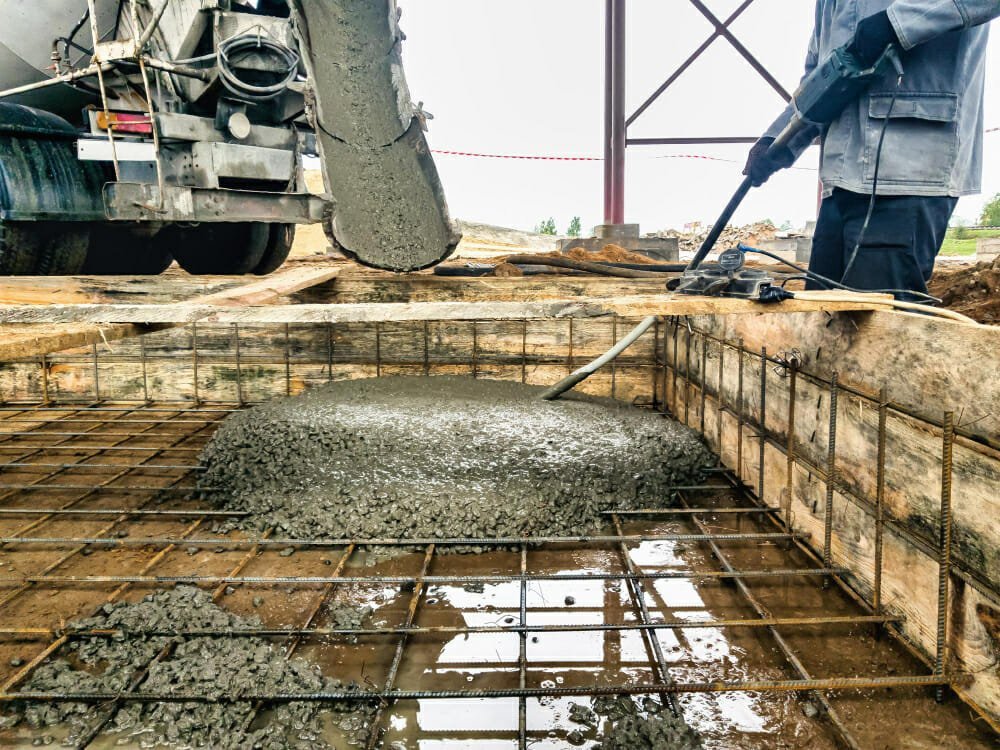
The scope usually begins with a layout from the plant's coordinate system, not from a building line. We excavate or saw-cut the existing slab, prepare the subgrade, and form the pad with an isolation joint where the drawings call for one. Reinforcing steel is heavier than most flatwork, with top and bottom mats, ties and dowels into any existing slab, and anchor bolts are set in a rigid template so nothing moves during the pour.
The finished pad gets a flat, level top within the supplier tolerance and a curing regimen that protects it from thermal stress. We shoot bolt locations and elevations after the pour and issue them as a turnover set. If the machine will be grouted, the top is left clean and roughened to the grouting contractor's requirements, and we do not use curing compounds that interfere with the bond. Where a pad is cut into an existing floor, we match the surrounding industrial concrete floor so forklifts cross the joint smoothly.
Vendor drawings first, then the codes
Machine foundations are governed by the equipment supplier's requirements first and by the structural engineer's stamp second. We ask for the vendor's anchor bolt plan, weight, operating frequency and allowable settlement before the pad is detailed. Where the machine carries dynamic loads, we look for a foundation that is heavier than the machine and isolated from adjacent structures, and a thick block follows the thermal rules we describe under mass concrete pours.
Permitting depends on the facility. In a city the building department reviews the foundation like any structure, and the adopted code edition and local amendments govern. Texas law makes the International Building Code the municipal commercial floor and lets cities adopt amendments, so we confirm the edition with the local office. Inside a plant fence, the owner's engineering standards and management-of-change process usually come first.
Working in live plants
Pouring next to energized equipment or process piping needs controls the open-field crew never sees. We attend the owner's orientation, follow hot-work and excavation permits, and keep the site equipment out of exclusion zones. Before any saw cut or dig, buried lines are located and marked, and where the plant's drawings are not reliable, we hand-dig.
Heavy formwork, bolt templates and reinforcing cages are lifted with rated rigging by trained crews. We shore deep pits and barricade open excavations, and we keep the pour area clear of non-essential traffic until the concrete is stripped and the area is released.
Shutdown windows and cure time
A plant shutdown is a schedule with no slack. Pad work has to be finished early enough for the equipment crew to set, level and align the machine inside the same window, and concrete does not gain strength faster because a shutdown is ending. We plan the pour a minimum of several days ahead of the equipment delivery, and where time is tighter, we discuss high-early mixes, heated enclosures and cylinder breaks before the date is set.
Because ready-mix has to travel, we confirm plant capacity and the haul route to a refinery or industrial yard well before the pour. A pad that starts in the morning and has to finish in the afternoon heat is a different job from one that starts at dawn. See our approach to hot and windy weather concrete for how we handle the summer calendar.
What moves the number
Mass and reinforcing dominate pad cost, followed by excavation, formwork and any isolation material. Tight tolerances add finishing labor. Work inside a live plant adds orientation, permits and escorts, and all of that appears in the estimate as time.
The best way to hold cost down is complete information at bid: the vendor drawings, the soils recommendation and the allowable settlement. If the pad needs containment around it, we price that as a related scope, usually together with containment pads and secondary containment, so the two pours share a subgrade and a schedule.
Have a machine arriving soon?
Send the vendor foundation drawing, the soils recommendation and your shutdown dates. We will review the pad design, the access and the cure time, and tell you what is realistic.
Common Questions
Do you need the equipment vendor drawings before bidding?
They help most. The vendor anchor bolt plan, weight, operating speed and tolerance requirements decide the pad thickness, reinforcement and top finish. Without them we bid with stated assumptions and update the price once the drawings arrive.
How is a machine foundation different from a regular slab?
It is sized for dynamic loads, often thicker and heavier than the machine, and separated from surrounding floors by an isolation joint so vibration does not travel. Embedded bolts and sleeves are positioned within tight tolerances, and the top is prepared for grouting and leveling.
Can you pour a pad inside an operating plant?
Yes, if the owner allows it and the permits are in place. We follow site safety rules, locate every buried line, and plan the delivery route for trucks and pump lines. Work in a live unit often takes more preparation and less actual placing time than in an open field.
How long before equipment can be set on a new pad?
It depends on the strength the vendor requires, not on a fixed number of days. We run cylinder or maturity checks and release the pad in writing. If the schedule is short, a high-early mix or heated cure can bring the date forward.
Who handles grout and baseplate leveling?
Usually the mechanical contractor or equipment supplier, since grout is part of installation. We prepare the top surface to the grouting specification and leave a clean, level bearing area, with elevations recorded so installers can verify.