
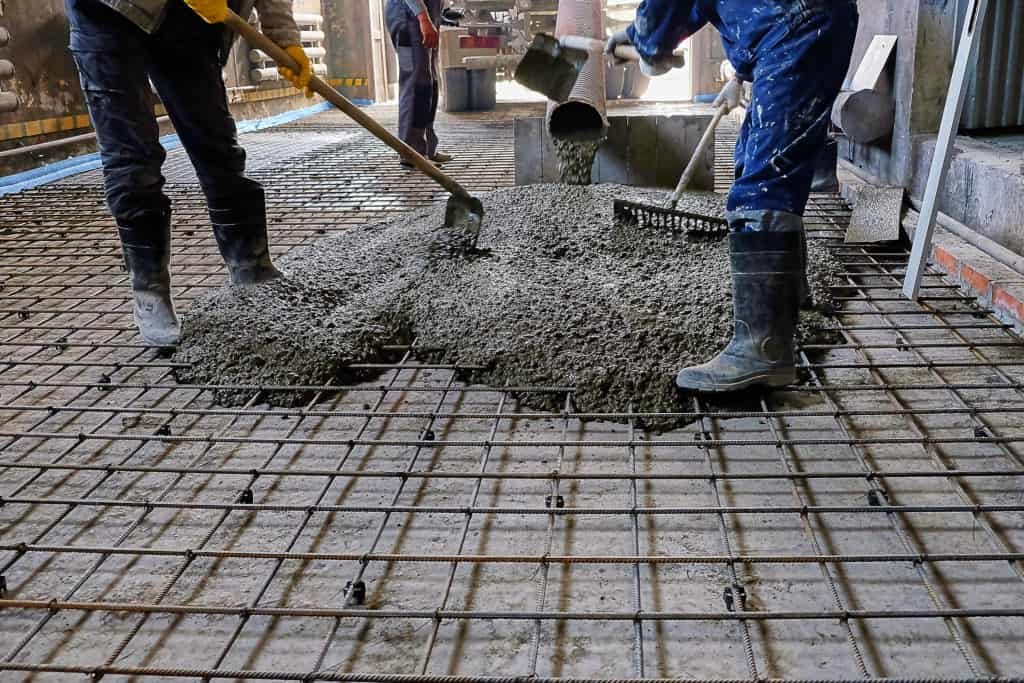

Thick concrete cooks itself. Cement reacts with water and gives off heat, and in a slab a foot deep that heat escapes through the top and bottom before it does harm. In a mat four or five feet thick, the center keeps heating while the outer face cools, and the temperature difference between them sets up stresses that crack the concrete. Mass concrete is the practice of placing big sections so that the heat is managed, not ignored.
In Texas, the problem is compounded by climate. A hot afternoon raises the concrete temperature before it is even placed, and a long haul in summer heat can push a mix near its limit. Specifications for these placements commonly cap the peak temperature at around 160 degrees Fahrenheit and limit the temperature difference between core and surface to about 35 degrees, so the work turns into thermal planning as much as placement.
We build mat foundations, thick pile caps, heavy equipment bases, tank foundations, large footings and dam-type or pier structures, placed continuously with the mix, the cooling and the monitoring set well before the first truck arrives. The goal is simple: a large section that cures without thermal cracking and carries its design load.
Heat, restraint and the thermal plan
The thermal plan comes first. We work with the engineer and the concrete supplier on a mix with moderate cement content, supplementary materials such as fly ash or slag to slow heat release, and a w/c ratio that still delivers strength. Aggregates are kept shaded or sprayed, mixing water may be chilled and ice can replace part of it so that the mix leaves the plant cool.
Restraint matters as much as temperature. A mat cast against an existing slab or rock restrains movement along the base and is more likely to crack than one on a slip layer. We review the soil or rock bearing, joints, reinforcing and blockout layout with the engineer, and we sequence the placement so that no section is cold-jointed to the next. The thermal model that predicts temperatures through the thickness is usually prepared by the engineer or specialty consultant, and we build to it.
Placing, consolidating and curing a large block
A mass pour is a logistics exercise. Dozens or hundreds of truckloads arrive in a planned sequence, one pump or several place the concrete in layers and vibrators consolidate each lift into the one below so there are no cold joints. The concrete pumping and placement team we coordinate sets the pump layout, the truck routes and the lift thickness before the first truck rolls.
After placement comes curing, and curing is the second half of the thermal plan. We cover exposed surfaces with insulating blankets so the surface does not cool faster than the core, install temperature sensors at the middle, near the surface and at the bottom, and log readings continuously. Blankets stay on until the temperature difference drops within the limit, and removal is staged to avoid shock.
Specifications, testing and special inspection
The project specification defines mass concrete by thickness and sets limits for maximum temperature, differential and sometimes the rate of cooling. It also describes how the monitoring is documented. Strength is verified with cylinders and sometimes with in-place maturity data, and special inspectors watch the placement. Our testing and quality control process records temperature at the plant, at discharge and in the placed mass.
Texas commercial building code is set at the municipal level, with the International Building Code as the statutory floor and cities adopting later editions and amendments of their own. For public and industrial work, owner specifications usually exceed those minimums, and we follow the stricter document. Any thermal control plan is typically submitted for approval before the first placement.
Starting before dawn and finishing without a gap
A mass pour often runs 12 to 24 hours or longer, so the schedule is built around the batch plant capacity, haul times and crew rest. We coordinate with the ready-mix supplier for enough trucks and a backup plant if available, plan lights and traffic control for night work, and arrange crews in shifts so finishers and vibrator operators stay fresh.
Summer pours begin at night or early morning to keep concrete temperatures lower, and winter pours need protection against cold on the exposed surface. Our hot and windy weather practices apply to the early hours of placement, and we will move a start date when a front or storm is likely. Starting a mass pour is easy, and stopping in the middle is expensive, so we hold a hard go or no-go decision the afternoon before.
Energy and digital infrastructure are the big buyers
Large, thick placements show up wherever very heavy equipment lands. Sempra Infrastructure reached a final investment decision on Port Arthur LNG Phase 2, which includes two liquefaction trains and one LNG storage tank, with about 13 million tonnes per year of nameplate capacity and commercial operations expected in 2030 and 2031. Foundations for process trains and storage are the kind of thing oil, gas and midstream owners need poured in a single, controlled operation. We follow those developments around Port Arthur and the Gulf Coast closely.
Data centers are the other big consumer. Reports describe the Stargate campus in Abilene as having over 6,400 workers on site, a secondary-source figure that should be confirmed with the operators. State law also now sets large-load interconnection standards for loads of 75 megawatts or more, and the large-load pipeline suggests heavy foundations to come. Utility and energy companies and developers building near Abilene will need contractors who can plan thermal control.
Plan the thermal work with us
Send the foundation drawings, the thickness and the pour date. We will review the mix and temperature limits with your engineer, price a continuous placement and set the monitoring plan.
Common Questions
How thick is a mass concrete placement?
There is no single number. Many specifications treat any section thicker than about three feet as mass, and some start lower, depending on the mix and cement content. The engineer defines it for the project, and we follow that definition.
Can the pour be done in sections to reduce heat?
Sometimes. The engineer may allow staged pours with defined joints, which reduces peak heat but adds joint preparation and sequencing. When a single placement is required, the thermal plan, the mix and the cooling carry the load instead.
What do temperature probes tell you?
They show the core temperature, the surface temperature and the difference between them, which is what the specification limits. We watch the readings through the cure and keep blankets in place until the difference is within bounds.
How does summer heat change the plan?
It narrows the margin. We chill the mix with ice or chilled water, shade aggregates, schedule the pour for night and early morning and shorten the haul. If the placement temperature cannot be held within the limit, we move the date.
Who writes the thermal control plan?
Normally the engineer of record or a specialty consultant, based on the mix and geometry. We contribute field constraints such as pump capacity and truck cycle times, and we carry out the plan.