
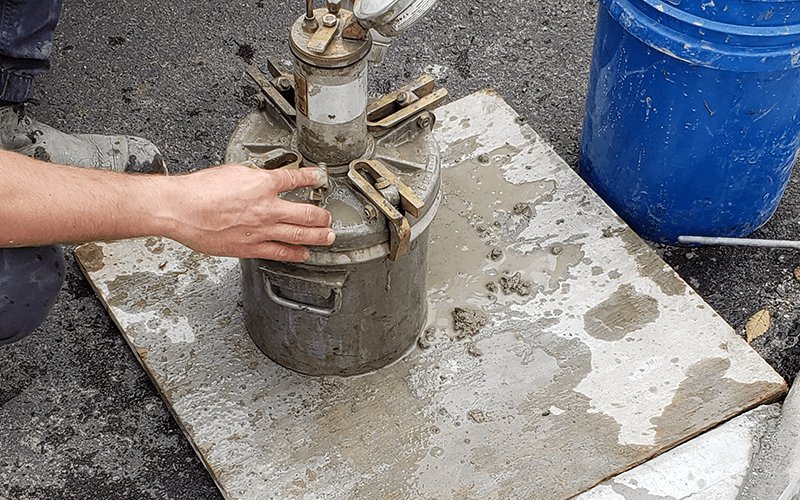

A cylinder break reports on concrete that was placed weeks ago, which is why quality control has to start long before the lab. By the time seven-day and twenty-eight-day numbers come back, the slab is walked on, the racking is ordered and the paint is drying. What protects an owner at that point is the record built during the pour: slump and air readings at the truck, temperature of the mix and the ambient air, the time each load left the plant, and where each batch ended up in the structure.
We run concrete testing and quality control as part of the work and not as an afterthought. That means sampling to the specification, keeping cylinders cured the way the standard demands, and sharing results with the engineer and the owner's representative while there is still time to act. It also means knowing when to stop a placement. A load that fails slump or air at the truck costs a few hundred dollars to reject, and the same load buried in a floor costs far more to remove.
What testing covers on a concrete job
Field testing begins with the fresh concrete: slump, air content, unit weight and temperature at delivery, with cylinders or beams cast for strength. On slabs and pavements we also keep a log of finishing conditions, evaporation risk and the time of saw cutting, because those affect cracking more than most owners expect. For structural elements, we track embedded items, reinforcement cover and formwork release against the shop drawings before concrete is called.
Beyond the pour, we coordinate with an independent testing laboratory for strength results, core samples when needed and nondestructive checks such as rebound hammer or ground-penetrating radar for locating reinforcement before coring. The laboratory works for the owner or engineer, which keeps the results independent, and we support them with access, curing space and an honest field record. Where the project needs a subgrade test, we link it to building pad preparation so compaction and moisture records exist before the base is placed.
What the specification and the code expect
Texas has no single statewide commercial code enforced identically everywhere. State law sets the International Building Code as the municipal commercial baseline and lets each city adopt local amendments by ordinance, so the testing frequency, special inspection triggers and acceptance criteria you meet in one city may differ from the next. We read the contract documents and the local amendments together, and we confirm the edition with the building department before we write a testing plan.
Most projects add their own layer on top: the engineer's specification, the structural drawings and any owner standard. Where those disagree, the stricter rule governs unless the engineer says otherwise in writing, and we ask for that answer before the pour and not after. Public work adds submittals, mill certificates for reinforcement and tighter documentation, and on accessible routes we keep slope and surface checks tied to the plans so the TDLR review later finds no surprises.
How we make results useful
Testing only protects a project if people act on the numbers. We post slump and air results where the foreman and the pump operator can see them, and we agree in advance on the adjustment limits: how much water the driver may add, who approves it, and when a load is rejected outright. Fresh-concrete data is entered the same day and shared with the engineer, so a trend, for example slumps creeping up as the day warms, is caught while the pour is still underway.
Cylinder handling matters as much as the testing. Specimens go into initial curing boxes on site, protected from heat, vibration and direct sun, then move to the laboratory within the allowed window. In the hot, dry stretches of the state and in the humid Gulf Coast alike, careless initial curing can drag strength numbers down and trigger a false alarm. We treat curing records as part of the quality file, and we keep them with the placement log for turnover.
Why one coordinated team helps
When the same company that places and finishes the concrete also runs the field QC, problems are found at the cheapest possible moment. A foreman who watches the slump test can slow the pump or call for a different load without waiting on a second party. A finisher who knows the cure plan can start the compound at the right time. Because we coordinate the pump and place directly, those decisions are made in minutes rather than escalated by phone.
That integration scales to demanding projects. A $17 billion semiconductor plant announced near Taylor shows the kind of owner expectations now arriving in Texas: tight flatness, tight vibration limits and exhaustive documentation. Industrial slabs need the same attention at smaller scale, particularly super-flat floor slabs, where the testing plan and the finishing plan are essentially one document.
Where testing meets the rest of the scope
Quality control touches every scope we perform. It supports post-tensioned slabs, where strength at stressing decides when the tendons can be loaded, and it matters on underground work where backfill density controls settlement of manholes, ducts and pavement above them. For owners building speculative space, such as the nearly 400,000 square feet of industrial space reported under way in Edinburg, a consistent testing record is part of what lenders and later buyers ask to see.
If you are a developer, a general contractor or a municipal owner choosing between a low bid and a documented one, we suggest you compare what each includes for sampling, curing and reporting. A documented pour is cheaper than a disputed one. We would rather explain our plan up front to commercial developers and public owners than defend an incomplete record after a failed break.
Bring us the specification
Send us the structural notes and the testing section of your specification. We will walk through sampling, curing and reporting with you before the first load is ordered.
Common Questions
How often should concrete be sampled on a slab or foundation pour?
The specification and the local building department set the frequency, commonly tied to a volume of concrete or a number of placements per day, with a minimum for each class of mix. We follow the governing document and add extra samples when conditions change, such as a mix adjustment, a new batch plant or a sharp temperature swing.
What happens if a seven-day cylinder comes back low?
One low result is a signal, not a verdict. We check handling and curing records for that specimen, review the batch ticket and look at the companion cylinders. If the problem is real, the engineer decides whether to wait for the twenty-eight-day result, take cores or evaluate the structure. Early, honest records usually make that conversation short.
Can you test concrete that someone else placed?
Yes, within limits. We can coordinate coring, scanning and review of existing records so an owner understands what is in place before adding load or modifying a slab. Without placement records, results are harder to interpret, and we will tell you plainly when a question needs an independent laboratory or a structural engineer.
Does hot weather change how you test?
It changes the plan more than the tests. We watch concrete temperature, ambient temperature, wind and humidity, and we protect specimens from heat during initial cure. The risk in a Texas summer is plastic cracking and rapid slump loss, so we pair testing with retarders, cooler mix temperatures and early starts, all documented in the log.
Who pays for testing, and who receives the results?
That depends on the contract. Many owners retain an independent laboratory directly, and in other cases the cost is carried in the concrete bid. Either way, we ask that results go to the engineer, the general contractor and us at the same time, so nobody is working from a different set of numbers.