
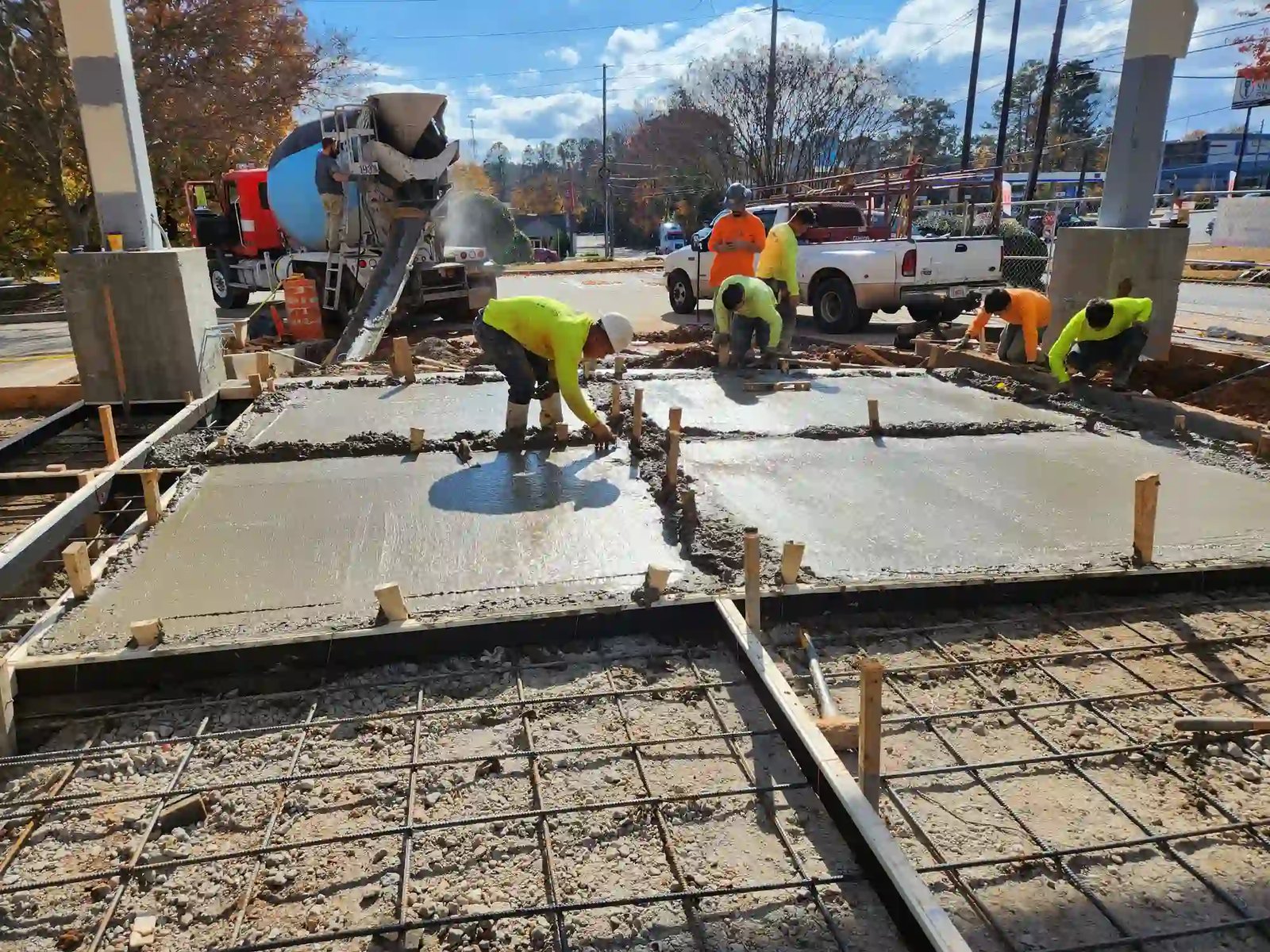
Blackland clay and billion-dollar projects arrive together in Taylor, and a contractor who ignores the first will struggle with the second. We build heavy industrial slabs, truck and employee paving, equipment pads and the underground utilities that support them, and we do it on soils that swell when wet and shrink when dry. Taylor and its neighbor Hutto sit over the blackland prairie, so we plan for movement before we plan the pour.
Industrial announcements have changed the area. A semiconductor maker announced in November 2021 a $17 billion plant near Taylor that was expected to employ 2,000 people, and the published account says limited operations began in 2025 while construction continued. Large projects like that bring suppliers, service companies, housing and roadwork, all of which need concrete and utilities. We do not claim any part of the plant; we claim the ability to build the kind of work that grows around it.
Our proposals show earthwork, utilities and concrete as separate lines, supported by the soil report and a schedule that reflects the weather.
Working on blackland clay
Clay with high plasticity changes volume with moisture, which is why industrial floors here rely on lime or cement treatment, select fill caps and sometimes post-tensioned slabs. We follow the engineer's design and add field practices that matter: keep the subgrade at a uniform moisture, avoid ponding next to the pad and protect treated soil from rain until it is covered.
We also watch the weather in a way that sounds old-fashioned. A blackland pad that has been rained on becomes slick, heavy and slow, so we cover and crown the subgrade before storms and drain it as soon as possible. The lime and cement soil treatment and post-tensioned slabs teams we coordinate plan together so the stressing and cure schedule matches the soil work.
Grid operators, manufacturers and suppliers
The state grid operator, a countertop maker, a cabinet manufacturer and a residential detention center are among the area's larger employers. The first is an indication of how important electrical and control facilities are to Taylor, and the others show a mix of manufacturing and public-sector employment. For utilities and energy companies, our scope often includes foundations for equipment, duct banks, access roads and substation grading. For manufacturers, it includes slabs, docks and process areas.
Duct banks deserve attention. We encase them in concrete or flowable fill as designed, maintain separation and slope, and survey them before backfill. Electrical duct banks are not glamorous, but they carry the power that everything else needs.
A data center on a donated tract
An 87.97-acre tract in Taylor, reported to have been donated for $10 and later sold for $10 million, is slated for a 135,000-square-foot data center. This is a summary of a local account, so owners should confirm details with the developer. What matters for a contractor is what data centers require: very flat slabs for equipment halls, generator and transformer pads, heavy duct banks, fire lines and robust site drainage.
Our trade partners handle the basics, such as pad prep, concrete work and site utilities, for data center projects, and we work with the general contractor and the owner's engineers on the portions of the project that sit outside the secured building.
Where large-site budgets move
On a large industrial parcel, the largest variables are bulk earthwork volume, soil treatment depth and the length of utility extensions. A parcel of dozens of acres can involve hundreds of thousands of cubic yards of cut and fill, and a few inches of added lime-treated depth over the whole footprint is a substantial cost. That is why we request the geotechnical report early and why we recommend field trials of the treatment before the full pad.
Haul distance is second. Fill and aggregate that travel far cost more, so we look for borrow sources and ready-mix plants close to Taylor and reflect the real haul in our unit prices.
Fast timelines on big projects
Big industrial projects run on compressed timelines, and subcontractors who cannot keep up lose their place. We keep multiple crews on large earthwork packages, run equipment through two shifts when permitted and plan pours with backup ready-mix plants. We send weekly look-aheads and attend the coordination meetings the general contractor schedules.
When weather interrupts, we focus on drying out and getting back to work: we pump low spots, scarify and dry wet clay, retest and resume. Recovery plans are specific, with dates and crews, not vague promises.
Safe sites at industrial scale
Big sites mean heavy equipment, haul-road traffic and many trades working at once. We run internal traffic plans with one-way routes, spotters at blind corners and separated pedestrian paths. Trenches are shored or sloped according to the soil type, competent-person inspections are documented and utility locates are confirmed before digging.
Heat is a real hazard on open blackland ground in summer. We schedule water, shade and rest breaks, adjust start times and watch for early signs of heat illness. The same discipline that keeps crews safe tends to keep the concrete schedule on track.
Permits and inspections on large parcels
Large industrial parcels bring a long list of approvals: grading permits, stormwater plans, utility extensions, fire access and building permits. We read the conditions of approval early and map them to the schedule, so a missing inspection never surprises the general contractor. For stormwater, we install and maintain controls that match the approved plan, and we document inspections after rain.
Cities in Texas may adopt local amendments to the building code, so we confirm with the building official what applies on a given parcel before we sequence inspections of forms, rebar and subgrade.
Related markets
Taylor projects often connect to the larger Austin metro and to Round Rock, and to Sherman in North Texas, where wafer fabrication projects are also generating demand for site work.
Plan your Taylor project
Send the soil report, plans and target dates. We will tell you what the clay will require and how we would sequence the work.
Common Questions
What is the biggest risk building on Taylor soils?
Moisture change in the clay. Controlled subgrade moisture, proper treatment and drainage away from the slab reduce it. Follow the geotechnical engineer's recommendations.
Can you build equipment pads for a data center?
Yes. We build generator, transformer and chiller pads with reinforcing and embeds to the engineer's design, plus the duct banks that connect them.
How do you handle large earthwork quantities?
With multiple crews, GPS-guided equipment where appropriate, and a haul plan that balances cut and fill on site. We track quantities weekly.
Do you take on work that supports large plants but not the plant itself?
Yes: supplier buildings, truck courts, roads, utilities and equipment foundations are all within our scope.