
Stressing day is the moment a post-tensioned slab becomes what the engineer drew. Until then it is a mat of concrete with steel strands running through plastic sheaths, and the strands only start working when hydraulic jacks pull them tight against the hardened concrete and lock them off. From that point the slab is compressed in both directions, which keeps cracks closed and lets a thinner section carry more load or resist more soil movement than a conventionally reinforced slab of the same depth.
In Texas, the main reason owners ask for post-tensioning is the ground. Large parts of the state sit on clay that swells when wet and shrinks when dry, and a stiff, prestressed slab rides out those movements better than a floor that depends on joints alone. We install post-tensioned slabs on grade and elevated decks for commercial, institutional and residential-scale projects, and we coordinate each step with the engineer of record, the tendon supplier and the inspector.
Where post-tensioning earns its place
Central and north Texas have a great deal of blackland clay. Reports on the Austin area describe the east side as mostly flat, with towns such as Hutto and Taylor sitting over blackland prairie, and the area east of Temple is described as part of the same Blackland Prairie region. Soils like these move with the seasons, and a prestressed slab can be designed to resist that movement without relying on deep piers under every column line.
Rainfall adds to the picture. McKinney, north of Dallas, is described as humid subtropical with annual precipitation near 41 inches and May as its wettest month, which is a reminder that clay moisture in that part of the state swings from saturated springs to dry late summers. We plan the sequence of tendon placement and stressing so the slab is protected through those swings, not merely at the moment of the pour.
Design choices that affect the field
A post-tensioned design is only as buildable as its shop drawings. Tendon profiles, banded and distributed layouts, end-fitting spacing, edge details and openings are all decided before the first strand is cut, and we review them against the plumbing, electrical and mechanical sleeves that must pass through the slab. We flag conflicts early, because moving a tendon after the layout is approved means calling the engineer and may mean a re-stressing plan.
Where the building has columns and a grid of beams, concrete foundations and deep elements sometimes combine with the slab, and the tendon layout has to work around them. On elevated work, elevated slabs and decks add formwork, shoring and sequenced stressing to the same tendon discipline, and we plan reshoring around the stressing date.
Placement, stressing and finish
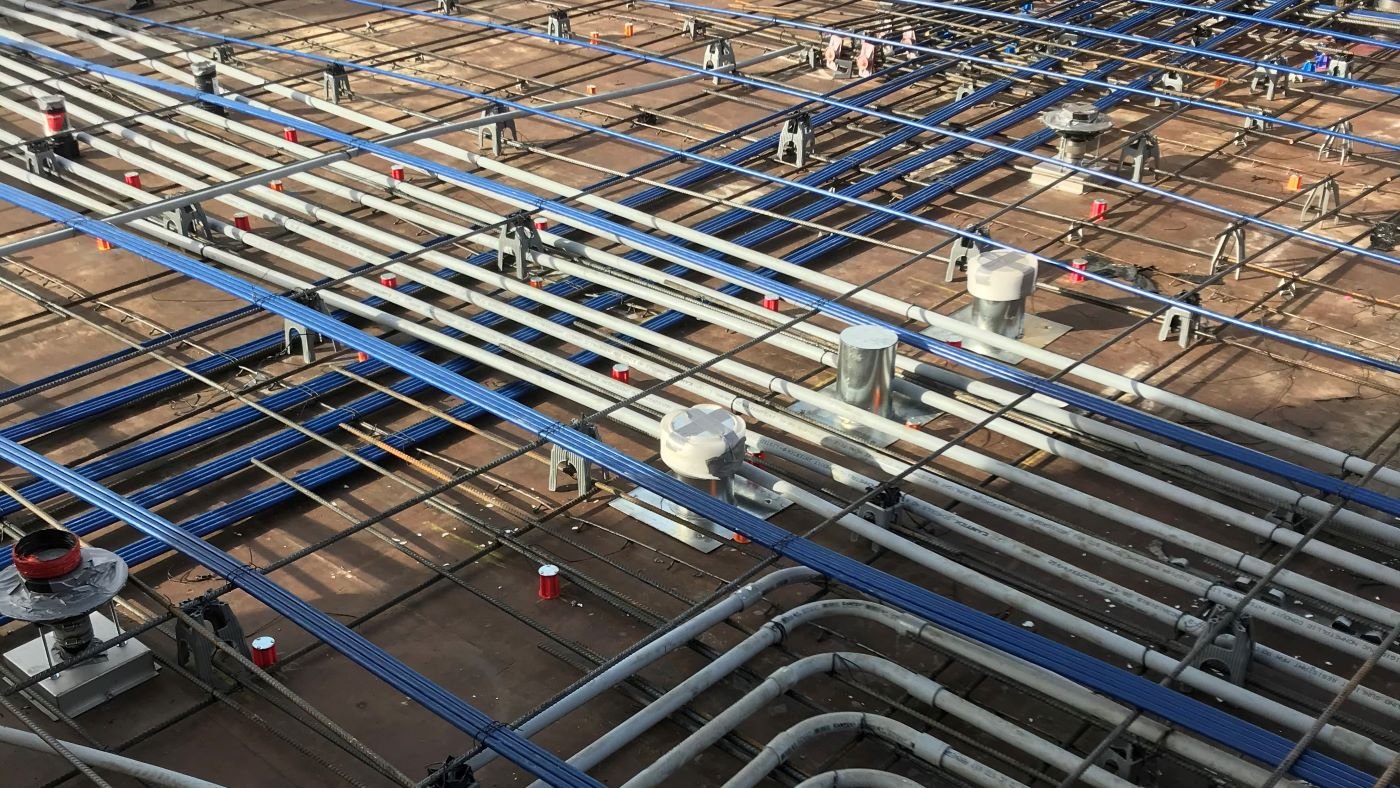
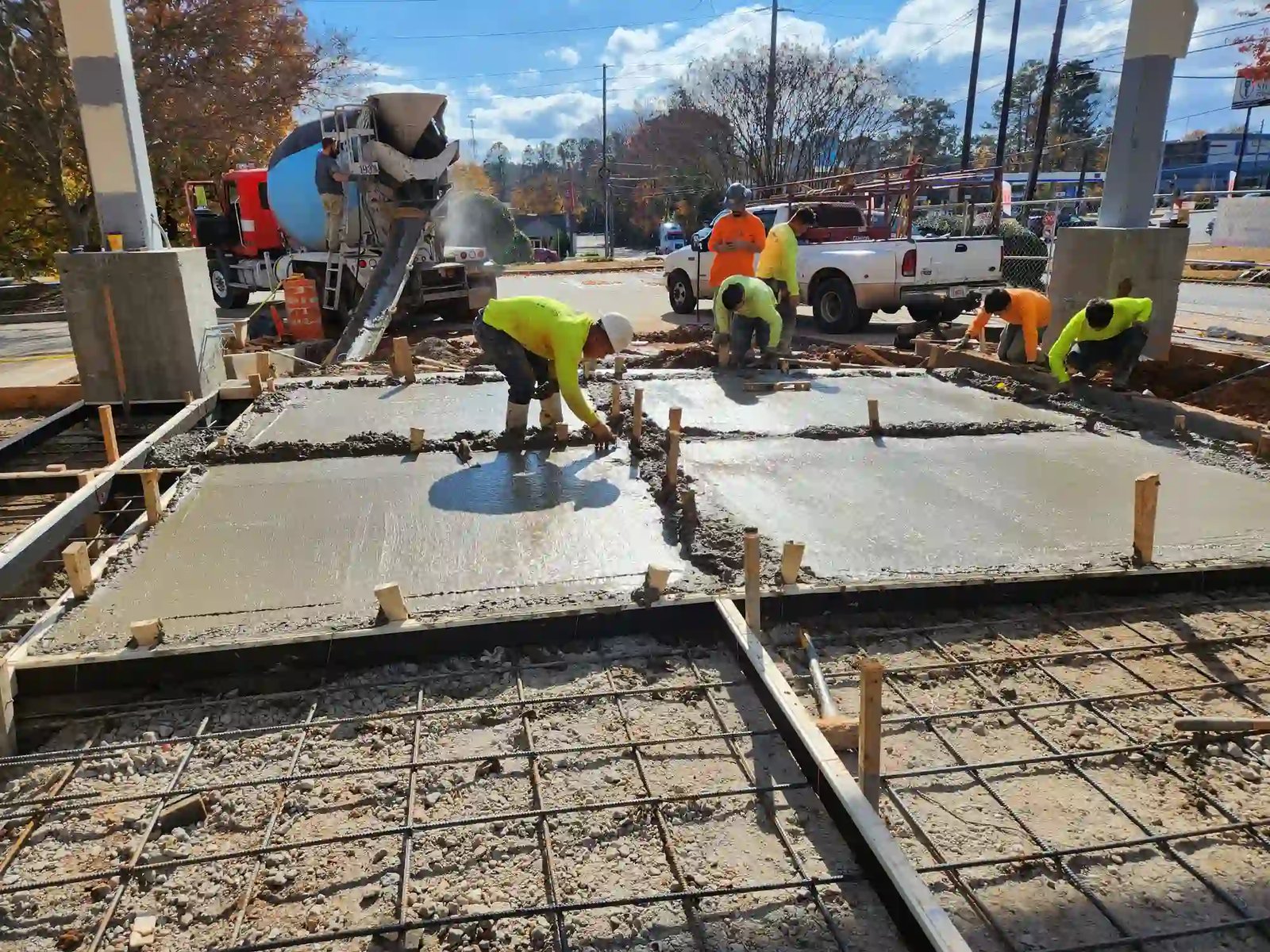
Tendons are laid to profile on chairs set to the specified heights, and we measure the drape at the high and low points before concrete is placed. Stressing-end fittings are secured to edge forms, pocket formers are installed, and the inspector confirms the layout and the sheathing condition. Concrete placement keeps the tendons in place and avoids dragging vibrators across them, and finishers pay attention to the end zones where steel is most congested.
After the pour, cylinders are broken to confirm that the concrete has reached the strength the design requires for stressing, which is why we plan the curing and the lab schedule together. Strands are then stressed in the specified sequence, elongations are recorded against the calculated values and the tails are cut and the pockets are patched. Our trade partners keep a stressing log for each slab so the engineer sees what was done and when.
Safety around stressed steel
A stressed tendon holds a great deal of energy, and the area behind and beside the jack is a restricted zone during stressing. We set up barricades, keep workers out of the line of the strand and give the stressing crew clear rules. End fittings are inspected before and after stressing for cracks or slippage, and damaged sheathing is repaired and approved before a pour.
The hazard continues after the slab is finished. Cutting or coring into a post-tensioned slab without locating the tendons can release a strand, so before any penetration we scan the slab with ground-penetrating radar or review the as-built tendon map and mark the safe areas with the owner. Our work with utility potholing and locating includes the same discipline of locating before cutting, and we share the as-built information with the building owner at turnover.
Schedule and who we work with
Post-tensioning adds a few trades and a few days to a typical slab sequence. The tendon supplier delivers fabricated strands, the placement crew installs them, and the inspector checks the layout before the pour. Stressing follows after the concrete reaches strength, and the slab is released for the next work after the engineer accepts the elongation records. We build that sequence into the baseline schedule and give the general contractor firm dates for each step.
Owners who benefit most include commercial developers building office and medical space, along with those building medical offices and mid-rise office buildings, where thinner slabs and longer spans can improve floor-to-floor heights and finish performance. We also serve owners in the Austin and Temple corridors where clay soils are common.
Considering a post-tensioned design?
Send us the geotechnical report and the structural drawings. We will review the tendon layout, price the slab as post-tensioned and conventional if both are possible, and lay out the stressing schedule.
Common Questions
Does post-tensioning change how quickly the building can be enclosed?
Slightly. The slab is usually stressed within days, and the engineer decides when walls, racks or heavy equipment can load it, so the enclosure schedule follows the stressing date. Because the slab is stiff and often thinner, other trades can usually begin sooner after stress release than they could on a conventional slab that has to reach full design strength first.
Is a post-tensioned slab always better than a conventional slab on expansive clay?
Not always. It suits large, lightly loaded buildings and clay soils with high movement potential, but a conventionally reinforced slab on treated or replaced soil can be cheaper in some settings. We can price both so the decision rests on numbers.
How soon after the pour can the slab be stressed?
When the concrete reaches the strength specified for stressing, which the lab confirms from cylinder breaks. The time depends on the mix, the weather and the specification, so the date is set by test results, not a calendar.
Can we drill or core a post-tensioned slab later?
Yes, but only after the tendons have been located. We use scanning and the as-built tendon drawings to mark safe zones, and any penetration is approved by the owner and engineer. Cutting blind is the one thing nobody should do.
What happens if a tendon is damaged during construction?
The damage is documented, the engineer is notified and a repair is approved before the slab is stressed or put into service. Early reporting is far less expensive than a late discovery, so we train crews to report even minor sheath damage.