
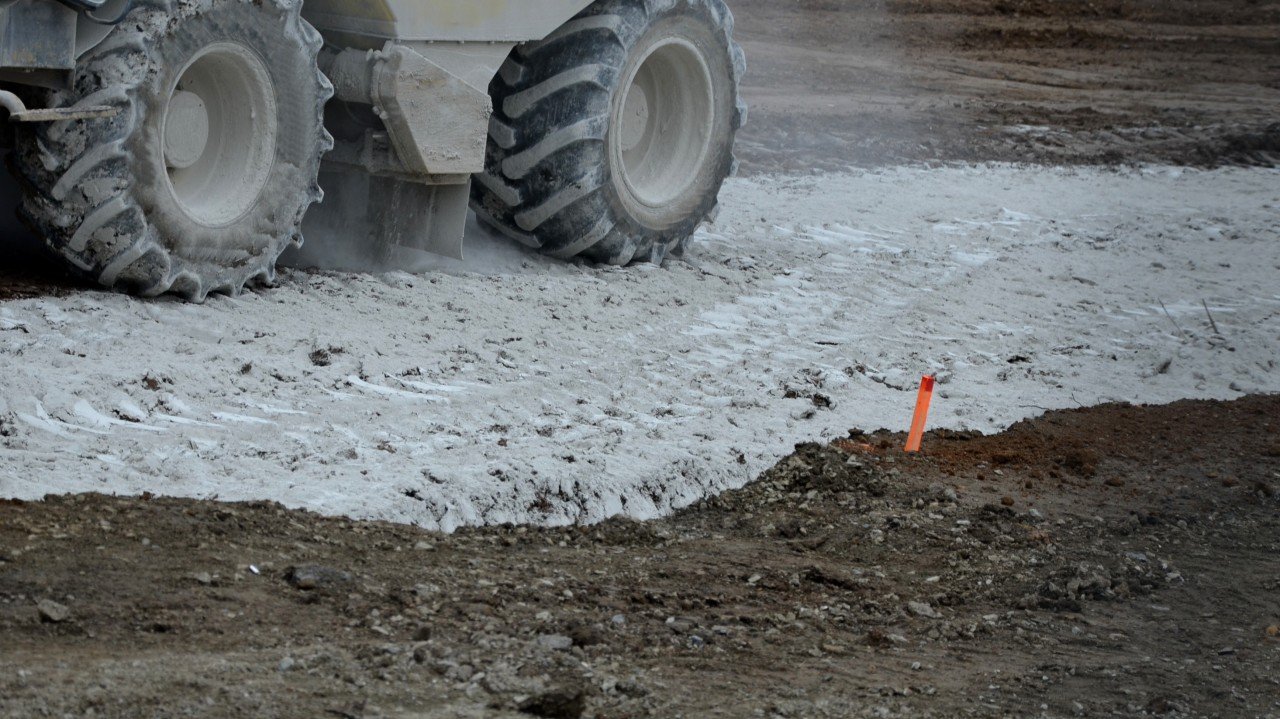

Mixing lime into clay changes it chemically, and that is the whole point. Calcium from the lime exchanges with the sodium and other ions on the clay particles, the particles flocculate into something closer to a silt, and over the following days a slow cementing reaction builds strength. A plastic, sticky clay that would have been hauled off at great cost becomes a workable subgrade that drains better, swells less and carries a load. Cement does something different, binding the soil particles directly, and it suits sandy and silty soils where lime has little to react with.
We treat soil in place with a stabilizer spreader, a reclaimer or pulvimixer, and a roller train, and we do it against a mix design from a laboratory, not by eye. The application rate, the mellowing time and the final density all come from the test results, and the field work is a matter of hitting them consistently. In a state where the ground under a pad can be sticky clay in one county and loose sand in the next, knowing which binder to reach for is half the job.
From mix design to cured layer
The sequence is specific. We scarify the soil to the treatment depth, spread the lime or cement at the design rate with a calibrated spreader, and mix it with a pulvimixer while adding water to reach the target moisture. With lime in heavy clay, the mixture is left to mellow for a day or more so the reaction can proceed, then it is remixed, brought to grade and compacted. Cement is more time-sensitive, because it begins to set as soon as it is wet, so mixing and compaction follow quickly.
The surface is then cured, usually by keeping it moist and sealing it with a light coat of emulsion or a rolled seal, until it is covered by base or the slab. Testing runs through the process: moisture, depth of mixing, gradation of the pulverized material, density, and sometimes the unconfined strength of field samples. We record the application rate per area, because a spread rate that is off by a small percentage is the usual reason a treated layer underperforms.
Where Texas clay calls for treatment
Published descriptions of Temple note that the Blackland Prairie region, a rich farming area, lies toward the east of the city. Blackland soils are the black, expansive clays that Central Texas builders know well, and they are the typical candidate for lime treatment because they shrink and swell with moisture. We treat that description with the caution it deserves, as a general regional reference rather than a soil report for any site, and we always rely on project borings for the actual design.
Road and highway work, including our road subgrade preparation, is a major user of treated subgrade. Descriptions of Tyler list Interstate 20 along the north edge, U.S. Highway 69 through the center, State Highway 64, Loop 323, and Loop 49 as a limited-access outer loop. Those corridors and their frontage roads have long histories of stabilized subgrade in East Texas. For Killeen, published sources name Interstate 14 and U.S. Highway 190 as the main highway with business loops and State Highway 195 leading toward the Fort Hood gate, the kind of high-traffic network where subgrade quality shows up in pavement life. These are general descriptions, and any treatment depends on the borings for the specific project.
Sulfates, specifications and testing
The most important test before treating a clay with lime is for soluble sulfates. When lime meets sulfate-bearing soil in the presence of water, minerals can form that swell dramatically, and a treated layer can heave after the pavement or slab is placed. If the sulfate content is above the limit, engineers may switch to cement, use a staged process with longer mellowing, or avoid lime entirely. We ask for the sulfate results in the report and flag any treatment plan that proceeds without them.
Specifications also set the mixing depth, the minimum strength or pH test, the allowable time between mixing and compaction and the required cure. We follow the owner's or the agency's document and run the tests it asks for. Treatment of subgrade for a state highway follows the state's specification, while a private pad follows the geotechnical report, and we adjust our procedure to whichever applies. Where the pad is going to receive a slab, we coordinate with the engineered fill and soil stabilization scope so layers are not duplicated.
Dust, caustic materials and neighbors
Quicklime and cement are caustic, and both generate dust that can cross a property line in a light wind. We use slurry for lime when the site is close to buildings or traffic, shut down spreading when wind exceeds the limit set for the job, and cover trucks. Workers wear eye protection, respirators where required, and skin coverage, and we keep eyewash on site.
Dust is also a stormwater and community issue. We coordinate with the project's erosion control and SWPPP plan so that treated soil is not washed into inlets and so that the spread and mixing are not done ahead of a storm. Quiet communication with neighbors, particularly on road and utility corridors, is worth the effort, since a lime cloud is noticed much faster than a clean grade.
Cure time, weather and the order of trades
Treatment is a weather-sensitive operation. Cold slows the reaction and a hard freeze can ruin a layer that has not cured, while rain in the first days can wash lime off the surface or leave it too wet to compact. We prefer to treat in stable weather, keep the exposed length short, and cap each day's treated area with compacted, sealed surface by evening.
Because the layer has to cure, the schedule needs to leave a gap before the next trade. On an office building pad or a road, that gap can be a few days. If an owner needs to compress it, a cement-treated layer reaches working strength sooner than lime, and the engineer may allow it. We lay out the options with the schedule effect so the choice is informed.
What treatment costs compared with replacement
Treatment is generally cheaper than removing and replacing a deep layer of clay, but not always. The main costs are the binder, the equipment, the mixing and compaction time and the testing. Binder quantity depends on the soil, and soils with high plasticity or high sulfate content may require more or may need a different approach. Haul distance for replacement fill is the other side of the comparison, since a long haul can make treatment the clear winner.
We price treatment per square yard at a stated depth and rate, with test results and records included. For a homebuilder or multifamily developer working on a large tract, treating the street and lot subgrade in one program can lower the per-unit cost, and it gives the geotechnical engineer a single set of records for the whole development.
Start with the sulfate results
Start with the soil borings and the sulfate results, and we will recommend a binder, a rate and a schedule. Send the geotechnical report and a site plan and we will price treatment against replacement.
We will tell you plainly when treatment is not the right answer for your soil.
Common Questions
How do I know whether lime or cement is the right binder?
The lab decides. Plasticity index, gradation and sulfate content point to lime for heavy clays, and to cement for sands and low-plasticity soils. The geotechnical engineer picks the binder, and we run the mix design before the field work.
Does lime treatment work in wet weather?
Poorly. Lime can be spread on wet soil, but compaction will be difficult and rain can wash it away. We prefer dry conditions, and we stop and seal the surface when a storm is coming.
How long before we can build on a treated layer?
For lime, the layer is typically left to cure for several days before base or slab, and the engineer may require a minimum time or strength test. Cement-treated layers reach working strength faster. We follow the specification.
What is the risk of sulfates?
Soils with high soluble sulfates can swell after lime treatment, damaging pavement or slabs. We require sulfate testing in the report, and if levels are high, we recommend a different binder or a modified procedure.
How deep can the soil be treated?
Typical treatment depths run from six inches to a foot or more for pavement subgrade, and deeper for building pads, done in lifts. The depth comes from the design. We check mixing depth in the field as the work goes.