

Fifteen regional flood plans now sit under a first-ever state flood plan, and the practical message for anyone moving dirt in Texas is that the public is paying closer attention to where construction runoff goes. Erosion control and the stormwater pollution prevention plan, usually called the SWPPP, are how a site keeps its sediment on its own side of the fence. They are also among the most inspected parts of a project, because a silt fence that failed after the first storm is visible to every neighbor and to the regulator.
We install and maintain the controls that the plan calls for: perimeter silt fence and wattles, inlet protection, rock construction entrances, stabilized stockpiles, sediment basins and traps, temporary seeding and mulching. We do it in the order the grading sequence demands, which usually means before the first bulldozer pass, and we keep inspection records that match what the permit requires. A SWPPP is not paperwork. It is a plan that has to be built, repaired and adjusted as the site changes.
What the permit and the plan require
In Texas, construction stormwater is regulated under the TCEQ's construction general permit. Large sites generally need a notice of intent filed before work begins, smaller disturbed areas still need a plan on site, and every operator needs a written pollution prevention plan that is updated as conditions change. Inspections are required at set intervals and after rainfall of a stated depth, and records have to be kept and available.
Cities add their own layers. Many municipalities require a separate erosion control plan with the grading permit, and some require a bond or an escrow for site stabilization. The Texas Commission on Environmental Quality also states that before building on the recharge, transition or contributing zones of the Edwards Aquifer, a plan must be reviewed and approved by its Edwards Aquifer Protection Program under 30 TAC Chapter 213, and that technical review of an administratively complete application takes 90 days. On sites in the San Antonio region, those 90 days belong in the schedule before earthwork starts, and the controls we install have to match the approved plan.
Flood planning has changed expectations
The Texas Water Development Board states that Senate Bill 8 of 2019 directed the first-ever state flood plan for Texas, built from 15 regional flood plans with more than 350 planning group members and over 550 public meetings. The board approved the 15 amended regional plans on March 5, 2024, and the draft state plan was open for public comment from May 10 to June 17, 2024. Flood planning at that scale does not change the permit rules by itself, but it does raise the profile of runoff, detention and downstream impacts, and owners and cities increasingly ask how a site will behave in a storm.
Storms in the arid west are no exception. El Paso Water states that a 2006 storm dropped a year's worth of rain on El Paso in two days, causing more than $200 million in damage to businesses and homes and $115 million in damage to the city's stormwater system, after which the City Council established a stormwater utility in 2008. A dry region can still produce a flash flood across graded, bare soil, and a site without controls in that situation sends sediment into streets and drains within minutes.
Install first, inspect often, repair fast
We start by walking the site with the plan and marking where each control goes, including the locations the plan did not anticipate. Perimeter controls go in before clearing, construction entrances go in before trucks arrive, and inlet protection goes in as soon as the structure exists. As grading proceeds, we shift the controls to match the new drainage patterns, because the plan drawn on the original contours rarely fits the site after the first cut.
After every significant rain we walk the site and repair what failed, and we keep a log that is more than a checkbox. A silt fence that fell over, a basin that filled with sediment or a stabilized entrance that is covered in mud gets fixed the same day, and the date of the repair is recorded. The cut and fill earthwork crews we coordinate understand that they are responsible for the controls in their work area, which keeps the responsibility close to the machine.
The controls we build and maintain
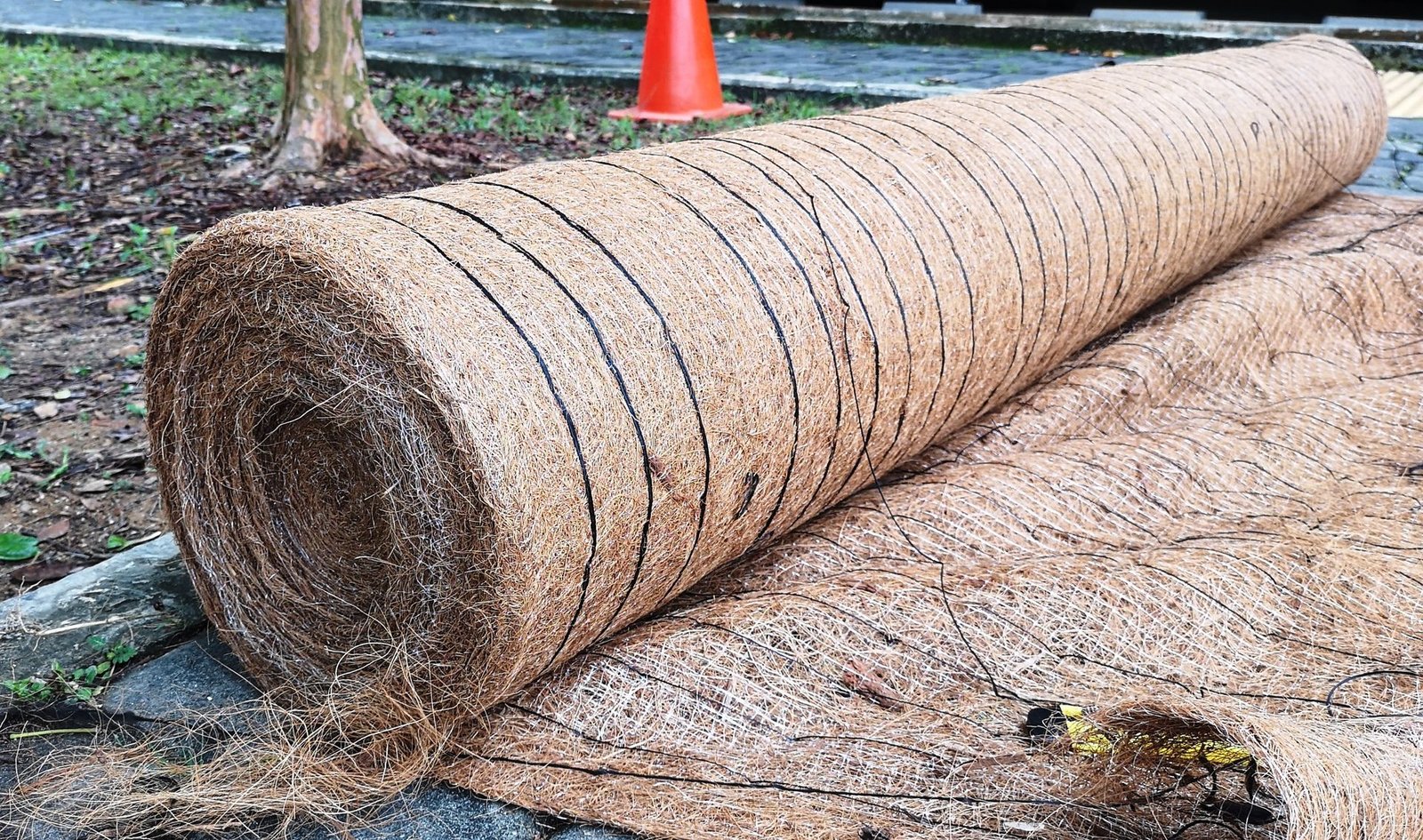
The standard kit includes silt fence, compost or straw wattles, rock berms, inlet protection, stabilized construction entrances, concrete washout areas and temporary sediment basins. Stockpiles from topsoil stripping and stockpiling get their own perimeter control, and slopes are protected with erosion control blankets, hydromulch or seeding, and areas that will sit idle for a period are stabilized so they do not rely on perimeter controls alone. For longer-term protection we place permanent seeding, sod or riprap at outfalls.
Concrete washout belongs on the list because this is a concrete contractor's site. Washout water is high in pH and cannot go to the street or the inlet, so we set up a lined pit or a portable container and manage it for every pour. Where a pond is part of the permanent drainage, a temporary sediment basin often becomes the permanent detention or retention pond, and we plan its excavation so the transition is simple.
Phasing, weather and the costs of getting it wrong
The biggest erosion risk is a bare slope before a storm. We phase grading so that the area exposed at any time is as small as practical, and we stabilize completed areas immediately instead of waiting for the end of the project. On a large site that may mean working in sections, which adds some mobilization cost but saves much more in repairs and fines.
A failed control can lead to a notice of violation, a stop-work order and an expensive cleanup of the neighboring property or a creek. Even without a violation, sediment in the storm system can clog inlets and ponds that the owner will inherit. We keep the owner informed, report problems early, and document the work so that an inspector's visit is routine.
What drives the cost of erosion control
Size of the disturbed area, slope, soil type and the rainfall pattern are the main variables. Sandy and silty soils erode faster than clay, steep slopes need more protection, and sites near creeks or aquifers need more conservative controls. The length of the project matters too, because controls have to be maintained for as long as the ground is bare.
The cost of installing controls correctly is small compared with the cost of a stop-work order. For commercial developers and for retail shopping center sites that sit beside busy roads, we show the controls as a separate line in the bid so the owner can see what is being bought.
Put the controls in before the first pass
Put the controls in before the first pass. Send us the SWPPP and the grading plan and we will price installation, maintenance and inspection as a clear line in the bid.
We will point out where the plan and the actual site do not match, so repairs are planned, not discovered by an inspector.
Common Questions
Who is responsible for the SWPPP on a project?
Every operator with control over the site has responsibilities under the permit. In practice, the general contractor or the site developer holds the plan, and subcontractors who disturb soil must follow it. We install the controls for our work and coordinate with the plan holder.
When do I need to file a notice of intent?
Generally when a project disturbs five or more acres, a notice goes to the state before work starts. Smaller sites still need a plan and a posted notice. The project engineer or general contractor usually determines which applies, and we help with the field side.
How often do controls have to be inspected?
Inspections follow the schedule in the plan and the permit, commonly at set intervals and after storms above a rainfall depth. We keep a written record of each inspection and of any repair.
What happens to concrete washout water?
It must be contained. We use a lined washout pit or a portable container, and the water is allowed to evaporate or is hauled off. The hardened solids are removed and disposed of properly when the pit is full.
Can the controls be removed once the site is paved?
Controls come out when the site is stabilized, which means vegetation or pavement covers the soil and the permit conditions are met. We coordinate with the plan holder on the timing, and we remove the sediment that has collected before leaving.