
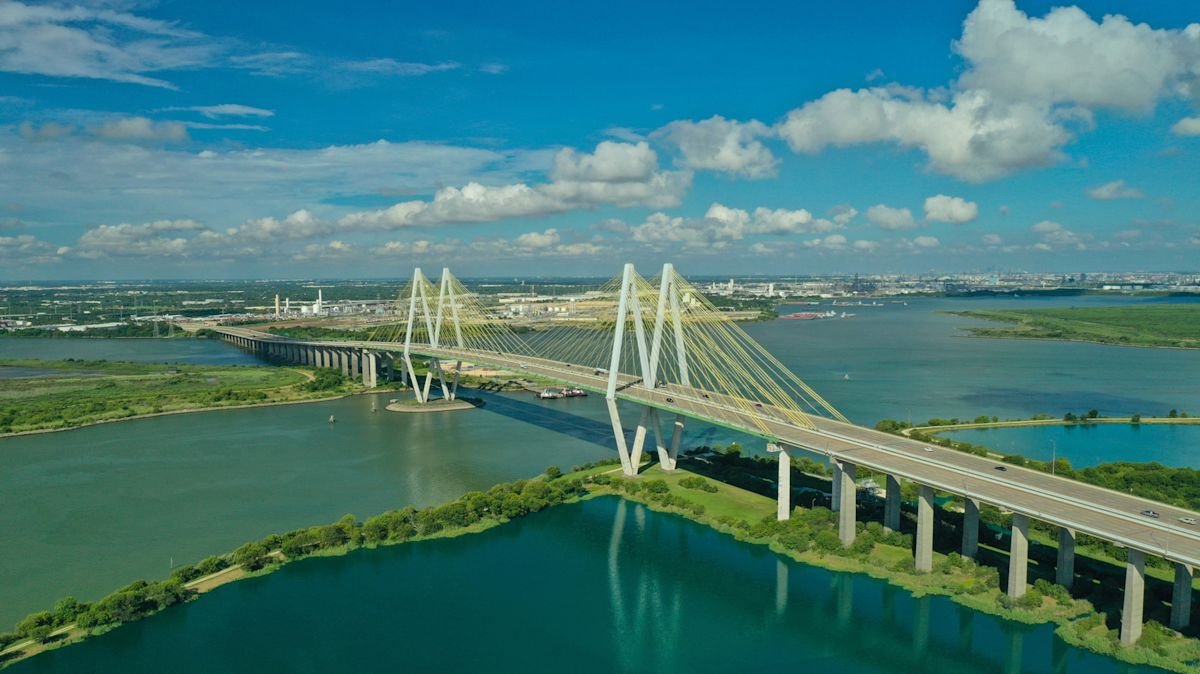

A petrochemical complex with thousands of contract personnel on the property cannot afford slow site work, and Baytown owners hire concrete and utility contractors who can move material, people and inspections on a tight daily rhythm. We pour foundations, pipe supports, pads and paving, we install the underground systems that feed them, and we plan around the traffic and permit systems that come with major industrial campuses.
The scale here shapes everything. One chemical and refining complex lists 3,400 acres, approximately 1,900 employees and an average of 4,800 contract personnel, and its fact sheet notes that one of North America's largest advanced recycling facilities started up there in December 2022. When thousands of contractors share gates and roads, concrete trucks must arrive on time, laydown areas stay organized, and excavation notices are filed days in advance.
Outside the fence, rail- and barge-served industrial parks give logistics and manufacturing owners a different set of needs. We serve both, with the same attention to subgrade and the same insistence on a finished surface that drains.
Industrial parks with rail and barge access
The Baytown Economic Development Foundation lists a 960-acre, rail-served industrial park and a 15,000-acre master-planned park described as rail- and barge-served, with 57 miles of dual-service rail track and two barge dock terminals. For concrete, that means rail spur foundations, track-adjacent pads, heavy-haul truck courts and unloading aprons that see steel wheels and steel loads every day.
Owners who put distribution or manufacturing buildings near those rail lines ask about truck courts and dock aprons that will not rut, and about manufacturing plant floors that carry forklift and machine loads. We design joint layouts and subgrade preparation around the heaviest wheel in the fleet, not the average one, because a pavement fails at its worst load.
Starting with the soil report, ending with the cure
Baytown's coastal clay behaves like a sponge that dries slowly and swells wet. We follow the geotechnical engineer's recommendations on stabilization, which in this setting often means lime or cement treatment under pavement or a thick layer of select fill under slabs. Treatment must be mixed uniformly, compacted within a moisture window and protected from rain before the base is placed, so we schedule it for dry stretches wherever we can.
Concrete placement then follows a plan: truck spacing set against the pump or chute, finishers staged to match the placement rate, and curing compound applied as bleed water leaves. In a Gulf Coast summer, we start before sunrise and use evaporation retarder when wind and heat combine. That is how we keep joints sawed on time and cracks where the engineer intended.
Permits and inspections on industrial ground
Industrial work in the Houston area combines several layers of approval: the city or county for building and site permits, the drainage or utility district for water and sewer, the fire marshal for fire lines, and the plant owner for its own excavation and hot work permits. Texas leaves commercial building code adoption to cities, with an International Building Code baseline and local amendments, so we ask which edition and amendments apply before we price anything.
Stormwater is another requirement. A site over one acre generally needs a pollution prevention plan, silt fence or other controls, inspection after rain and a stabilized construction entrance, and we maintain those items as part of the site package. Special inspection and materials testing are scheduled with the owner's agency, and we keep daily records so a failed test, if there is one, is addressed immediately instead of at closeout.
Moving trucks and people through busy gates
A plant with thousands of workers has traffic limits at shift change, and ready-mix suppliers must factor in security screening and escort rules. We build the pour calendar around those realities, confirming batch plant capacity, haul time and backup trucks before the day. If a unit turnaround is behind the project, our early start times let the concrete cure before the process crew arrives.
Work in Pasadena and across the ship channel follows similar rules, so crews trained on one set of site procedures adapt quickly to another. We keep one superintendent on each job and one point of contact for the owner, so the question of who is responsible never arises.
Keeping a crowded campus safe
Where thousands of workers share a campus, hazards come from the interaction between trades: a backing truck near a pedestrian walkway, an open excavation next to a laydown area, a concrete pump hose crossing a haul road. We address them with traffic control plans, spotters on every backing movement and barricades and signage around open trenches. Our competent person inspects excavations daily and after rain, and we do not allow crews into trenches that are not sloped or shored to the soil type.
Heat is a standing concern from late spring through September. We schedule the hardest finishing work for early morning, provide water and shade, and watch for early signs of heat illness, because a tired finisher also makes poor concrete.
Where industrial site budgets go
On large industrial campuses, mobilization and access dominate cost. Time spent on badging, material inspections and safety orientation is real production time lost, so we propose crew sizes that fit the gate throughput instead of simply bringing more workers. Imported fill, haul-off of unsuitable material and dewatering also move the budget, and we price those against the geotechnical findings.
For owners comparing options, our site utilities and mass grading scopes can be bid together, which usually saves on mobilization and reduces conflicts at trench crossings.
Where Baytown work connects to nearby markets
Many Baytown customers are expanding in several places along the coast. Our trade partners also work in the Gulf Coast LNG and petrochemical corridor, and we support utilities and energy companies with duct banks, vault foundations and pipe trenching. Having one contractor across several sites helps owners standardize details, testing and safety paperwork.
Plan your Baytown pour
Share the drawings, the rail or barge access you expect to use and the turnaround dates that control the job. We will return a plan covering excavation, structural concrete and utility work.
Common Questions
Do you handle work with rail and barge access?
Yes. We build foundations and paving adjacent to rail spurs, unloading pads and heavy-haul truck courts. Clearance, track geometry and railroad requirements come from the rail operator, so we confirm them early and schedule any work near live track with the operator.
How does contractor traffic affect concrete deliveries?
Gate screening, escort requirements and shift-change congestion can add real time to a truck's trip. We confirm access rules with the owner, brief the ready-mix dispatcher, and build in margin so the concrete is placed within its time limit.
What soil treatment is common on coastal clay?
Lime or cement treatment and select fill are common, depending on plasticity index and the structure above. The geotechnical engineer specifies the treatment, depth and test frequency, and we place it according to that design.
Can you work during a turnaround?
We can, provided the scope and sequence are set before the shutdown. Foundations and underground work are best finished ahead of time, with only tie-ins and punch work left for the window. We staff and plan to those dates.
Can you price utilities and concrete together?
Yes, and it often helps. One contractor sequencing excavation, pipe, backfill and slab avoids repeated mobilization and reduces conflicts at crossings. We break the price out so you can see each scope.