
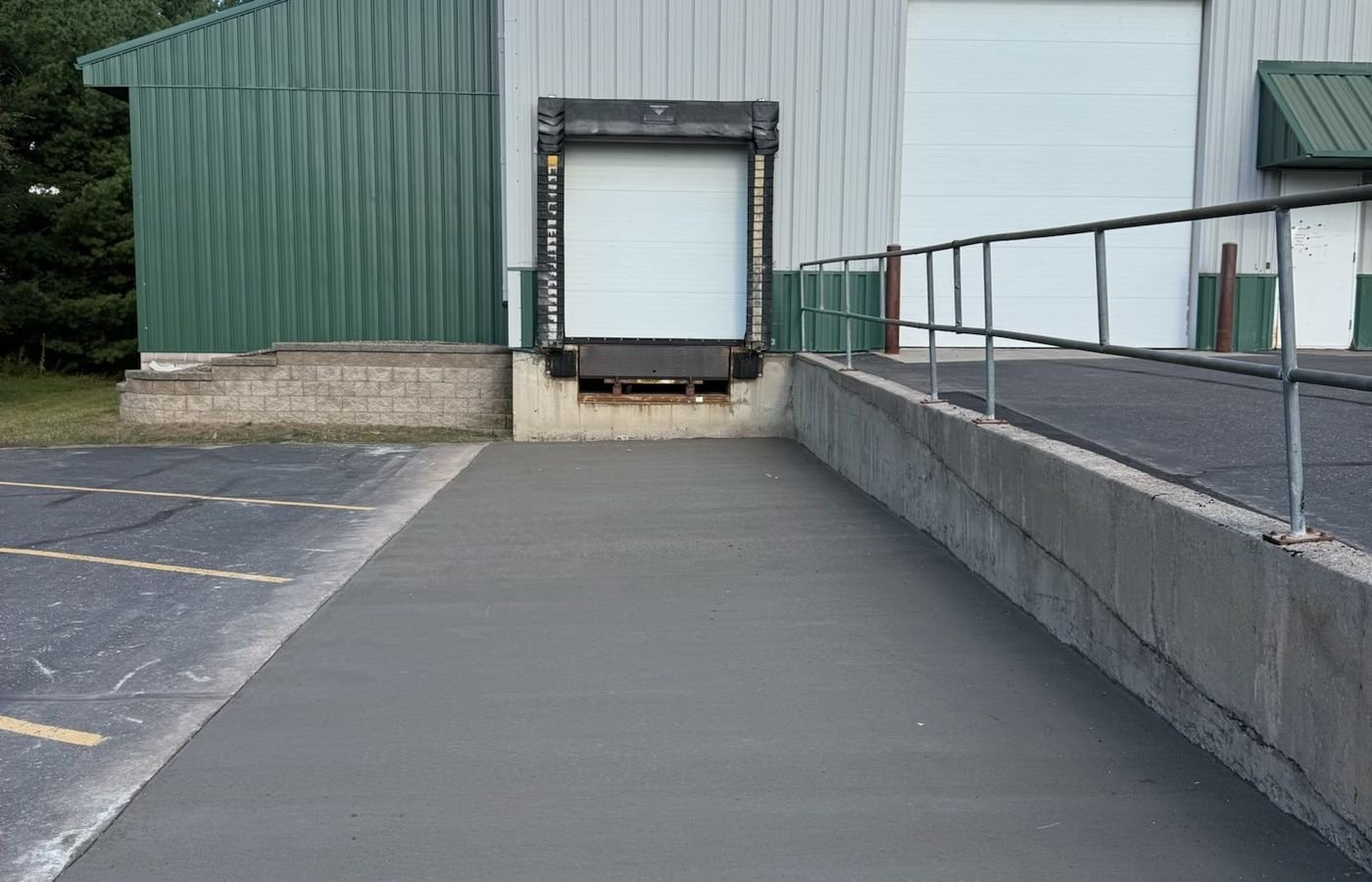
Trailer landing gear punches small steel feet into the pavement under a loaded semi, and it does that in the same spot every time a trailer is dropped at the same stall. Add the turning force of a tractor swinging a 53 foot trailer into a dock position, diesel and hydraulic oil leaking onto the surface and summer heat that softens asphalt, and it is easy to see why the truck court is the first pavement to fail on a warehouse site that was built cheaply. Concrete is the sensible answer for these areas, and the right thickness and joint layout make the difference between a court that lasts and one that needs rebuilding.
We build truck courts, dock aprons, trailer staging and gate lanes for warehouses, cross-docks, terminals and manufacturers across Texas. We work from the site plan and the geotechnical report, add what we know about how drivers actually use a yard, and propose sections and joints that match. Truck pavement is the least forgiving concrete on a project, and we treat it as such.
How trucks actually load a pavement
A truck court is stressed in three different ways. Axle loads travel across it in the main lanes, where joints need good load transfer and the subgrade needs uniform support. Landing gear pads concentrate load in trailer stalls, which is why stall areas are often thicker, and braking and turning forces act at the dock approach, where the surface needs to resist scuffing and joint damage. A single thickness rarely suits all three, so design drawings often show different sections for lanes, stalls and aprons.
We study the plan to see where trailers will stop and where they will turn. If the layout shows a tight radius at an entry or a dock position with a short approach, we flag it at the bid stage, because a pavement is rarely cheap to alter after it is poured and because the driver's path usually matters more than the lines on the drawing.
Building a court that holds up
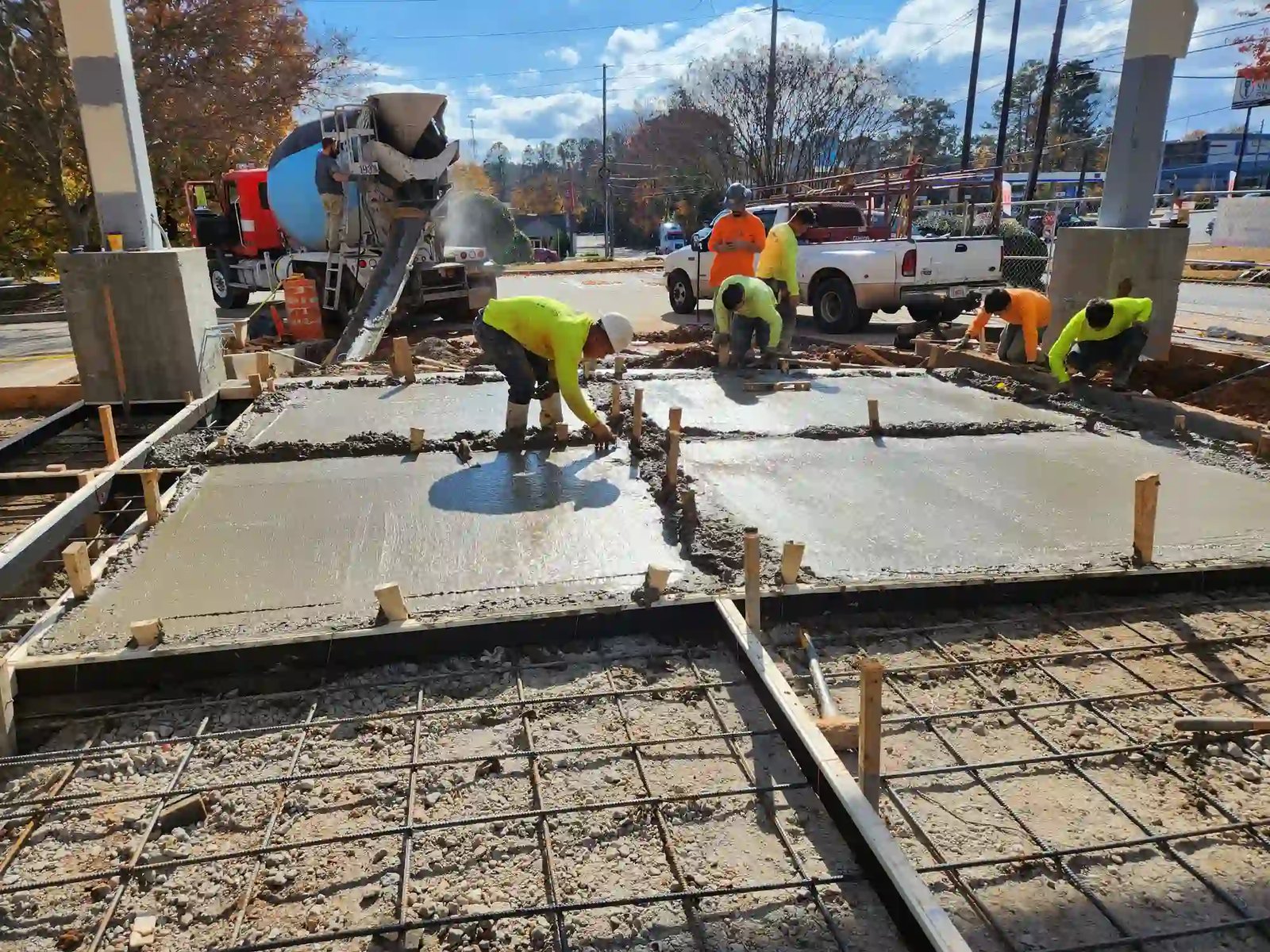
We begin with the subgrade. A truck court on clay needs a uniform, stabilized platform, which often means lime or cement treatment mixed to the depth the geotechnical engineer recommends, as described in our lime and cement soil treatment work. On sandy ground, density and consistent moisture matter more. We proof-roll before placing base, fix soft spots and check grades before the forms go in.
The pavement itself uses dowelled transverse joints, tied longitudinal joints and reinforcement where the design requires. We pour in lanes that match the truck movement, place joints so that wheel paths avoid the corners of panels and saw promptly, because a joint cut late is a joint that cracks first. A hard-troweled or broom finish is selected for traction and appearance, and curing compound goes on right after finishing so the surface can resist the abrasion trailers will bring.
Dock aprons, stalls and gate lanes
The pavement at the dock face has particular requirements. The apron slopes away from the building so water does not run toward dock doors, and where the dock height changes, the slab transitions to the pit or ramp built for loading dock pits and ramps. Dock approach slabs are often thicker and have extra reinforcement at the edge of the building where trucks back in and hit the bumpers.
Trailer stalls get thickened pads or full-depth concrete, and truck lanes link them with the gate. We also place concrete at fuel islands, scale pads, guard houses and other pieces of the yard that share the same loading. Where the owner is comparing concrete with asphalt, concrete paving pricing for the main lanes can be separated from the heavy stall areas so the owner sees how each choice affects the budget.
Why timing matters at the dock
Yards are usually built late in the project, after the building shell and before certificate of occupancy, which leaves a short window for a lot of concrete. We plan to pour as soon as the dock walls and grade are ready and keep a pour calendar that accounts for the plant, trucks and weather. Large courts are placed in lanes with construction joints planned, not discovered, and the opening strength is confirmed from cylinder breaks before delivery trucks are admitted.
For tenant-driven buildings, the first trailers often arrive within days of the end of construction, so we coordinate with the general contractor and the owner on a phased opening. If one half of a court can be opened while the other cures, truck traffic can start early without risking the new pavement.
Working in and around live yards
Many truck court projects are done at operating facilities, where trucks keep moving during construction. We set up separated work zones, barricades and signs, post flaggers where necessary and arrange crew parking away from truck routes. Concrete trucks are scheduled with the facility's gate and shift changes in mind, so they do not block access.
Inside new buildings, we coordinate with the dock equipment installer on the location of levelers, bumpers and door frames, because concrete forms for those embedments must be accurate before the pour. Cutting or patching an apron after the equipment is installed costs far more than setting it correctly at the start.
Cost, thickness and the volume of freight
The cost of a truck court rises with the thickness of the pavement, the amount of reinforcement, the subgrade treatment and the area. Texas freight volume is a reason owners should not skimp: about 14,000 commercial trucks cross each day between the World Trade Bridge and the Colombia Solidarity Bridge at Laredo, and Port Laredo handled over $354 billion in imports and exports in 2025, according to the city's economic development agency. Yards that serve that kind of flow take a beating, and a pavement that is under-designed fails quickly.
Near the Union Pacific intermodal terminal that sits partly in Wilmer and partly in Hutchins in southern Dallas County, similar pressure applies to trailer yards. Owners at the Southern Dallas inland port and Laredo have good reason to look hard at concrete, and developers building logistics and warehouse projects often ask us for sections that can handle container chassis as well as trailers. The three Class I railroads that operate about 84 percent of the state's freight track show how much freight Texas moves by rail too, and the sites that connect to them carry more truck traffic than their size suggests.
Planning a yard or dock?
Send the site plan, the geotechnical report and the expected truck count. We will recommend sections for lanes, stalls and aprons and give you a price you can compare with other options.
Common Questions
How thick should a truck court be?
The pavement design report decides, based on expected truck counts and weights. Truck lanes are typically thicker than car parking, and landing gear areas are often thicker still. We build to the design and can price alternatives if the traffic assumptions change.
Why do concrete dock aprons crack at the building edge?
Trucks backing in, restrained movement against the foundation and uneven support under the slab are the usual causes. Isolation joints, dowels, thickened edges and a uniform subgrade reduce the problem.
Should the whole yard use the same thickness?
Not necessarily. Many yards use a standard section for lanes and thicker concrete for stalls and the dock approach. This saves money and puts the strongest section where the loads are concentrated.
How soon can we use a new court?
When the concrete reaches the opening strength, confirmed by test cylinders or beams. In summer that may be a few days, and in cold weather longer. We plan phases to open parts of the yard sooner.
Can you repair damaged joints and panels in an active yard?
Yes. We cut out damaged panels, replace or dowel them and refill joints, working in sections so trucks can continue to operate. We recommend finding out why the panel failed before replacing it.