
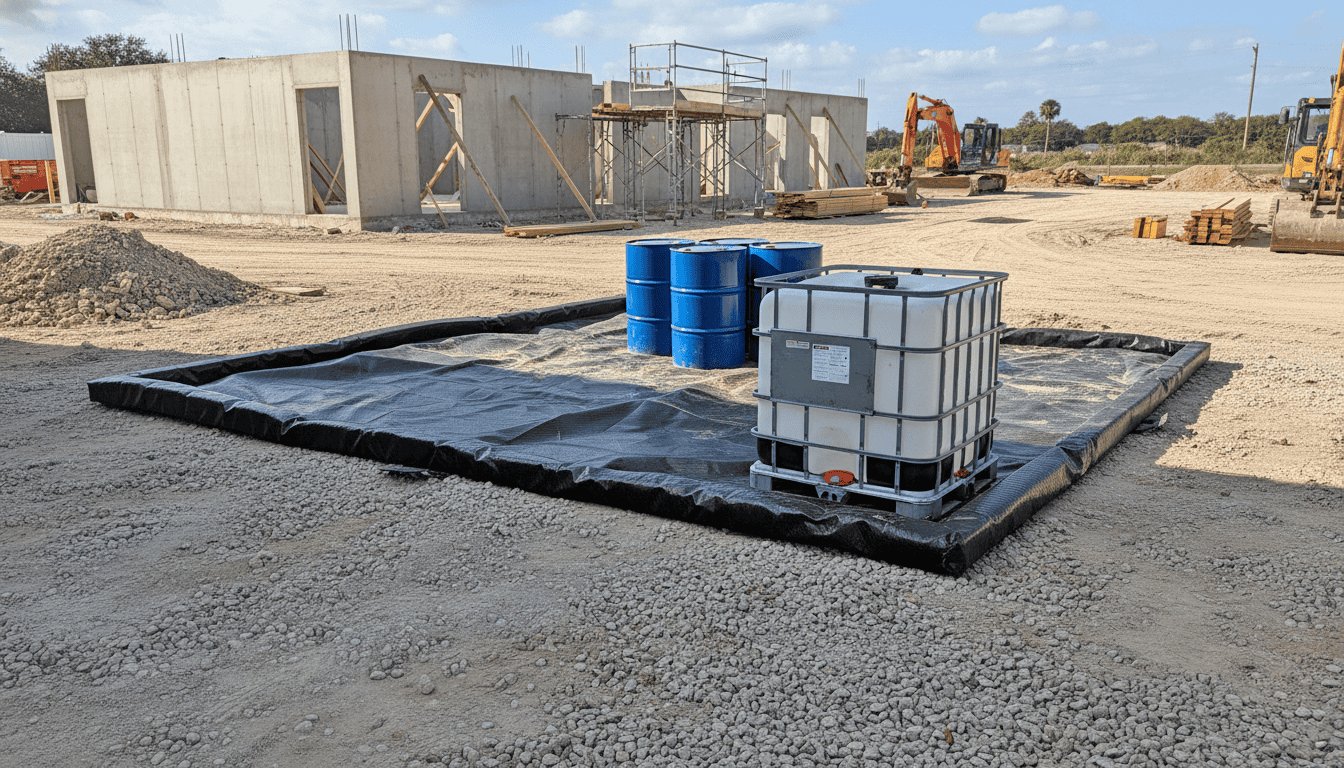

A containment slab has one job that no other slab has: to hold liquid that someone hopes will never touch it. The floor inside a tank dike, the pad under a loading rack, the apron where a tanker backs in and the sump that collects what drips are all designed on the assumption that a failure upstream will eventually put product on the concrete. If the joints leak or the surface cracks into the soil below, the slab fails at the single moment it was built for.
We build these pads for plants, terminals and yards across Texas, and the work reads differently from ordinary flatwork. Slopes are tight and exact so that spills run to a sump instead of pooling. Joints are fewer, sealed with a chemical-resistant product and detailed to move. Edges turn up into curbs and low dike sections that have to bond to the floor rather than sit on it. And the schedule is usually dictated by an operating facility next door, which has its own permits, hot-work rules and contractor badging.
Scale on the Gulf Coast shows what owners are protecting. A single refining and chemical complex at Baytown is described as covering 3,400 acres, with an average of about 4,800 contract personnel working alongside its own employees. A site that size runs many separate containment areas at once, each one with its own tie-in to existing drainage.
What a containment floor has to survive
The chemical on the slab decides the concrete. Fuels and many solvents are tolerated by a dense, low-permeability mix with a sealed surface; acids, caustics and some process fluids are not, and those pads need a coating or lining system over the concrete, which in turn needs a surface profile the finishers have to deliver. We ask for the product list early, because a surface that is perfect for a coating is not the same as a surface that is perfect for a hard trowel finish.
Weather is the other test. When a Texas storm sits over a plant, a dike fills with rainwater, and the same pad that is supposed to hold a spill may hold days of rain until it can be released. After Hurricane Harvey dropped more than 40 inches of rain across Jefferson County, the weather service noted that several refineries took on floodwater and stayed offline for an extended period. We treat that as a design reality: drains, sump pumps and valves are laid out with the rain case in mind (our trench drain and concrete drainage work covers the collection side), and the floor is poured so water actually reaches them.
Pads, dikes, sumps and the pieces between them
A containment package is rarely one pour. It usually begins with a compacted and proofed base, then a vapor or liner layer where the engineer requires one, then the reinforced slab, then the curb or dike turn-up, then the sumps, then the penetration sleeves for piping and pump supports. Each of those joins another, and each join is a place for a leak path if it is formed carelessly.
We pour sump boxes and catch basins monolithically with the floor wherever the drawings allow, set embedded steel and sleeves before the pour and fix them against floating, and form the dike turn-up with waterstop or bonded keyed joints as the details call for. Where a tank pad meets the dike floor we coordinate the ring wall with the tank contractor, since the tank erector will have a tolerance on levelness that we have to hit before they mobilize. Spill pads under truck loading are usually reinforced more heavily than the tank floor, because of wheel loads and braking.
Specifications, inspection and the paper that comes with them
Containment is governed by more than the building code. Owner standards, spill prevention plans, fire marshal requirements and the permits behind the facility all shape the details, and the municipal commercial building code in Texas is the International Building Code unless a city has adopted a newer edition with local amendments, so we confirm with the building department which one applies. For a plant with its own standards, the owner specification is normally the stricter document and we build to it.
Expect testing beyond the usual cylinders. Many owners ask for a flood test of a completed cell, filled to a stated depth and watched for a stated time, with the joints inspected before and after. We schedule that into the programme, because a flood test needs the pad cured, the sealant installed and the owner present, and it cannot be compressed at the end of a job.
Where the money goes
The largest swing on a containment package is the joint and surface system, not the concrete. A dense reinforced slab costs what a dense reinforced slab costs, but a high-performance sealant, a lining or a coating applied to a prepared surface can double the line item for that area. Pump-out sumps, secondary-containment piping and penetrations add labour in small, fussy pieces, and weather hold-ups on a coated floor can re-run a day of work.
Access matters too. Work inside an operating facility goes slowly when each crew needs an escort, gas monitoring and a permit for each task. We price that honestly and sequence so the permit and the pour line up. A contractor who bids a containment pad like a parking lot will be asking for a change order by the second week.
Owners who need this poured correctly
Most of this work comes from oil, gas and midstream operators, plants and terminals, and utility and energy companies that store fuel, lubricants or transformer oil. Food and beverage plants also need washdown and spill-containment floors, and we cover those under food and beverage processing work.
On the coast, projects like the Golden Pass LNG facility, which reported first LNG production in March 2026 and expects further trains through the first half of 2027, show how long and staged a program can be. Our concrete trade partners work to the owner phasing, pour by pour, and we usually find ourselves tying a new containment cell into the Gulf Coast LNG and petrochemical corridor drainage that is already in service. Related slab work, such as equipment pads and machine foundations inside the same area, is usually packaged with it.
Talk to us about your containment floor
Send us the drawings, the product list and the facility rules. We will come back with a pour sequence, a joint and sealant plan, a flood-test window and a price that includes the permit time. Call or use the quote form and we will walk the site with your engineer.
Common Questions
How long does a containment pad take to cure before it can see product?
It depends on the mix and the lining. A plain sealed concrete floor generally needs the standard cure plus the sealant cure time before service, and a coated floor needs the concrete dry enough for the coating manufacturer to approve. We put the earliest service date in the schedule on day one and update it if weather delays a pour.
Can you add a sump or a dike to an existing slab?
Yes, but the bond is the problem. We saw-cut and core as needed, drill and set dowels, roughen the old surface and place the new concrete against it with a bonding detail the engineer approves. Joints between old and new are the most likely leak path, so they get extra attention and are usually flood tested. If the old floor is cracked, we do the concrete repair first.
Do you need a spill plan from us before mobilizing?
We work to the owner plan for the site and add one for the concrete work, covering fuel for equipment, washout and curing compound handling. Tell us early what the facility requires, such as hot-work permits or gas testing, since those requirements set the crew size and daily output.
What slope should a containment floor have?
The drawings set it, and it is often a modest fall of a fraction of an inch per foot toward the sump. What matters is that finishers can hit it, since a slope too flat holds puddles. We shoot grades during the pour, not after, and correct while the concrete is workable.
How do you protect the floor from the weather during a pour?
Rain, wind and heat are all in play on the Gulf Coast. We stage covers, check the forecast, plan the pour around the dry window and apply curing compound or wet cure in the heat. If a storm is likely, we stop at a planned joint rather than finishing in bad conditions.