
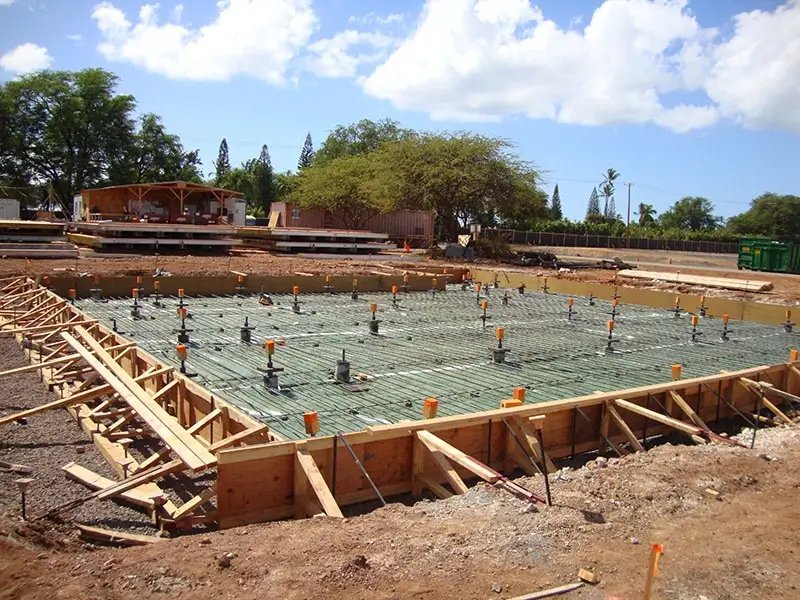

Before a drill rig is mobilized, a geotechnical engineer has already decided what a drilled pier is going to be asked to do. Texas gives that engineer a great deal to think about. Stiff clay in the north swells and shrinks with the weather, soft Gulf Coast soils carry load mostly by skin friction, and in parts of the west a rig meets cemented caliche or rock a few feet down. The shaft, the bell, the reinforcing cage and the concrete all follow from the soil boring log, and we read that log before we price a single foot of hole.
We build drilled shafts for tilt-wall and steel buildings, equipment structures, canopies, pole bases and the column lines of cast-in-place frames. A pier is simple to describe and unforgiving to build. It is a hole that must stay open until concrete fills it, and the steel inside it must sit where the drawings put it. A sidewall that sloughs or groundwater that rises faster than expected turns a routine afternoon into a casing and slurry problem.
Public records give a sense of what the state asks of deep foundations. In Sugar Land, reporting on the U.S. 59 crossing of the Brazos River describes river erosion undermining the ground beneath the bridge, and a $53 million bridge extension project of about 38 months to reconstruct part of it. In Dallas, the Trinity River is held between earthen levees about 50 feet tall, which shapes how nearby foundations are sited and drained.
Soil by region, shaft by region
North Texas clay is the simplest case to describe and the one most often misjudged. Piers there are drilled below the active zone, often with a void form under the grade beams that tie them together, so the swelling soil lifts nothing it touches. We commonly pair piers with grade beams for exactly that reason, and the spacing of both is set by the geotechnical report.
On the coast the problem reverses. Soft, wet soils want longer shafts, and the water table shows up in the hole. Around Fort Worth the underlying Barnett Shale and the Cross Timbers terrain make for variable ground, and the city includes well sites that occupy about two to five acres each, a reminder to ask the owner about old pads and buried lines, and to run a locate, before a rig sets up. In the Hill Country and the west, we expect rock and plan accordingly with rock and hard ground excavation tools.
Open holes and loaded cages
An open shaft is a fall hazard to people and equipment. We cover or barricade every hole at the end of the shift, keep spoil piles back from the edge and keep the drilled spoil off the haul route. Nobody enters a shaft. Where a bell or a deep cleanout needs visual inspection, the engineer's inspector uses a camera, a down-hole light or an approved procedure, not a ladder.
Reinforcing cages are heavy and awkward. We set them with a crane, use spacers and centralizers so the cover is right on every side, and never trust a cage that is hung on the rig by one bar. The pour itself is done by tremie or pump line with the discharge kept near the bottom, so the concrete rises through the water, not falls through it.
What the shaft package includes
The package starts with a survey of every pier location and a utility locate. Drilling follows the diameters and depths on the drawings, with temporary casing where the log calls for it. We measure the depth and the bottom condition, set the cage, and place concrete the same day so that the hole does not stand open overnight. For pier groups on a building pad, we sequence the drilling so the rig does not track over holes already filled.
A bell, when one is drawn, is formed with a belling tool and verified before the cage goes in. Anchor bolts and rods for steel columns or sill plates are set in templates before the concrete is placed, and elevations are shot after the pour so the steel erector has a reliable benchmark. Every pier is logged with its depth, volume and any surprises.
What changes the plan after the boring
Groundwater is the first variable. If the log shows water inside the planned depth, we ask the engineer early whether a casing, a slurry method or a dewatering approach is required, and we price those options separately. The dewatering crew we coordinate can control water at the surface for a grouped pier cluster, but a single shaft in a saturated seam is a casing job.
The second variable is access. A rig and a crane are heavy, and soft ground after rain can leave them stranded. We ask for a working pad, usually a few inches of compacted base, before we mobilize, and we schedule around rain whenever the site has clay at the surface. Overhead lines, buried pipelines and neighboring structures all go on the pre-drill checklist.
What drives the price of a pier
Footage is the headline number, but diameter, depth, casing, rock and rig mobilization are what move it. Every foot in rock costs more than a foot in clay, so a boring log that finds rock early is a gift to the estimator. Reinforcing steel and the volume of concrete are the next two lines, and ready-mix distance adds to the unit cost on a rural site.
We treat a quantity of piers as an allowance until the geotechnical report is final. If drilled depth changes after the rig is on the ground, the unit price carries through and the owner sees the new total at once. That is a straightforward way to avoid arguments, and it is how we like to work with municipal and public works owners who need defensible unit costs.
Piers across the state
Drilled shafts are poured wherever heavy structures sit on variable soil, which in Texas is nearly everywhere. We support developers, general contractors and industrial owners from the Panhandle to the coast, and we match rigs and crews to each region's ground. A tall utility structure at a plant is a different job from a column line at a manufacturing plant, but both begin with a log and end with a pour.
Near the river corridors, such as those around Sugar Land, we plan for soft alluvial layers, scour and moving water and we take the engineer's guidance on how deep a shaft must go to remain outside the zone of erosion.
Need piers drilled and poured?
Send the boring log and pier schedule. We will review depth, groundwater and rig access, then give you a footage price with the assumptions written out.
Common Questions
How deep does a drilled pier need to go in Texas?
It depends entirely on the geotechnical report. Piers in expansive clay are drilled below the active zone, while shafts on the coast are sized for skin friction and in the west they may bear on rock. The engineer sets depth, and we confirm it with the rig as the hole advances.
What happens if we hit groundwater while drilling?
We stop and compare what we see with the log. If the engineer approved a casing or slurry method, we switch to it. If not, we hold until a direction is given in writing. Pouring concrete into standing water without a plan is the fastest way to a defective shaft.
Do you handle the anchor bolts and the cage?
Yes. We build or receive the cage, set it with spacers, and place anchor bolts in templates for the steel erector. After the pour we shoot elevations and mark centerlines so the structure above begins from a reliable reference.
Why pair piers with grade beams?
Piers carry the load, and grade beams span between them and tie the building together. On expansive clay, a void form under the beam lets the soil swell without lifting the beam. The combination is common on North Texas buildings for that reason.
Can piers be drilled near existing utilities?
Yes, with care. We locate lines before we set up, hand-dig or pothole near them, and keep a safe offset for the rig. Where a line crosses a pier location, the layout is adjusted with the engineer before drilling begins.