
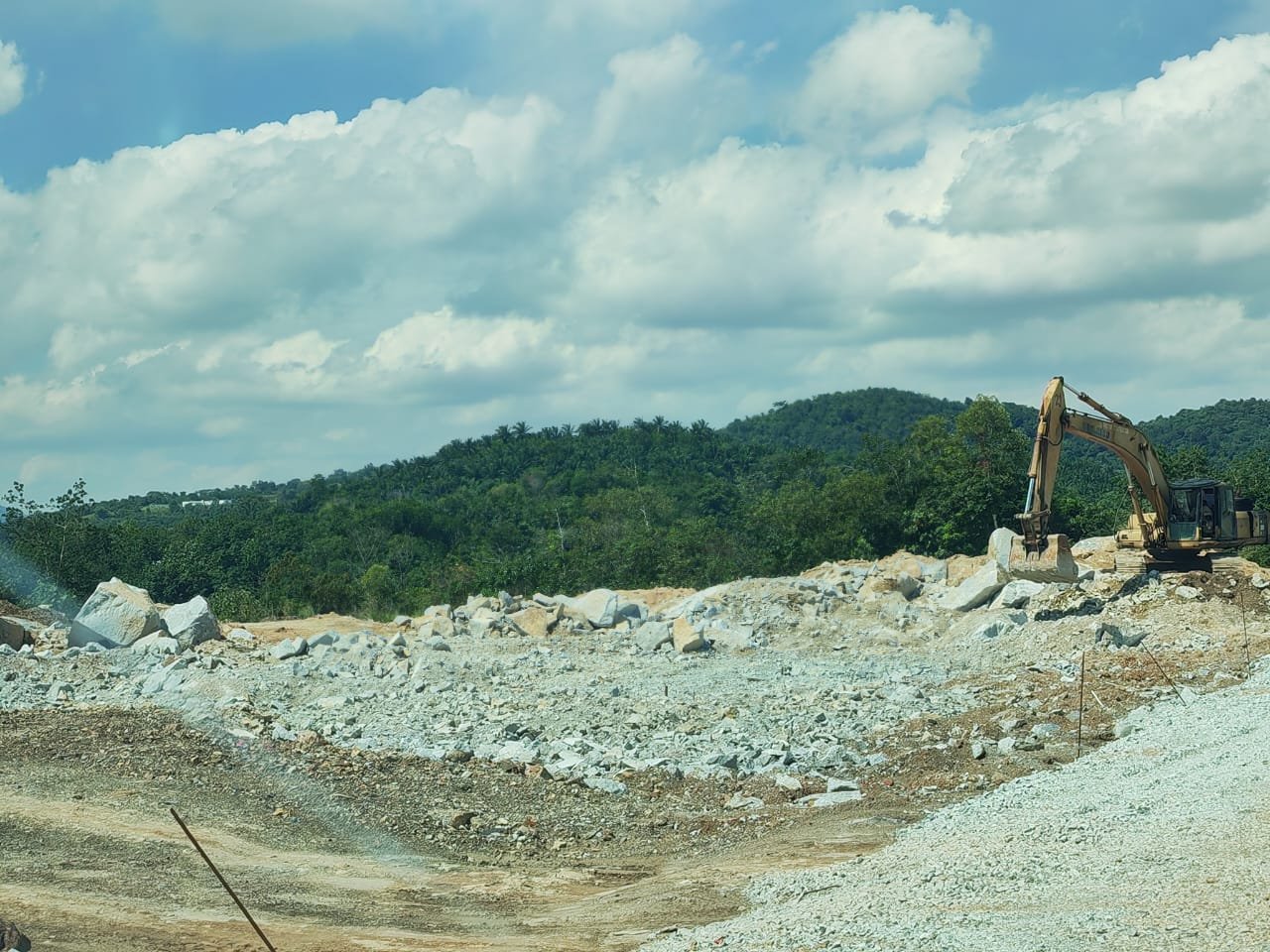

Hard ground comes in grades, and the bid depends on which one is under the bucket. Soft caliche can be ripped by a dozer in a morning. Cemented caliche, limestone ledges and layers of chert need a hydraulic hammer, a rock saw or controlled blasting, and they can turn a half-day trench into a week. Rock and hard ground excavation is the part of site work where the geotechnical report, the equipment choice and the unit price have to agree, and where a contractor who has dug it before is worth the difference.
We excavate rock and hard ground for foundations, utility trenches, pits, ponds and mass cuts across Texas. The first question we ask is how the material will behave, which means looking at the borings, the nearby outcrops and any test pits, and the second is how to remove it with the least disturbance to the neighbors, the utilities and the schedule. Most of the time the answer is a combination of methods, and the work goes more smoothly when we have planned the combination before the machines arrive.
Limestone, fault lines and aquifer country
Central Texas shows how much the ground can vary. The Austin Chalk Formation, a limestone escarpment, rises 230 feet and runs roughly north to south through Dallas County, and Dallas is described as prone to extreme weather, tornadoes and hailstorms. A project that cuts into that formation meets stone of varying hardness, and a day of heavy rain can turn the clay between the layers to slick mud, so rock work in the Dallas area is also a drainage and stability job.
Further south, published descriptions say San Marcos sits on the Balcones Fault, the boundary between the Hill Country and the Coastal Plains, and that San Marcos Springs, which feed Spring Lake and the San Marcos River, rise from the Edwards Aquifer. A published description likewise places New Braunfels along the Balcones Fault, 32 miles northeast of Downtown San Antonio, with the Comal River winding about 3 miles through the city before meeting the Guadalupe River. We take those descriptions as general context, not site data. For us, the practical meaning is that rock can be shallow and variable along the fault, groundwater and springs can be close, and the sensitivity of the aquifer makes erosion control, spill prevention and dust control important on every dig.
Ripping, hammering, sawing and blasting
We match the method to the rock. Ripping with a dozer works in weathered or fractured material and is the cheapest way to move it. A hydraulic breaker on an excavator handles harder rock in trenches and pits, with productivity that drops quickly as the rock gets stronger. Rock saws and trenching machines cut clean, narrow trenches for pipe and conduit with little vibration. Controlled blasting, done by a licensed blaster, handles large cuts of hard rock where mechanical methods are too slow.
After the rock is broken, it is loaded, hauled and either crushed for reuse or taken off site. Crushed rock makes excellent base and bedding material if it is screened to the right size, and recycling it on the same site cuts both the import and the export bill. The excavation crews we coordinate and the trenching and backfill crews we coordinate share the equipment for these jobs.
Classification, unit prices and the risk of the unknown
The central question on any hard-ground job is who bears the risk of rock. A lump-sum bid that assumes no rock leaves the contractor holding it, and a bid that assumes too much rock prices the owner out. We prefer a defined rock classification, such as material that cannot be ripped by a specified dozer or that requires a breaker, with a unit price per cubic yard or per foot of trench. That puts the risk where the borings leave it, and the owner pays only for what is encountered.
We help owners and engineers write that classification and verify it in the field. Test pits before the bid are cheap compared with a rock surprise, and a day with a large excavator can tell more than a dozen borings. Where the plans call for deep utilities, a few cuts along the line can save a change order. This also affects site utilities scheduling, because rock can slow a trench crew to a fraction of normal production.
Vibration, flyrock, dust and silica
Blasting and hammering make vibration, noise and dust, all of which have limits near buildings, pipelines and neighbors. Licensed blasters design each shot for the distance to structures, monitor with seismographs and file the notices the local authorities require. Mechanical methods are quieter but not silent, and a hammer running for days near a hospital or a school still needs a plan.
Silica dust from cutting and crushing rock is a health hazard, and we control it with water, vacuum or enclosure, and with respirators where needed. Flyrock is controlled with mats and sequencing, and everyone is kept outside the exclusion zone during a shot. Because many hard-ground sites lie over sensitive groundwater, we keep fuel, hydraulic oil and concrete washout away from open excavations and out of the pit. The erosion control and SWPPP plan is our reference.
Production rates and the long tail of rock
Rock production is slow and uncertain, and schedules should reflect that. A trench that runs forty feet a day in soil may run ten in rock, and a pit that takes two days in clay may take a week. We use the test-pit data to estimate the rate, and we add equipment, such as a second breaker, to hold the schedule when it matters.
Weather affects rock work less than soil work, but not zero. Water collects in cut areas, and wet clay seams make benching dangerous. We pump and drain cuts as we go, and we avoid leaving a rock face exposed in a heavy rain. For utilities and energy companies running lines across hard ground, we plan the route with the production in mind.
What rock adds to a budget
Rock adds equipment cost, tooling wear, disposal or crushing costs and time. A hydraulic hammer's tools wear out in a few hundred hours of hard rock, and the base machine and operator are expensive per hour. Blasting adds permits, seismograph monitoring, insurance and often a pre-blast survey of nearby structures.
We reduce cost by choosing the cheapest method that works, by reusing rock on site, and by minimizing overbreak, because excavating beyond the lines is expensive and can damage the bearing surface. When rock is found under a slab, we advise on the backfill needed for a clean, uniform bearing surface, which can include engineered fill to even out the transition from rock to soil.
Dig a test pit before you bid
Dig a test pit before you bid. Send us the borings and the plans and we will recommend where to open the ground, what method fits and how to write the rock into the contract.
We price hard ground by the unit, so the owner pays for what is actually there.
Common Questions
How do you know whether it is rock before bidding?
We read the borings and the geologic map, look at nearby cuts and outcrops, and ask for test pits where the stakes justify them. A few hours with an excavator on site gives the best sense of how the ground will dig.
Is blasting allowed in town?
Sometimes, with limits. Cities often regulate blasting by distance to buildings, hours and vibration. Where it is not allowed, we use hammers, saws and expansive agents.
What is caliche and how hard is it?
Caliche is a calcium carbonate layer that forms in dry soils. It ranges from a loose powder to a hard cemented layer that can resist a dozer. The hardness varies even across a single site.
Can excavated rock be reused?
Often. Crushed and screened rock can serve as base, bedding or fill if it meets the specification. Reusing it on site cuts the trucking bill and the import cost.
Who pays if we hit more rock than expected?
The contract decides. We recommend a unit price for rock beyond a stated assumption, so the owner pays for the quantity actually encountered, and the contractor is not forced to guess.