
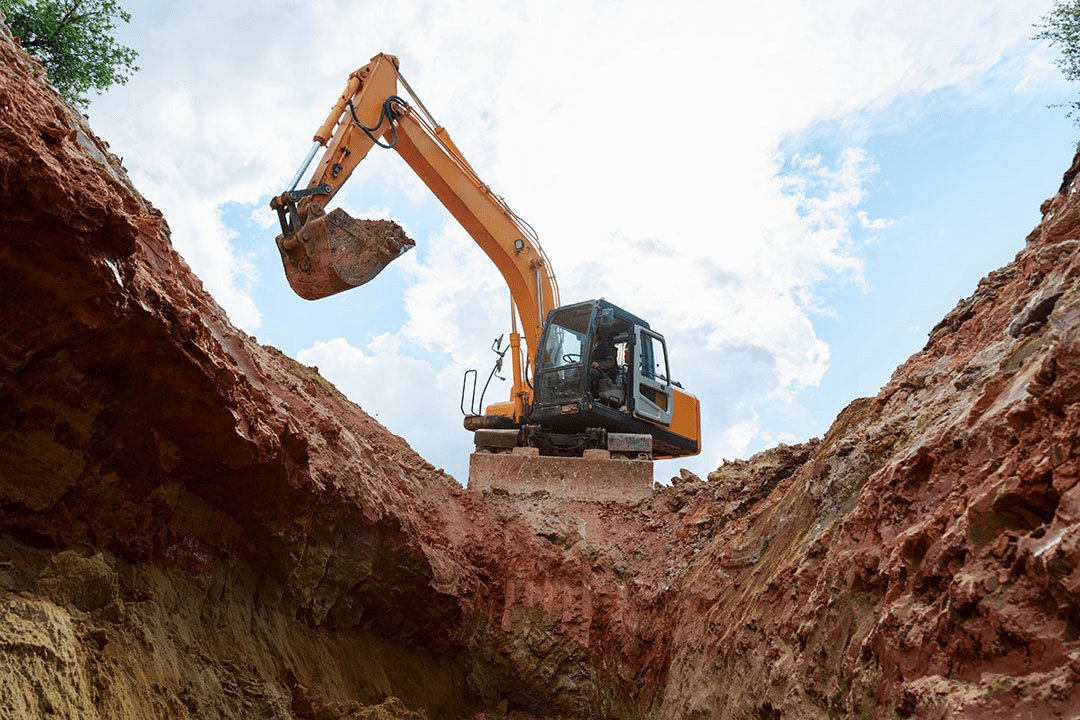

Three questions decide how an excavation goes: what is already in the ground, how deep the bottom has to be, and what the soil will do when the sides are opened. Excavation looks like the simplest part of a concrete job, a machine and a hole, but it is where a project first meets the real conditions of the site. We treat it as engineering work with a bucket on the end, planned from the geotechnical report and the utility locate and not from the plan sheet alone.
Our excavation scope covers foundation and footing digs, pits for vaults, dock pits and equipment foundations, utility structure holes, and the large open cuts that come before a building pad. Each has its own risks. A footing dig is shallow but unforgiving about bearing surface. A vault pit may be deep, close to existing structures and wet. A large cut may be mostly a logistics problem. We choose the machine, the sequence and the protection system to suit the dig in front of us, and we keep a competent person on site whenever the sides are open.
Keeping the sides standing
A trench or pit wall is a load waiting to fall. OSHA's excavation standard puts a competent person in charge of daily inspections, and it requires a protective system, such as sloping, benching, shoring or a trench box, once a cut reaches the depth where the standard applies. We do not leave that to chance. Before anyone enters, we classify the soil, set the slope or the box, check for water, and mark an exit within easy reach of every worker.
Spoil placement matters as much as the wall. The excavated pile has to sit back from the edge, and heavy equipment has to stay off the lip. Vibration from traffic, standing water behind the wall and a recent rain can all change a stable face into an unstable one in a few hours, which is why we inspect again after any change in the weather. Our trade partners who handle trenching and backfill use the same protocol on every cut.
Digging where the ground is already busy
Texas projects increasingly land on sites that carry heavy rail, port or utility infrastructure, and that changes how we excavate. The Port of Victoria says a $20.35 million TxDOT grant, awarded in October 2023, is funding the first phase of rail at the Texas Logistics Center, with about 42,000 feet of track that includes three 10,000-foot drop and pull tracks, and that a $6 million federal CARES Act grant in 2021 funded a 1.9-mile rail loop and a 2,000-foot ladder track at the North Industrial Park. Track subgrade is excavated to a tight profile, because rail will not forgive the kind of soft spot that a parking lot can absorb.
The coast shows the other extreme. The Port of Corpus Christi states that in 2025 it marked completion of the Corpus Christi Ship Channel Improvement Project, which deepened the channel from 47 to 54 feet. Our work is on land and far smaller, but a site near a ship channel often has a high water table and tidal influence, so excavations there need pumps, shoring and a plan for water before the first cut is made. That is where dewatering becomes part of the excavation scope and not a separate afterthought.
What the dig includes
A complete excavation package starts with locating and marking buried utilities, then clearing and stripping to the start of the cut. We excavate to the plan elevation, leaving a thin layer of protective soil above the final bearing surface when the foundation will not be poured immediately. The last few inches are removed by hand or with a smooth bucket right before the concrete or the base is placed, which protects the bearing soil from rain and foot traffic.
Haul-off or stockpiling is part of the scope, and so is the disposition of unsuitable material. If a pit encounters old foundations, buried debris or contaminated soil, we stop, document it and report to the owner. Good records of what was found, with photos and depths, are worth far more than a verbal note when a change order is discussed. For sites where hard ground is expected, we coordinate with the rock and hard ground excavation crew before the schedule is locked.
Permits, locates and inspection points
Texas requires excavators to notify the one-call center before digging, and we do it every time, with the ticket number on file for the job. Local jurisdictions add their own requirements for right-of-way cuts, traffic control and stormwater controls. Where an excavation disturbs enough ground, a construction general permit and a stormwater pollution prevention plan apply, and our erosion control and SWPPP work makes sure the controls are in before the dirt moves.
Inspection points are where excavation meets the rest of the project. Footings need to be inspected at the bearing surface before reinforcement is placed, and geotechnical engineers often want to see the bottom of a pier or pad dig. We schedule the inspection, keep the excavation open and protected until it is signed off, and avoid the common failure of digging early and pouring late, which leaves bearing soil exposed for days.
Where we excavate across Texas
We work in the regions where soils range from sticky gumbo on the coast to caliche in the west, and we adjust equipment and method to each. Clay digs smoothly when dry and ruts badly when wet. Caliche may need a ripper tooth or a breaker. Sandy soils collapse faster than they look, which changes how we slope and shore.
General contractors and owners looking for a single excavation partner for a project that crosses regions can talk to us about general contractors and construction managers work, and about how excavation ties into manufacturing plant foundations and equipment pits. We bid by region because production rates and haul patterns differ.
Tell us what is in the ground
Tell us what is in the ground, how deep the dig has to go and when the concrete crew is due, and we will build an excavation plan around those facts.
We bid foundation digs, pits and building cuts with the protection and disposal included, so the number you compare is the number you pay.
Common Questions
How do you find buried utilities before digging?
We call the one-call center, wait the required time, and then verify the marks by potholing where the plans show crossings. Marks can be wrong or incomplete, so we expose the line by hand or vacuum excavation before a machine gets close.
How deep can you dig before shoring is required?
The OSHA standard requires protective systems at a depth that depends on the soil, and many contractors apply them at about five feet. We set the system from the soil classification and the water conditions, not just a depth number.
What happens if you find something unexpected in the dig?
We stop work in that area and document the find with photos and measurements. Then we notify the owner, the engineer and, if necessary, the permitting agency. Old tanks, foundations and contaminated soil each have their own procedure.
Can excavation be done in the rain?
Light rain is workable, but heavy rain softens the bearing surface and fills the hole. We keep the excavation sloped to a sump, pump out standing water and cover critical surfaces. If the bearing surface is damaged, it has to be removed and replaced with compacted material.
Do you handle disposal of excavated soil?
Yes. We can stockpile for reuse, haul to a designated site or export to a permitted facility. Contaminated or regulated material needs testing and special handling, and we coordinate with the environmental consultant on those loads.