
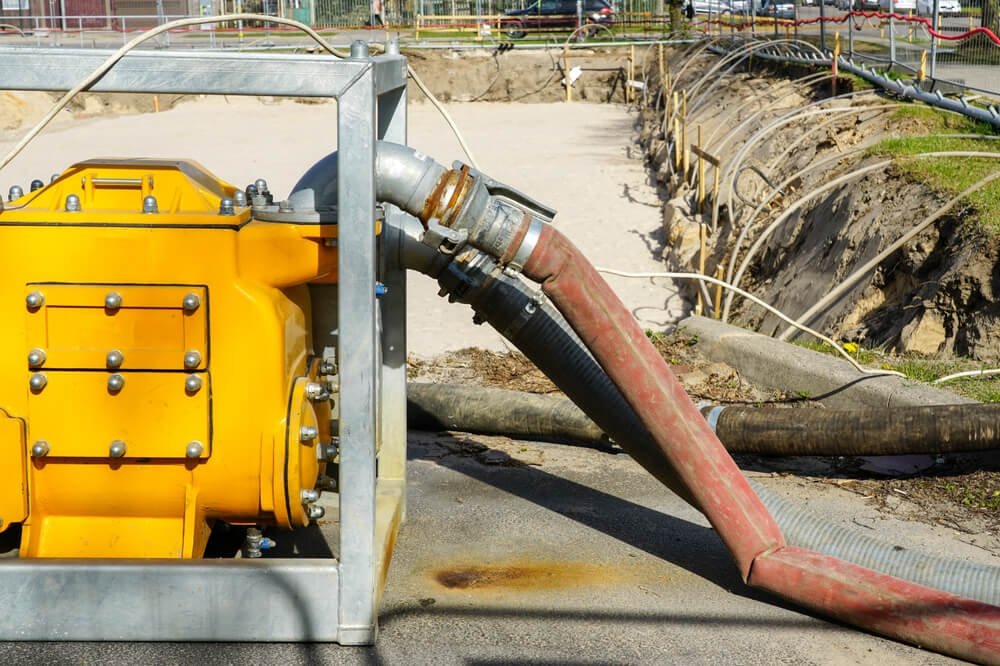

During Hurricane Harvey in August 2017, a NOAA tide gauge at Port Lavaca read 6.2 feet above Mean Higher High Water. Ground that sits that close to the Gulf does not stay dry for long, and a trench dug there is below the water table almost as soon as the bucket goes in. Dewatering is the work of lowering groundwater, or keeping surface water out, so that an excavation can be built dry, and it decides whether pipe, structures and footings are placed in firm ground or in soup.
On a pad or a trench with a shallow water table, dewatering can be the largest single risk in the schedule. We use sumps and trash pumps for light seepage, well points for sandy ground with moderate flow, and deep wells where the water table is high and the excavation is deep. The method is chosen from the soils report and the depth, not from habit. Our trade partners install, operate and monitor the system, and they remove it when the structure is far enough along to resist uplift.
What the soil report tells us about water
The geotechnical report is the first place we look. Boring logs show the depth to groundwater when the borings were drilled, but the water level on the day we dig may be higher after rain or lower in a drought. Sand, gravel and fractured rock transmit water quickly and need an active system, while tight clay yields water slowly and often needs only sumps. Layered soils, like clay over sand, can make a trench stable on top and hazardous below.
Place matters as much as soil type. San Marcos sits on the Balcones Fault, and its springs rise from the Edwards Aquifer, which means water in the ground there is often tied to a larger system of fractured limestone rather than a simple water table. Where aquifer protection rules apply, discharge water must be managed carefully, and pumping can interact with nearby wells. We confirm those conditions with the engineer before the system is designed.
Designing a system that keeps the trench dry
A good dewatering system is sized for the flow, not guessed. We estimate the inflow from the soil permeability, the depth below the water table and the length of open excavation, then choose pumps, headers and discharge capacity with a margin. Well points are installed in a line parallel to the trench, spaced by the soil, and connected to a header pipe and a vacuum pump. Deep wells have their own submersible pumps.
Discharge is part of the design. Pumped water must go somewhere, and it must be cleaned before it leaves the site. We route it through sediment bags, settling tanks or baffled basins to the point of discharge the plan allows, and we avoid sending it onto neighboring property or into a storm system without permission. Monitoring wells or piezometers let us confirm that the water level has dropped enough before excavation reaches the pipe elevation, and we keep logs of pumping rates for the record.
Trench stability and pumped-water hazards
Water in the soil turns a stable trench wall into a collapse risk. Even a trench that was properly sloped can fail if seepage erodes the toe of the slope, so dewatering is a safety measure as much as a convenience. A competent person inspects excavations daily and after any rain, and trench boxes or shoring are matched to the soil and to the amount of water present.
Pumps bring their own hazards. Fuel and electric power on a wet site need protection, discharge hoses must be secured, and noise and fumes can affect neighbors. We place pumps on containment and run them with sound enclosures where required. When a system must run overnight, we assign a monitor and set alarms so a failed pump does not flood the trench before morning.
Surface water, groundwater and construction sequencing
Dewatering covers three situations that look similar and are not. Surface water control keeps rain and runoff out of the excavation with berms, ditches and sumps. Groundwater control lowers the water table below the bottom of the excavation using wells or well points. Temporary diversion keeps a flowing creek or channel away from a work area using cofferdams, pipes or pumps. Many projects use all three at different stages.
The work belongs in the sequence from the first day. Wells are installed ahead of excavation so the water table is down before the trench reaches it, and the system stays in service until the pipe or structure has enough weight and backfill to resist uplift. For a manhole or vault, that can mean running the system until the structure is backfilled and the base slab has cured. For a long sanitary sewer run, it means moving the system along the trench as the work advances.
What makes dewatering expensive
Duration and flow drive the price. A system that runs for a month at a high flow rate costs far more than one that runs for a week at a trickle, and fuel, power, labor for monitoring and equipment rental all accumulate daily. Sandy ground below a high water table is the worst case, because the pumping rate and the number of wells are both high.
Discharge treatment can add cost, particularly where permits require sediment control or testing before release. Rain events during construction can raise water volumes unexpectedly, and tropical storms can flood an excavation overnight. Hurricanes Dolly in 2008 and Hanna in 2020 are cited in the description of McAllen as examples of how storm events affect the Rio Grande Valley. We recommend carrying a dewatering allowance or a unit-price schedule in the contract, tied to the soil report, so a wet season does not turn into a dispute.
Where dewatering shapes our bids
The Gulf Coast is the obvious region, from Port Lavaca and Calhoun County to Galveston and the Houston ship channel, but it is not the only one. River valleys across the state have shallow groundwater, and spring-fed areas in the Hill Country require careful planning. Valley sites in the south can hit water within a few feet of the surface.
We design and operate dewatering for oil, gas and midstream owners building near the coast, for municipal and public works projects in river towns and for developers whose sites cross low ground. If a project needs a pond or basin excavated below the water table, we coordinate with the detention and retention design so the sequence is workable.
Get the water table into the estimate
Send the geotechnical report and the excavation depths and we will tell you where we expect water, which method fits and what to carry in the budget.
Common Questions
How do I know if my site needs dewatering?
Look at the geotechnical report for the depth to groundwater and compare it to the depth of your deepest excavation. If the water table is within a few feet of the bottom of a trench or footing, plan on some form of dewatering. Sites near rivers, the coast or springs deserve extra caution.
Can pumped groundwater be discharged to the storm system?
Sometimes, but only with permission from the owner of the system and after the water is cleaned of sediment. Some areas have rules on discharges, particularly near aquifers or sensitive waterways. We plan the discharge route with the engineer and the owner before pumping.
What is the difference between well points and deep wells?
Well points are small-diameter pipes driven into the ground in a line, connected to a vacuum header, and suit shallow excavations in sandy soil. Deep wells are larger and drilled deeper, with submersible pumps, for deep excavations or high flow.
Does dewatering cause settlement of nearby buildings?
It can. Lowering the water table can consolidate soft soils and settle structures nearby. The engineer may require monitoring points on adjacent buildings. We follow that monitoring program and adjust pumping if movement is detected.