
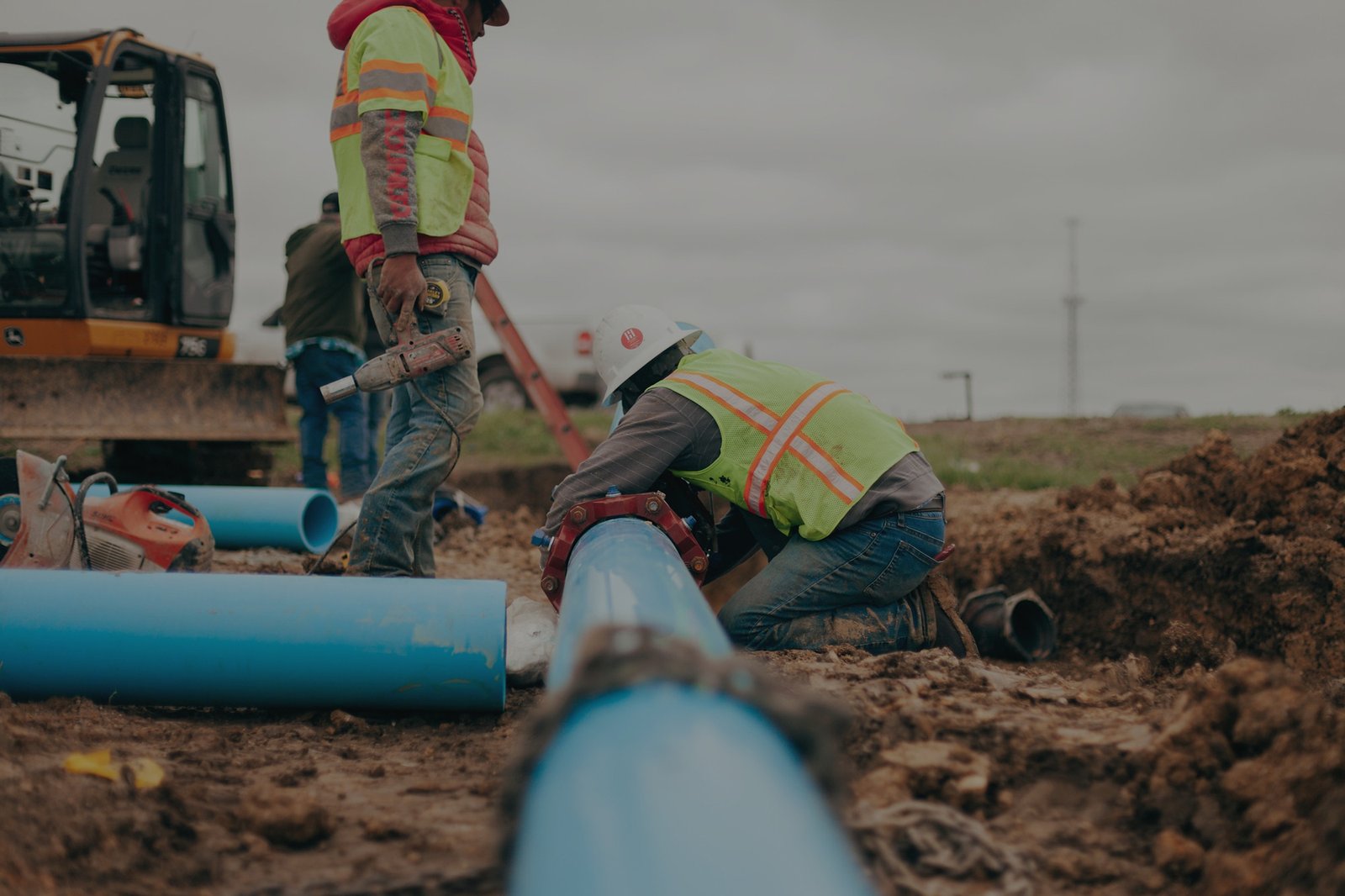

Gravity does the work in a sewer, and gravity is unforgiving about a quarter inch. A pipe laid a little flat holds standing water and solids; a pipe laid a little steep can carry the flow away so fast that solids are left behind. Sanitary sewer installation is the discipline of setting a line to a design slope and keeping it there through bedding, backfill and a year of settlement, and it is the scope on most sites where an error is hardest to correct once the pavement is poured above it.
We build sanitary sewer mains, service laterals and the manholes that join them as part of a combined concrete, utility and earthwork package. Grade is set from the invert, not the ground surface, using laser or a total station, and it is checked at every structure before the next run is laid. Because we also pour the slabs and pavement that sit over these lines, we have a direct reason to build them right: a sunken trench under a loading apron is a repair we would be the ones asked to make.
Why sewer capacity decides where buildings go
On a growing site, the question is often not whether you can build the sewer but where it connects. In the Austin area, the Brushy Creek Municipal Utility District is described as the largest district in Round Rock, a reminder that sewer service in many Texas suburbs is delivered by special districts with their own standards and their own timelines rather than by a single city department. A developer who assumes one set of details will find the next parcel uses another.
Industrial parks that already have infrastructure shorten the schedule. The Baytown area lists a 960-acre rail-served industrial park among its sites, and master-planned parks of that scale typically stub main lines to individual lots. In those cases our work is a lateral and a cleanout, not a trunk. Where a parcel sits out past the last manhole, the extension is a cost the owner should know before closing on the land.
Setting pipe to grade and holding it
We begin with the invert elevations in the plan and verify that they work against the existing manhole we are tying into. Surprises at the connection point are common, because as-built records age and manholes get re-topped. A pothole or a field shot at the tie-in before we mobilize the trench crew usually settles it. Once the line is released, we excavate to the pipe bedding depth, place and compact the bedding, and lay pipe with the laser set on the spigot end of each joint.
Bedding and haunching matter more for sewer than for most utilities, because a flexible pipe like PVC takes its strength from the soil around it. We place haunch material by hand tamping where needed, then compact in lifts, and we deflection test flexible pipe after backfill on the schedule the owner specifies. Where the line crosses a future pavement, we match the backfill to the building pad or pavement subgrade plan so settlement does not telegraph through the slab. That coordination runs through the slab on grade crews we coordinate and the manhole and vault work.
Deep trenches and confined spaces
Sewer trenches are among the deepest on a site, and depth changes the safety plan. Anything beyond five feet needs protective systems, and we use trench boxes, shoring or sloped walls chosen for the soil class at the time. A competent person inspects each excavation daily and after rain, and spoil stays back from the edge. Ladders or ramps are within reach of every worker, and access is controlled at the ends of open trench.
Manholes bring confined space issues. Before anyone enters an existing structure to tie in, the atmosphere is tested and ventilated, and a rescue plan is in place. New structures are safer, but live flow in an adjacent line changes the risk. Bypass pumping, plugs and temporary flow diversion are planned in advance and coordinated with the utility, since interrupting a sanitary main without notice is a violation as well as a hazard.
Fitting sewer into the project calendar
Sewer is almost always on the critical path, because the building cannot receive a certificate of occupancy until its service is connected and accepted. Rough-in plumbing needs the lateral stubbed out before slab pours, and underslab plumbing is inspected before concrete. We schedule the main and laterals ahead of the foundation crew, and we leave clear access for the plumber to connect before we backfill beside the footing.
Testing adds hold points: an air or low-pressure test, deflection testing on flexible pipe, and camera inspection on larger lines. Allow a few days after pipe is complete for the owner to schedule these. Rain extends the timeline, because wet trenches slow compaction and delay backfill. On a site in the Blackland Prairie east of Temple, for example, a rain-saturated trench can stay unworkable longer than a rock-based trench in the hills, so we hold float in the sewer line rather than assuming dry weather.
Who we build sanitary sewer for
Homebuilders and multifamily developers bring us subdivision-scale sewer, with laterals to each lot and a main that has to be accepted before final plat recording. Logistics and warehouse developers tend to need shorter runs and larger structures, with grease or sand interceptors where truck wash or break facilities discharge. Municipal owners often put the work out as public projects with prevailing wage and detailed bonding requirements, which we price and manage accordingly.
Food processors, cold storage and similar plants send high-strength or high-volume waste, and their pretreatment and sampling structures have their own rules. We coordinate those with the owner's engineer so that the sampling manhole, flow meter and trap are placed where the pretreatment permit expects them.
Before the first trench is opened
Three questions are worth answering before bidding. What is the soil, and is there a geotechnical report that shows the groundwater table? Where are the other utilities that will cross or run parallel to the line, and have they been located? And who owns the line after construction? The answers change the shoring, the dewatering and the warranty. If the geotechnical report is not available, ask for it before the sewer is priced, because an unknown water table can double the cost of a deep run.
We also recommend verifying the downstream manhole's condition and capacity. Connecting a new development to an overloaded or deteriorated line can pass inspection and still fail the owner. A short video inspection of the receiving line, paired with a coordinated plan with utility potholing and locating, is inexpensive compared with the risk.
Start with the invert elevations
Send the plan and profile sheets and we will check the tie-in elevations, the soil assumptions and the test requirements before the bid goes out. It is a short conversation that can prevent a long delay.
Common Questions
What is the minimum slope for a gravity sewer?
The minimum slope depends on pipe diameter and the owner's standard, and it is set so the flow keeps a self-cleaning velocity. Smaller lines need steeper slopes. We build to the plan grade and verify the invert at each structure, and we flag early if the plan slope cannot be met at the connection point.
How are sewer laterals connected to existing mains?
Connections are made at an existing manhole, with a core drilled and a boot installed, or with a saddle or tee on the main, depending on the owner. The utility usually dictates the method. We coordinate the work with the owner's inspector and sometimes with bypass pumping when the main cannot be shut off.
What testing is required before a sewer is accepted?
Most owners require an air or vacuum test on gravity lines and manholes, a deflection test on flexible pipe, and sometimes a camera inspection. Requirements vary by owner. We confirm them during estimating so the test equipment and time are in the schedule, not discovered after the pipe is buried.
Can sewer be installed in wet ground?
Yes, with dewatering and proper bedding. Well points, sumps or deep wells lower the water table below the pipe invert so the trench can be dry during laying. Stabilization stone under the pipe is sometimes needed in soft ground. The cost is considerably higher than in dry conditions, which is why the geotechnical report matters.