
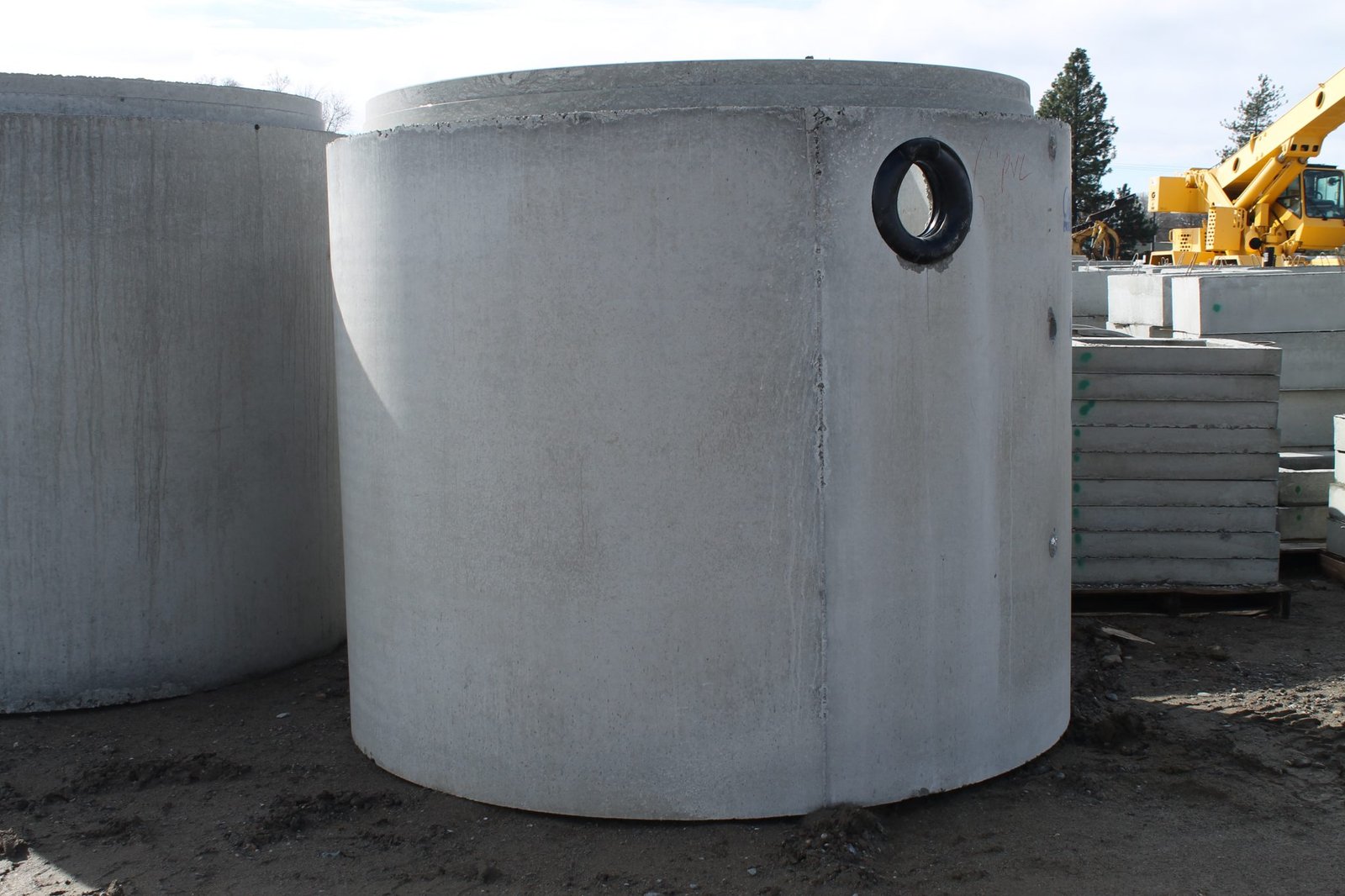

Empty, a precast manhole is a buoyant box. Set it in a trench where groundwater rises, and a heavy rain can float it out of position or crack the pipe joints around it. This is the quiet reason that manholes, vaults and underground structures are a specialty inside utility work: they are the one place on a line where the pipe stops being flexible and starts being a rigid, hollow object that the soil, the water table and traffic all want to move.
We build and set sanitary and storm manholes, junction boxes, valve vaults, meter vaults, electrical pull boxes and cast-in-place structures for utilities and private sites. Some are precast and delivered by crane; others are formed and poured in place because the size, shape or pipe angles do not suit a catalog unit. Either way, the structure is where flow lines meet, where access happens and where inspectors look first, so we give it the same attention as the main it serves.
Setting a structure so it stays put
Setting a structure begins with the base. We excavate to the required depth, place and compact a stable bedding layer, and verify elevation before the structure is lowered. A base that is out by half an inch can throw off the invert elevations of every pipe that enters. Precast sections are joined with sealant or gaskets and checked for plumb at each lift. Pipe connections are made with boots or grouted collars that stay watertight as the soil settles.
Once a structure is set, backfill is placed evenly around it in lifts so lateral pressure is balanced and the barrel is not pushed sideways. Rings and covers are set last, to final pavement grade, with adjustment rings or grout. A cover set a half inch high in a driveway gets hit by plows and tires, and a cover set low collects water and debris. We coordinate the final cover elevation with the paving crew so it is placed after the surface course, not before.
Structures in ground that moves and floods
The Houston area shows how the ground can change under a structure. Reports citing the Harris-Galveston Subsidence District describe localized subsidence in the greater Houston area, including The Woodlands, caused by groundwater removal that compacts aquifer clay and is permanent. A manhole in a subsiding area may sit in ground that moves relative to the pavement around it, so we use flexible joints at pipe connections and plan frame and cover adjustment for the future.
Near Cypress, the area is described as lying in the Cypress Creek and Little Cypress Creek watershed, where high groundwater and creek flooding affect structure design. Along the coast, storm surge matters: the National Weather Service reports a surge of 5 to 10 feet in Brazoria County near Freeport during Hurricane Ike in 2008. Structures near the coast are specified with sealed lids or bolt-down covers and with antiflotation measures so floodwater does not lift them or carry them away. We build to those details in The Woodlands, Cypress and along the Gulf.
Precast and cast-in-place from one crew
Many structures arrive on a truck and are set by crane, but a project that needs a nonstandard vault, a large junction chamber or a structure with several skewed pipe entries is better built in place. We form and pour walls, floor and lid with reinforcing designed by the engineer, and we place the pipe sleeves or penetrations to the angles on the plan. Because the concrete and utility work is coordinated by one company, there is no gap between the party who sets the pipe and the party who forms the box around it.
Quality of the concrete matters here more than in a sidewalk. Structures that hold water or sewage need dense, crack-resistant concrete, and the joints between floor and wall are watertight details. We test slump and air content and cast cylinders, and we cure structures under wraps or with curing compound so a hot afternoon does not craze the surface. Our concrete testing and quality control practice covers those checks.
What connects to a structure
A manhole is a node in a larger system. Sewer lines arrive at it through sanitary sewer installation, storm pipes through the storm drain scope, and electrical conduit through duct banks that end in pull boxes and vaults. Each arrives at a different elevation and angle, and the structure has to accommodate them all without compromising the walls.
On industrial sites, valve vaults and meter pits join the list, and they come with the requirement for access hatches sized for equipment and ladders. Cover loading class matters: a vault in a truck court needs a heavier cover than one in a landscaped island. We read those details during estimating so the right castings and slabs are ordered at the start, not after the first inspection.
Details inspectors check
Inspectors look at structures with a checklist. Invert elevations must match the plan, pipe connections must be watertight, steps or ladders must be installed where required and the cover must carry the specified load rating. For sanitary structures, a vacuum or hydrostatic test is common, and some owners require a coating or liner in aggressive environments. For municipal owners, the standard details are strict and non-negotiable.
We review the owner's detail sheets before ordering. A frame and cover from a different foundry can differ in dimensions enough to fail a fit check, and a precast supplier's standard wall thickness may not meet a local requirement. Submittals are prepared early, and we record test results and photographs of each structure before backfill closes it from view.
Send us the structure schedule
Share the structure schedule and the invert table and we will review sizes, loading and groundwater provisions before ordering begins.
Common Questions
When is a cast-in-place structure better than precast?
Cast-in-place makes sense when the structure is unusually large, when it has multiple pipe entries at odd angles, or when the site cannot accommodate the crane or delivery for precast. It takes longer on site but offers more flexibility in size and shape.
How do you keep a manhole from floating in high groundwater?
The usual measures are a heavier base slab, a concrete collar, or an antiflotation ring that mobilizes the weight of the soil above. The engineer specifies the method based on the groundwater elevation, and we build it exactly, since floating happens when a detail is skipped.
What are the common causes of manhole leaks?
Leaks usually trace to poor joint sealing, unsealed pipe penetrations, cracked sections and movement from poor backfill. Testing before backfill finds most of them. Fixing a leak after paving means excavation and a patch, so we test first.
Who sets the final cover elevation?
The paving or grading plan sets it, and we coordinate with the paving crew. Covers are usually adjusted after the final asphalt or concrete is placed, so they sit flush rather than above or below the surface.
Can existing manholes be modified for a new connection?
Yes, with a core drilled and a boot installed, plus a new invert channel formed in the base. The owner must approve the work, and flow may need to be bypassed. We arrange confined space entry and flow control for the modification.