
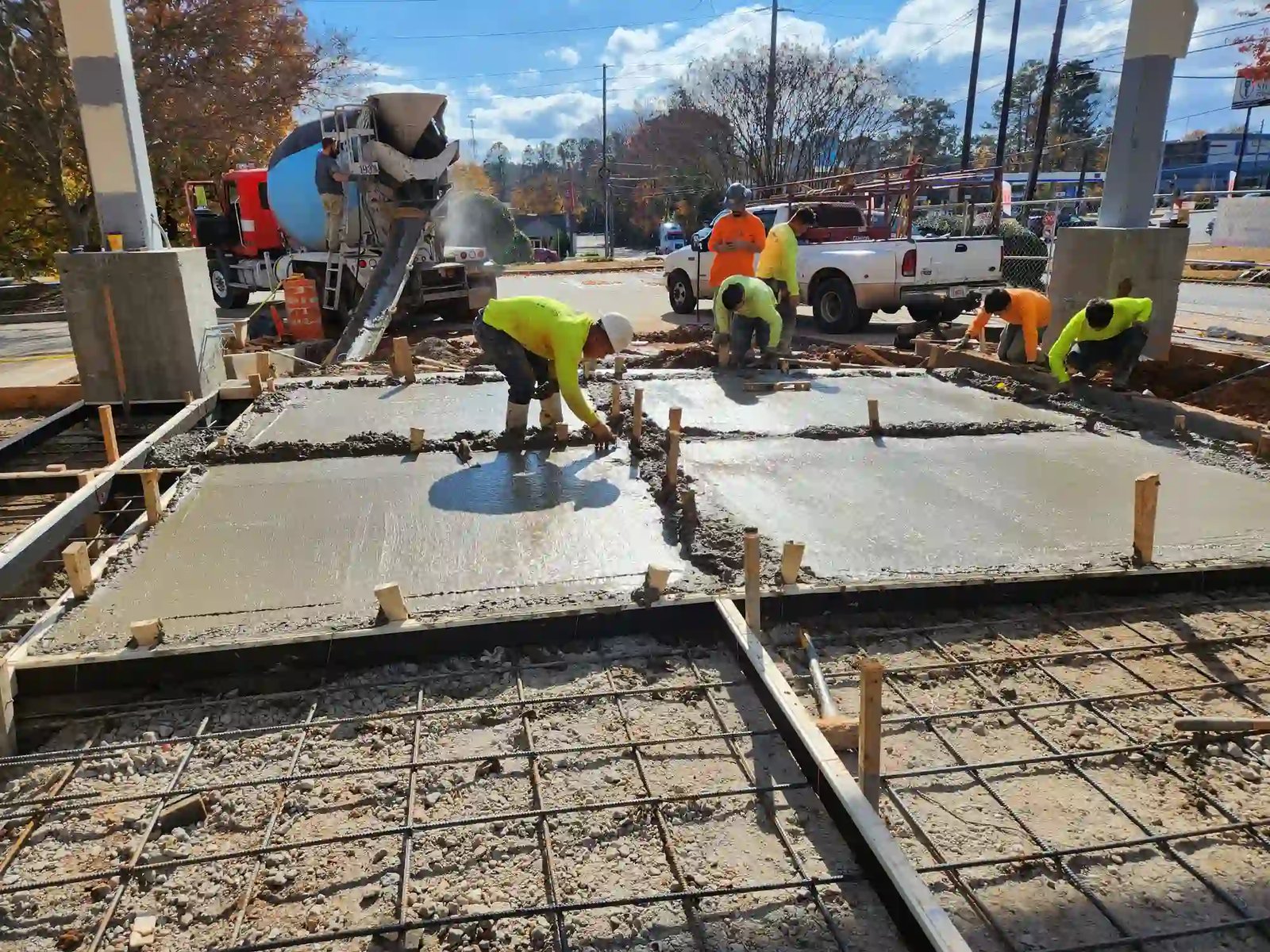
Big chemical plants on the upper Texas coast depend on local contractors who can mobilize quickly for maintenance, upgrades and new foundations, and in Calhoun County we pour concrete, move earth and install underground systems for plant and port owners. Our work spans equipment pads, pipe supports, containment, truck and rail loading areas and the roads and drainage around them.
The plants set the pace. A Victoria Economic Development Corporation article from July 2017 reported that one resin and plastics manufacturer was investing $5 billion in an expansion at Point Comfort, adding about 800 acres in Jackson County to bring the plant to 2,300 acres, with about 140 permanent jobs in Jackson County and 200 in Calhoun County. The same article said the company had 2,066 full-time employees and 922 full-time contract staff in Calhoun County and paid about 33 percent of the county's taxes. That article is several years old, so owners should treat its figures as history; it shows the scale the area supports.
The Seadrift Operations page of a major chemical producer says the site began operations in 1954 under an earlier owner, spans about 4,700 acres, employs more than 1,200 people and includes nine production plants.
Plants, a ship channel and a short list of roads
According to the Calhoun Port Authority, the Matagorda Ship Channel opened to traffic in 1965, the dry bulk dock at Point Comfort is 700 feet long with a current depth of 38 feet, and the liquid product piers are 38 feet deep today against a 47-foot design depth. Its directions route traffic from Victoria on US 87 south to Port Lavaca, then onto Texas 35 toward Point Comfort.
Those details matter because haul distance and road capacity shape concrete work. Ready-mix, rebar and aggregate arrive along a few roads, and a single closure can affect a pour. We confirm routes, load limits and alternate suppliers during planning. For oil, gas and midstream customers and utilities and energy companies, we also arrange for off-hour deliveries when needed.
The concrete and civil work plants need
Maintenance and upgrade work in a large plant uses small to mid-sized pours made in tight spaces: pump pads, tank rings, sump pits, pipe sleepers and slab repairs. We work with the plant's engineers on formwork that fits between existing pipe and structures, and we use pumps or buckets when trucks cannot reach. Our mass concrete pours approach applies where thick foundations require temperature control.
Civil work includes drainage upgrades, road repairs and laydown yards. Utility work includes fire water, process sewer, storm and electrical duct, all placed after careful locating of what is already buried. Documentation is part of the deliverable, and we keep records of tests and inspections.
Approvals for bayfront and plant sites
Calhoun County work may involve the county or city for building permits, the port authority for waterfront property, the plant owner for internal permits and the state for any work in or near coastal waters. Texas leaves commercial code adoption to municipalities, using the International Building Code as a baseline with local amendments, so we confirm which edition applies and whether any flood-related amendments exist.
Stormwater controls are required on larger sites, and bayfront ground raises the stakes: sediment barriers, stabilized entrances and washout pits are installed before excavation and checked after each rain. We keep inspection logs and fix deficiencies right away, since a reported violation can stop a job.
Surge, wind and plant access
A National Hurricane Center update dated August 26, 2017 reported that a NOAA tide gauge at Port Lavaca recently measured a water level of 6.2 feet above Mean Higher High Water. That figure is a reminder that bayfront ground floods, and owners design with elevation, drainage and equipment placement in mind. We build to the engineer's elevations and verify them by survey.
Access is the other consideration. Plants control gates, badges and work zones, and a late badge can cost a crew a day. We prepare personnel lists, training records and equipment documents ahead of time. Owners with work in Victoria or Corpus Christi can use the same documentation across sites.
Working around outages and long supply lines
Outages and turnarounds set hard dates, and the Calhoun County supply line is not short. Rebar, embeds and special mixes may come from Victoria or farther, so we order early and confirm delivery dates in writing. For pours that cannot be interrupted, we reserve batch plant capacity and have a backup source identified.
We can coordinate with crews in Freeport and on projects in the Gulf Coast LNG and petrochemical corridor, so owners with several sites do not have to repeat the planning. Schedules are shared weekly, and we flag any risk as soon as we see it.
Crews that can mobilize for short jobs
Plant maintenance work is often urgent, and a contractor that has to hire subcontractors for each task is slow. We keep forming, rebar, placing, finishing, excavation and pipe trade partners lined up, so we can respond to a request with a plan and a start date, not a bidding round. Foremen are experienced in working near live systems and in following hold points.
We also coordinate testing, with an independent lab taking cylinders and slump readings, and we keep the reports organized by pour. If a plant needs a mix with special properties, such as sulfate resistance, we work with the supplier and engineer on a design and trial.
What drives small and mid-sized plant jobs
On small jobs, mobilization and access dominate. A pour that takes four hours may take a full day once badging, safety meetings, escorts and cleanup are counted. We price those honestly and look for ways to combine tasks so the crew is on site once.
Material premiums matter too. Short pours cost more per yard than large ones, and special mixes add a charge. We ask for current numbers from suppliers and pass along what we learn.
Plan your Calhoun County work
Send the drawings, the plant or port access rules and your shutdown dates. We will build a plan for concrete, earthwork and utilities on the Point Comfort and Seadrift side of the bay.
Common Questions
Can you do small maintenance pours on short notice?
Yes. Our trade partners are set up for fast mobilization, and we keep forms, reinforcing and common mixes available. The main delay is usually plant access, so we ask owners to start badging as early as possible.
How do you handle limited access inside plants?
We use smaller equipment, pumps, buckets and hand placement, and plan formwork to fit around existing pipe and steel. We also check clearances before the pour.
What is the effect of limited roads on deliveries?
A closure or heavy traffic can slow trucks, so we confirm routes and alternate suppliers and set the pour start accordingly.
Do you keep records for plant owners?
Yes. We provide test reports, pour records, survey checks and inspection sign-offs by pour, organized for closeout.