
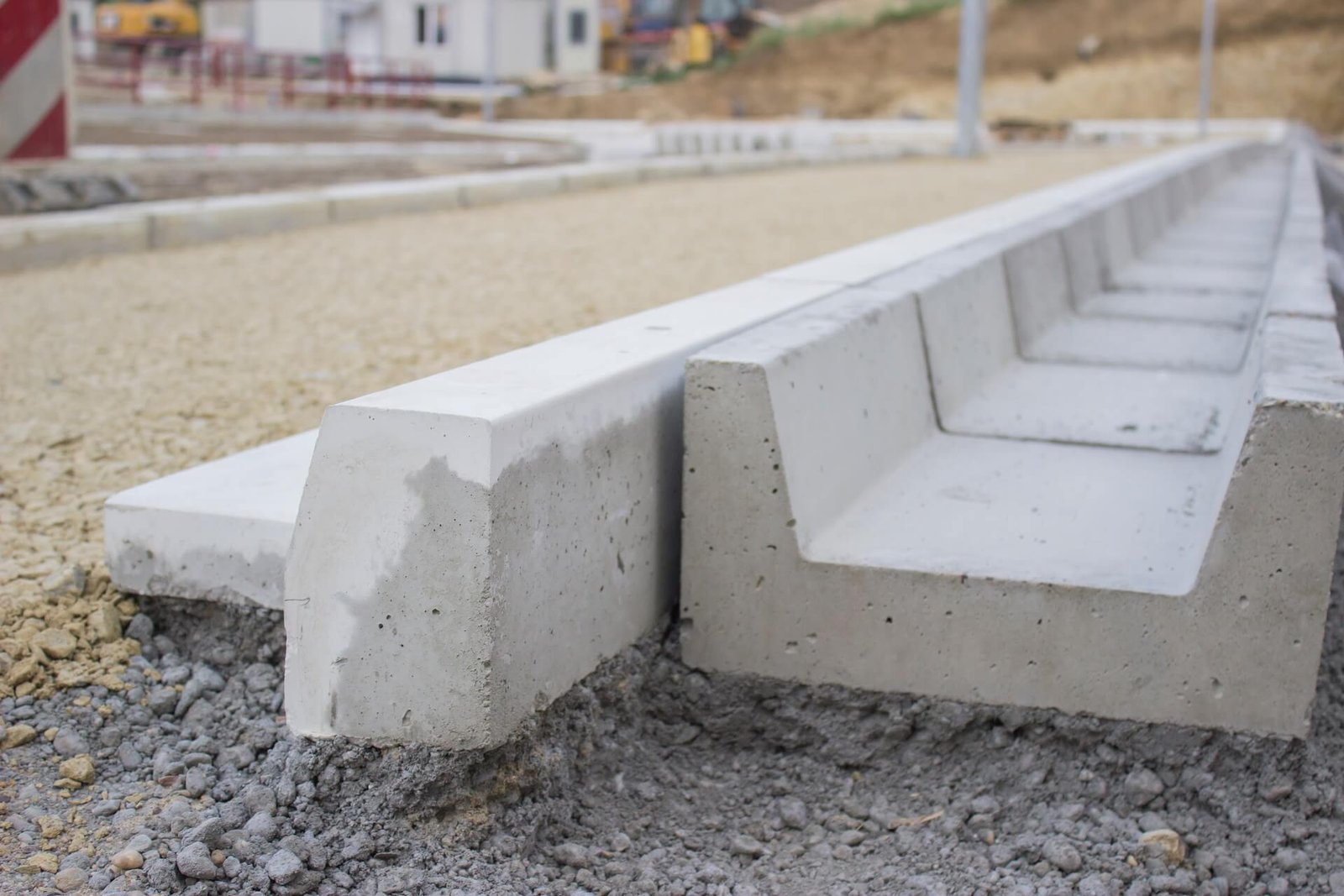

Water leaves a Texas parking lot in a hurry, and the curb and gutter decides where it goes. In a thunderstorm, a gutter line has to carry sheet flow to an inlet without ponding, overtopping the curb or undermining the pavement behind it, and it has to do that on a slope that may be only half a percent. That is why curb and gutter is some of the most grade-sensitive concrete on any site, and why a flowline that is off by a quarter inch shows up as a puddle after the first rain.
We build curb and gutter for streets, subdivisions, retail centers, industrial parks and public projects across Texas. Our trade partners place it with slipform machines on long straight runs and with hand forms around radii, islands, inlets and driveway returns. The geometry is ordinary. What takes experience is keeping the subgrade, the line and the grade in agreement over hundreds of feet, and making sure the curb is still doing its job after the pavement and landscaping have been built around it.
Curb types and where they are used
Barrier curb has a vertical or near-vertical face that keeps vehicles in the lane and defines the street edge, and it is the common choice along public roads. Mountable and rolled curb is used where vehicles need to cross, such as at drive entrances and in some commercial lots. A combined curb and gutter pours the curb and a gutter pan as a single section, which gives a smooth flow path to the inlet, and we also pour stand-alone curbs around islands and landscape beds.
On large developments, we install the curb as a sequence: subgrade is trimmed, the base is compacted, the line is staked by the surveyor, and the machine or forms run along the stakes. Dowels or tie bars are set at joints where the design requires, inlets and valley gutters are tied in, and the finish is broomed and cured. We coordinate the work with storm drain installation so that the inlets, throats and pipe invert elevations are in place before the curb crew arrives.
Standards and inspection
Most curb and gutter is built to the local standard detail, so the cross-section, concrete strength, joint spacing and base requirements come from the city, county or district that owns the street. Public projects add inspection hold points, usually at subgrade and before the pour, and we schedule our trade partners around the inspector's availability. On private projects the civil drawings govern, and they usually refer to the same city standards.
Drainage is also part of the regulatory picture. The Texas Water Development Board has completed its first state flood plan, built on 15 regional flood plans approved in March 2024, and local drainage criteria keep tightening as a result. For us that means careful attention to how curb inlets, gutters and valley sections hand water to the storm system, since an owner or city engineer will check those hand-offs closely.
Stormwater realities across the state
Flash flooding makes curb-and-gutter performance a safety matter in arid and semi-arid cities. In El Paso, a 2006 storm dropped a year's worth of rain in two days and caused more than $200 million in damage, including $115 million to the stormwater system, and the city created a stormwater utility in 2008 afterward. Developments there are laid out so that streets carry flow in the gutter rather than across lots, and we pay special attention to flowline continuity at inlets and to the strength of the section where drainage concentrates.
In places with proposed new freeway-style roadways, such as the main lanes TxDOT has proposed on Midland's Loop 250 with an overpass at Todd Drive and turnaround lanes, adjacent frontage and access streets need curb and gutter that meets the same standards as the main road. We read those plans closely so that our curb elevations match the roadway design and the future inlet locations.
Where the price comes from
Curb and gutter is priced by the linear foot, and the unit price depends on the curb type, the machine or hand-form method, the amount of base preparation and the number of radii and inlets. Long straight runs on open sites are the least expensive, because a slipform machine can place a great length in a day. Short runs, tight radii, driveway returns and existing utility conflicts force hand forming, which is slower and costs more.
Subgrade is a hidden cost. If a curb has to be set on soft clay or fill, over-excavation, lime treatment or extra base may be needed, and we recommend discussing it with the civil engineer during design. Road subgrade preparation done well makes everything above it cheaper, and we price that work separately so owners can see its effect.
Sequencing curb with the rest of the site
Curb comes after utilities and subgrade and before paving. On a typical commercial site, the underground storm and water lines are installed first, the pad and subgrade are trimmed, and the curb is placed once the lines have passed pressure and compaction tests. Paving and landscape follow, and the curb defines both.
We coordinate with commercial developers and general contractors on the release of areas, and we pour in segments that end at planned joints so that a rain interruption does not leave an unfinished run. Because flowlines are the sensitive element, we survey as-built elevations before moving on, and we share the readings with the site engineer. Retail and healthcare owners, such as those building medical office campuses, benefit from this because ponding at entries is a problem for accessible routes as much as a nuisance.
Need curb and gutter priced?
Send the civil plans and the quantities, or ask us to take them off the drawings. We will price the linear footage by type, call out the subgrade and inlet items that could change the number and propose a pour schedule that fits your paving date.
Common Questions
Is it better to use a curb machine or hand forms?
Machines are faster and cheaper on long, straight runs, and the output is consistent. Hand forms are better for radii, tight spaces and complex details around inlets. Most projects use both.
What slope does a gutter need so water does not pond?
Designers normally set a minimum flowline slope, often a fraction of a percent, but the exact number comes from the civil drawings. We hold the grade with survey stakes and laser checks and verify the finished gutter by running water or reading elevations before we accept it.
How do you prevent cracks in curb and gutter?
Properly spaced joints, adequate subgrade support and timely curing do most of the work. We tool or saw control joints soon after finishing, use dowels where needed and avoid placing curb on soft or wet subgrade.
Can curb be poured in extreme heat?
Yes, with precautions. We start early, order a mix that stays workable for the haul, apply curing compound promptly and shade or fog where needed so the surface does not dry too quickly.
Do you handle curb ramps and driveway returns too?
Yes. Curb ramps and driveway returns are poured with the same crews, and we check slopes before placement because they have to meet accessibility rules as well as drainage needs.