
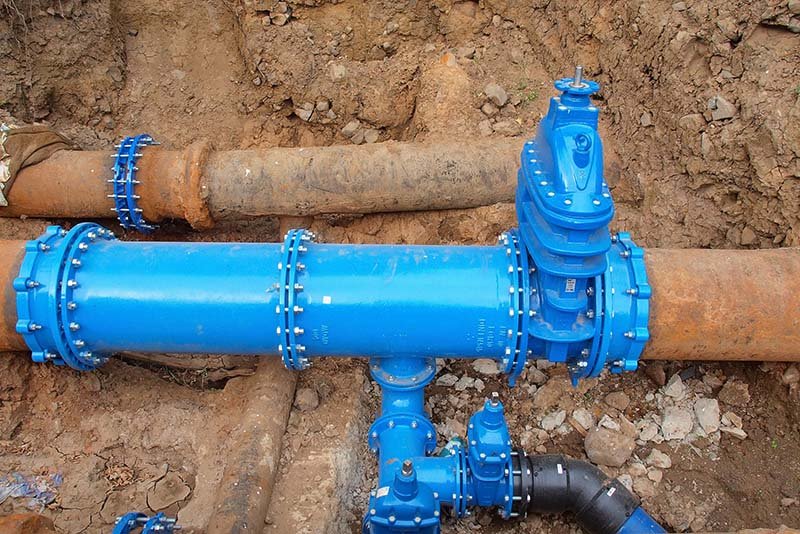

A water main fails in its fittings long before it fails in its pipe. Thrust blocks that were poured against loose spoil, a tee bedded on a soft pocket, a joint made up in a wet trench: these are the places where a new line leaks on pressure test, and they are the places we spend our attention. Water main installation is the work of laying domestic and fire-protection pipe from a public connection to a building pad, and doing it so the line passes inspection the first time.
We build water mains as one scope with the trenching, the concrete and the restoration around them. The same crew that cuts the trench sets the bedding, makes up the joints, pours the thrust restraint and backfills in lifts, so nobody is waiting on another trade to finish a step that decides whether the line holds pressure. The ground changes what that means. In the north, clay swells around a buried line and rewets unevenly. On the coast, groundwater arrives in the trench before the pipe does. In the west, caliche has to be broken out and replaced with bedding sand before a joint can be trusted.
Most of our water work serves new commercial, industrial and municipal sites, but we also tie into existing mains for expansions and for private fire service. Whoever owns the main, the standard is the same: a tested line, a clean record of what was installed, and a trench that does not settle under the pavement we pour above it.
What a water main package includes
The package starts with a utility plan and a conversation about where our line ends and the owner's begins. From there we handle trench excavation to the specified depth, pipe bedding and haunching, pipe laying in ductile iron or PVC as the drawings call for, fittings, gate valves, service taps and the thrust restraint at every bend, tee and dead end. We set valve boxes to final grade, which matters more than it sounds, because a box set low in a drive lane gets crushed and a box set high gets struck by a plow blade or a trailer.
Testing is part of the scope, not an afterthought. We flush, disinfect and pressure test to the owner's procedure, and bacteriological samples are taken on the schedule the utility sets. We keep the pressure test records with the as-built redlines so the closeout package is ready when the inspector asks. Surface restoration, whether new asphalt, concrete drive approach or seeded easement, is built by the same company, which keeps the warranty conversation short.
Standards, taps and inspection hold points
Water mains are built to the standards of the entity that will own them. A city public works department, a municipal utility district and a water supply corporation can each publish different pipe material lists, bedding details and testing durations, and a plan that was approved by one will not automatically satisfy another. We read the owner's standard details before we price, and we ask early about who performs the wet tap and whether the owner supplies the tapping sleeve or expects the contractor to.
Inspection runs on hold points. Bedding is inspected before the pipe goes in, the joints are observed before backfill, and the pressure test is witnessed before the line is accepted. A trench left open overnight over a hold point costs more than the inspection itself, so we schedule the inspector the way we schedule the concrete truck. For projects with state or federal money, expect additional submittal requirements on pipe origin and on certified payroll, and plan the procurement lead time for ductile iron fittings accordingly.
What moves the price of a water line
Depth, ground and restoration decide most of the number. A line at four feet in stable soil is a different job from a line at eight feet in running sand that needs shoring or dewatering. Rock or caliche adds production time at every foot, and pavement cut and replacement on a public street can approach the cost of the pipe itself. We price the restoration line honestly, because a low trench number with a thin restoration allowance is how owners end up with change orders.
Public funding is changing the market. Texas voters approved a constitutional amendment in November 2025 that sets aside up to $1 billion a year, starting in 2027, for water supply and related work including pipe repair, reuse and flood mitigation, administered by the Texas Water Development Board. For owners planning a water extension, that flow of money is a reason to get design and easements settled now, since utilities that line up funded work will be competing for the same pipe, fittings and crews.
How we sequence a water line in the field
We stage the work in short open lengths. A crew that opens six hundred feet of trench and lays pipe in the afternoon sun is gambling with the weather, with the neighbors and with the inspector. We prefer to open what we can lay, test and backfill within the same day or two, and to keep the pipe and fittings staged on the site before the excavator mobilizes, not after. Trench boxes or sloping go in the same day the trench opens, and every excavation gets a competent-person inspection before anyone enters.
Backfill is where a line becomes part of the site. Granular bedding goes around the pipe, select material above it, and the rest is placed in compacted lifts, tested to the density the geotechnical report or the owner requires. Under a future slab or pavement, the trench is the first place settlement shows up, so we treat trench backfill with the same discipline as the building pad, and we coordinate it with the building pad preparation crew when the two meet. Where a fire line branches off, we hand off to our fire line and hydrant work without a second mobilization.
Water work across the Texas map
Industrial parks that already advertise utilities change the scope. One 1,655-acre park on FM 3083 two miles east of I-45 in Conroe is described as having four-lane concrete streets with city water and sewer, which means a tenant's work is mostly a lateral and a meter set rather than a main extension. Parcels that lack that infrastructure carry the whole cost of the extension, and that cost belongs in the land evaluation, not in the budget after closing.
In arid parts of the state the water issue reverses. The Wikipedia entry for Pecos in the Permian Basin describes a semiarid to desert city on I-20 receiving roughly 10.48 inches of rain a year, which is a reminder that supply, not just distribution, shapes development there. We take water service work to the Permian Basin, to the coast and to the Rio Grande Valley, and we serve municipal and public works owners and commercial developers who need water built to a schedule.
Price a water line with us
Send the utility plan and the owner's standard details and we will walk through the tap, the test and the restoration with you before we write a number. Early input usually removes a change order.
Common Questions
Who is responsible for the wet tap and the meter?
It depends on the owner of the main. Some utilities perform the tap with their own crews and charge a fee, others require the contractor to supply a certified tapper under inspection. We confirm this in writing before pricing and carry the tap, the sleeve and the valve as explicit line items so there is no surprise at the connection.
How long does a pressure test and disinfection cycle take?
The test itself usually runs a few hours at the specified pressure, but disinfection, flushing and the laboratory results add days. Bacteriological samples often need a full day or more to read, and a failed sample restarts the cycle. We plan the water line to finish well ahead of the building schedule so occupancy does not wait on lab results.
Can you install a water line before the building permit is issued?
Sometimes, if the utility plan has been approved separately and the owner has a permitted extension. Many cities review the site utility plan on a different track from the building permit. We help sort out which approvals are in hand, because starting a public main without them risks a stop-work order and re-inspection.
What happens if we hit groundwater or rock in the trench?
Groundwater is handled with sumps or well points, depending on the volume, and rock is cut with a hydraulic hammer or broken out with a larger excavator. Both are covered by unit prices or by the geotechnical allowances in a well-written bid. We ask for the soil report during estimating so the unforeseen condition clause has something specific behind it.
Do you also restore the pavement and landscaping afterward?
Yes. Asphalt patches, concrete aprons, curb repairs and seeding are part of our package so the cut is closed by one party. Public streets usually require restoration to the owner-city standard, and we schedule pavement work for the weather window that gives that patch the best chance of holding.