
Industrial users choosing a lot in Conroe usually want one thing from a site contractor: a graded, drained, utility-ready pad with concrete that can take a truck fleet, delivered while the building permit is still moving. We grade lots, bring water, sewer and storm lines to the building, and pour dock aprons, truck courts and slabs that hold up to heavy wheel loads.
The setting favors that kind of work. Conroe Park North, in the words of the Conroe Economic Development Council, is an industrial park of 1,655 acres on FM 3083, two miles east of Interstate 45, with four-lane concrete streets, city water and sewer, more than 40 companies and over 3,000 employees. A large distribution center on 72 acres and a service center on 25 acres are listed among its recent projects. Another park, a 248-acre technology park off FM 1484, sits near the regional airport for owners who need lab and light manufacturing space.
We build for both, starting with the soil report and ending with a cure that lasts. The variety inside a single county is the reason a one-size slab design rarely works.
Lots, pads and concrete from the street in
A typical park lot begins at the street. We build the driveway apron to the city standard, cut the entrance to match the existing concrete street, and bring service lines in without damaging the pavement. Inside the lot, we clear, strip, grade to the civil plan and compact the building pad before we form the footings. Detention is shaped as the grading proceeds, so the site drains from day one.
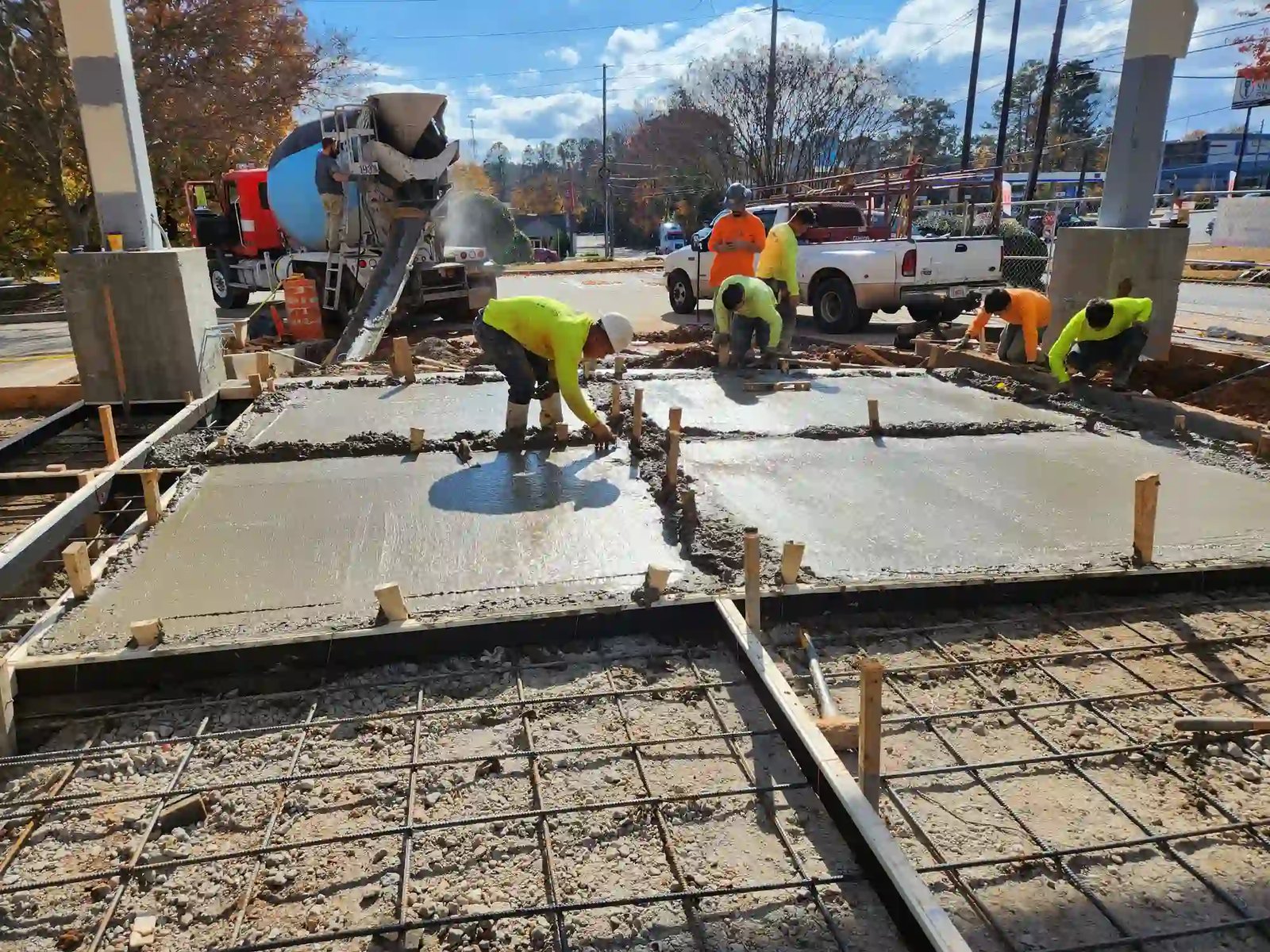
The concrete scope is heavy. Large-format distribution buildings need tens of thousands of square feet of slab and a wide apron where trailers back in, and the truck court and dock apron crews we coordinate pour reinforced panels with doweled joints to keep trailer landing gear from punching through. For buyers who want a sturdier surface, we also place concrete paving across drive lanes and staging areas.
Rail, highway and two kinds of park
Conroe's geography offers owners options. Interstate 45 links the city to Houston to the south, a distance a general reference puts at about 40 miles, and Loop 336 circles the city. Rail adds another layer: one railroad operates an east-west main line while another runs north from Houston, and the two cross at a diamond in downtown Conroe. These descriptions come from a general reference, so we verify rail access and crossing rules for any given parcel with the operator.
For concrete, rail proximity means spur construction, loading pads and heavy-haul pavements; for logistics owners it means a decision about whether to build to the railroad or to the highway. Our team works with logistics and warehouse developers to settle that question early, before the first grade stake is driven.
Reading the clay before pouring on it
Montgomery County sites differ from one lot to the next, and the geotechnical borings are the first honest picture of what is underneath. We look at plasticity index, moisture content and the depth of any sandy layers, then decide with the engineer whether to over-excavate, treat with lime or simply proof-roll and place select fill. Each method has a cure time, and we put that time on the schedule so nobody is surprised.
Once the pad is accepted, we form and pour in an order that keeps the crew productive and the cure uniform. Slabs are cut with early-entry saws as soon as the surface will take it, curing compound goes on right behind the finishers, and cylinders are cast for the testing lab. A truck-court slab that is cut late will crack where it pleases, so we cut on time.
Working with a city and park standards
Parks that already have concrete streets, city water and sewer reduce the unknowns on a lot, but they also carry design standards for driveways, easements and landscaping. We review the park's covenants, the city's utility connection rules and the drainage criteria before we bid, because a hydrant relocation or a pond resize discovered late costs time.
Texas leaves commercial building code adoption to each municipality, starting from an International Building Code baseline with local amendments, and the state accessibility program reviews projects of $50,000 or more against the Texas Accessibility Standards. We confirm all of that at the start and build to what is adopted.
Sequencing a pad for an owner on a deadline
Distribution tenants often sign leases against a delivery date, and everything depends on how quickly the pad and slab can be placed. We overlap work wherever the plans allow: pond excavation while utilities are laid, subgrade proofing while rebar is delivered, and slab pours in alternating bays so panel crews can begin early.
Weather is the main risk. A wet week in southeast Texas can idle a clay site, so we keep haul roads graveled, pump stormwater from the pad and protect treated subgrade with a sealed surface before storms. When the schedule slips, we reshuffle crews to other open work in The Woodlands or Cypress to keep them productive.
Pairing park work with utilities and earthwork
Many owners buy a package: building pad preparation, the underground, and the paving. Combining them reduces the number of contractors on a small site and shortens the critical path. For municipal and public works customers who need extensions of water or sewer to new parks, our municipal and public works experience means we know how to document pipe, backfill and testing for a city inspector.
What owners should compare in a Conroe bid
Compare soil treatment, import fill and slab thickness first. Lime treatment of a clay subgrade adds cost but can reduce slab thickness or reduce repair risk, and the right answer depends on the geotechnical report. Compare haul: if the site needs fill, ask where it comes from and how it will be tested.
Then look at the underground. A lot at the end of a water line may need a longer extension than one near the main, and a deeper sewer can add shoring and dewatering. Our sanitary sewer installation scopes list pipe depth, bedding and manhole counts, so apples-to-apples comparison is possible.
Start your Conroe project
Send us the park, the lot size and the building program. We will review the site plan with you and lay out grading, utilities, paving and slab work so the pad is ready when your steel or panels are.
Common Questions
Do you build in parks that already have concrete streets?
Yes. We cut and match driveway entrances, protect existing pavement, and use the park's utility stubs where available. Our trade partners take care with saw cuts, joint locations and curb returns so the new work blends with the street.
What is a realistic timeline from grading to slab?
Depending on lot size and soil, mass grading, utilities and pad compaction often take several weeks, followed by footings and slab. Weather can change that, so we give a range and update it weekly as the geotechnical results come in.
How do truck court slabs differ from interior slabs?
They are designed for concentrated wheel and landing gear loads, often thicker with dowels at joints and a stronger subbase. We follow the engineer's design and focus on subgrade uniformity, which is where most failures begin.
Can you handle a site near the regional airport?
Yes, with attention to any height or lighting restrictions and the owner's requirements. Airport-adjacent parks often have tighter lighting, dust and equipment-height rules, and we plan crane and lift activity accordingly.