
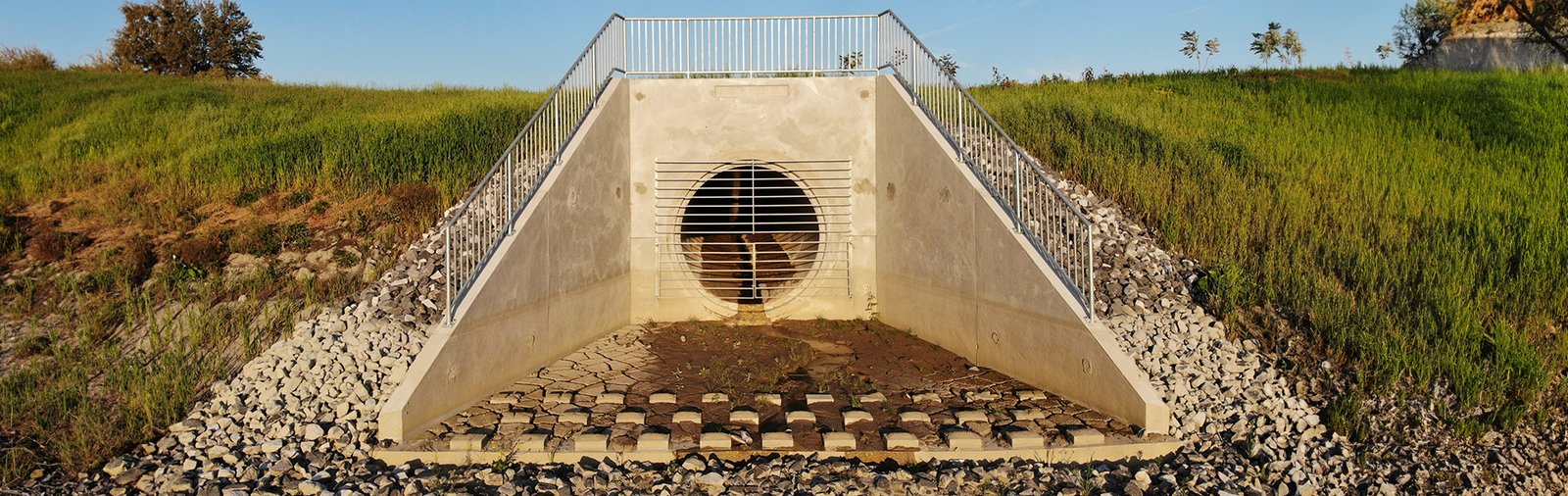

In De Witt County, the county maintains 690 miles of road, and a 2026 report from the Texas Association of Counties says repairs there can cost as much as $1 million per mile. Much of that cost is water: ditches that overtop, pipes that wash out, and road edges that fail where a culvert has lost its headwall. A culvert is a short span of pipe or box carrying water under a road, drive or rail, and the headwall is the concrete or masonry face that holds the pipe end, the soil and the flow in place. Small structures, they do most of the work of keeping a road open in the rain.
We build culverts and headwalls for private drives and plant roads, county and municipal roads, drainage channels, and industrial sites where truck traffic crosses ditches. Our trade partners excavate, set pipe or precast box sections, form and pour concrete headwalls, wingwalls and aprons, and restore the road surface above. The work looks simple on a plan. In the field it depends on bedding, cover, flow line and erosion protection, each of which can fail quietly for years before a storm exposes it.
Where culverts earn their keep
Road building is the major source of culvert work in Texas. TxDOT describes the Lubbock Loop 88 project as about 12.4 miles west of US 84, converting two-lane rural roadway to an access-controlled six-lane divided freeway with frontage roads. Every drainage crossing along a corridor like that is a culvert or bridge-class structure sized to the watershed, and new frontage roads add more crossings. Sections of the project completed in April 2026 and a final section scheduled to start in fall 2026 show how long a corridor can take, and how drainage structures are sequenced with the road.
Drought country matters as much as wet country. One north-central Texas city recorded 100 days at or above 100 F in 2011 during a multiyear drought, and the same city's records note an 1886 flood that destroyed the original waterfall on its river. Both facts are the same lesson: in North Texas, dry creek beds can carry a very large flow with little warning, and culverts built for the dry years fail in the wet one. We build to the design storm, and we recommend wider apron protection where the flow arrives fast.
Pipe, box, headwall, wingwall and apron
A culvert installation starts with the flow line. The invert elevation at each end determines whether water moves or stands, so we set the excavation to grade and place bedding to carry the pipe uniformly. We install reinforced concrete pipe, corrugated metal, HDPE or precast box culverts, selected for the load and the cover. Pipe joints are sealed or gasketed, and the pipe is backfilled in lifts with select material before the road base goes on.
The headwall holds everything together. We form and pour concrete headwalls with wingwalls that retain the road embankment around the pipe end, add aprons at the base to prevent undercutting, and place riprap or concrete lining where the flow leaves the structure. Where precast end sections are specified, we set them with grouted connections. Larger structures may include safety grates, cutoff walls and energy dissipation. Our trade partners coordinate with the storm drain and detention and retention work that feeds or receives the culvert.
Hydraulics, permits and who approves them
A culvert is a hydraulic structure, and the engineer sizes it for a design storm using the drainage area, the slope and the allowable headwater. For a county or state road, the road authority sets the design storm, pipe materials and end treatments. Crossing a creek or stream can require a floodplain permit and, for larger streams, federal and state environmental review.
We read these requirements before pricing. A culvert in a regulated floodway often needs a no-rise certification, which means the structure cannot raise the flood elevation, and that can force a larger opening or a box section instead of pipe. Standards for headwall geometry, cover and end treatment differ between agencies, so we use the standard drawings of the owning agency for the work in its right of way. For municipal and public works projects, we also provide testing and material certifications with each pay request.
Working in creeks and beside traffic
Culvert sites combine moving water with moving traffic. Before work starts in a flowing channel, we plan the diversion: a bypass pipe, a pump, a cofferdam or full dewatering that keeps the work area dry. We watch the weather, because a storm upstream can send water to a work area in minutes. Equipment is parked above the flood line, and the crew has a clear exit route from the channel.
Where the culvert crosses a live road, traffic control is part of the scope. We build the crossing in halves, keeping a lane open, or detour the traffic when the owner permits. Open trenches are protected with plates or barriers, and crossings are reopened to traffic at the end of each shift. Worker safety in the excavation follows the same sloping and shoring rules as any utility trench.
Build the crossing so it lasts through the first flood
Failures usually begin at the ends. Water undermines the apron, the soil behind the wingwall erodes, and the pipe end drops. We prevent that by setting the cutoff wall below scour depth, extending the apron beyond the expected turbulence zone and placing riprap sized to the velocity. The soil under the headwall is compacted to avoid settlement, and the connection between pipe and headwall is sealed so water cannot travel along the outside of the pipe.
The road above the culvert needs the same attention. Backfill over the pipe is compacted in thin lifts, and the road base and surface are placed only after the compaction test is passed. For heavy truck roads at oilfield and industrial sites, we increase the cover or specify concrete-encased pipe where cover is shallow. Heavy loading over thin cover is the cause of many broken culverts, and it is easier to prevent than to repair. We often work with oil, gas and midstream owners on lease roads and pad entrances where these conditions are the norm.
Review the crossings on your plan
Send the drainage plan and the list of crossings and we will review pipe size, cover and end treatment with you before pricing the work.
Common Questions
What size culvert do I need?
The size depends on the drainage area, rainfall, slope and the allowable headwater at the road. An engineer calculates it, usually to a design storm set by the road authority. We can review the proposed size and suggest changes where field conditions differ from the plan, such as a ditch that has grown since the survey.
Is a headwall always required?
Not always, but it is common for larger pipes, steep embankments and areas with fast flow. A headwall protects the pipe end, retains the soil and guides the flow. For small private drives, a mitered end or precast end section may be allowed. The owner or road authority decides.
How long does a culvert installation take?
A small pipe crossing can be done in a day or two, while a large box culvert with wingwalls and aprons can take several weeks including concrete cure time. Weather and flow in the channel control the schedule. We schedule installation in dry periods when we can.
How do you keep a road open during culvert replacement?
We stage the work in halves with a lane open, use temporary bypass pipes for flow, or detour traffic when the owner allows. Each approach is described in the traffic control plan, and the chosen method depends on the road class and traffic volume.
Can you repair or extend an existing culvert?
Yes. Extensions use matching pipe and a new headwall. Repairs may include relining, grouting voids or replacing a failed end section. We inspect the existing structure first, because the condition of the old pipe determines whether extension or replacement makes sense.