
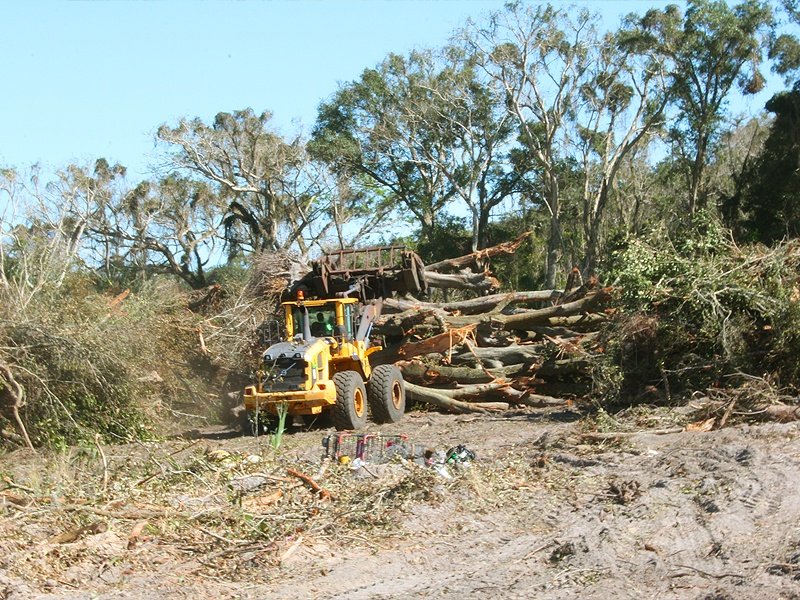

Before a single tree comes down on a parcel in the Georgetown area, someone should ask what lives there. The city's published geography lists five endangered species within its area, and a county-wide incidental take permit was obtained in October 2008 to deal with them. Not every Texas site carries that constraint, but any raw acreage can hold protected habitat, mature oaks that the city wants saved, old fence lines, buried trash and the stump holes of an earlier clearing. Site clearing and grubbing removes vegetation, roots and debris from a parcel so that grading, utilities and foundations can start on ground that is actually ready.
Clearing takes down trees and brush at the surface. Grubbing goes further, pulling stumps and root masses out of the soil, because a root left under a slab or a pavement rots, leaves a void and lets the ground settle. We do both, and we dispose of the material in the way the permit and the owner allow: chipping, mulching, burning where legal, or hauling off.
Raw land across the state looks different
The vegetation we clear depends on the region. Fort Worth sits in the Cross Timbers, in the Grand Prairie ecoregion, where oak and juniper cover rolling ground, and the same city sits over the Barnett Shale, with more than 1,000 gas wells counted in late 2009 and individual well sites taking up about 2 to 5 acres each. Clearing there can mean working around old well pads, pipeline corridors and access roads, as well as trees. In coastal and East Texas, dense pine, brush and wetlands can dominate, while in West Texas mesquite and scrub are the main problem.
Large industrial sites bring their own scale. In New Braunfels, the city council in June 2024 approved $20 million for its economic development corporation to buy up to 100 acres of a 240-acre tract at Kohlenberg Road and FM 1101 for future industrial, commercial or institutional use. Land like that has to be cleared, surveyed and graded before it can be marketed to a tenant, and clearing is the first line in the site budget.
Felling, grubbing, stockpiling and haul
The work starts with a survey of the limits of disturbance. Trees to be saved are marked and fenced at the drip line so equipment does not compact their roots, and silt fence goes up on the downhill side before we move any dirt. Brush and trees are cut, larger trees are felled and cut to length, and stumps are pulled with an excavator or ground out with a stump grinder when the plan allows grinding in place.
Grubbing digs out the roots to the depth the geotechnical report requires, often one to two feet below grade, and the resulting holes are backfilled with compacted fill. Debris is sorted: clean wood goes to chippers or mulch, brush is stockpiled or hauled, and trash and old structures go to a landfill. Topsoil is stripped and stockpiled for reuse where the plan calls for it, which ties the job to our mass grading operations.
Protected species, tree ordinances and burn rules
Clearing is regulated in more ways than most owners expect. Cities adopt tree preservation ordinances that limit removal of mature trees and require mitigation plantings. Federal and state rules protect habitat for listed species, and some counties have a habitat conservation plan that spells out what an owner may do. Work near a creek or wetland can involve a floodplain permit and a separate federal review. Construction itself requires erosion and sediment control measures installed before disturbance.
We ask for these approvals before we mobilize and we check the permitted limits against what is staked on the ground. Where nesting season limits the dates for clearing, we plan around it. Open burning is restricted in many cities and during dry periods in most of the state, so the disposal method is confirmed with the fire marshal. We will not start clearing on a site where a required permit is missing.
Decisions that save money later
Three choices shape the cost. The first is the clearing limit: clearing only what the building and the utilities need keeps more trees, protects more soil and cuts disposal volumes. The second is the disposal method. Mulching on site is usually cheapest and gives the owner a ground cover for erosion control, while hauling wood to a landfill is expensive and sometimes restricted. The third is stump depth and backfill: a shallow grub leaves roots that can cause settlement, and an overly deep one leaves a large volume of fill to compact.
It also pays to clear early. Clearing in the winter or dry season reduces mud, makes access easier and lets the geotechnical drilling crew see the true ground surface. We coordinate with the engineer so borings and survey follow clearing, and we recommend an early walk of the site to flag old foundations, septic tanks, wells and buried utilities before the dozers arrive. Our potholing and locating work helps there.
Chain saws, felled trees and moving machines
Tree work is among the more dangerous jobs on a site, because trees do not always fall where they are aimed. We use trained fellers, establish drop zones with a clear radius and keep other workers out of them. Equipment operators work from the machine with spotters on the ground, and powerline clearances apply to every tree near a conductor. Where a tree leans toward a line or a building, we use directional cutting, rigging or a crane rather than gambling on a fall.
Fire is a real risk in dry months. Hot work and equipment exhaust can ignite dry brush, so we keep water and extinguishers available and watch the weather. In dusty conditions, we water roads to limit dust and wear respiratory protection when stump grinding. Snakes, wasps and old wells or cisterns are other hazards that a walk of the site often reveals before work begins.
What clearing costs depend on
The density of vegetation and the size of the trees are the main variables. A site with scattered mesquite is a very different job from one with hundreds of large oaks and a dense understory. Terrain affects production, and wet ground can slow equipment or require mats. Disposal can account for a large fraction of the cost, particularly where mulch cannot stay on site.
Owners can control cost by defining the clearing limit early and by deciding what they want to keep. Selective clearing for homebuilders and multifamily developers costs more per acre than clear-cutting but may add value to lots. For logistics and warehouse developers who need every acre of a large pad, clear-cut and grub is the standard, and a clean, accurate bid helps the schedule move. We provide unit prices by acre or by tree size so changes in scope can be priced fairly.
Walk the parcel with us
Send the survey and the proposed limits of disturbance and we will tell you what we expect to find, what it will take to clear and how to keep disposal costs down.
Common Questions
What is the difference between clearing and grubbing?
Clearing removes trees, brush and surface vegetation. Grubbing removes stumps and roots below the surface, usually to a specified depth. A site headed for a slab or pavement needs both, because buried roots decay and cause settlement.
Do I need a permit to clear my land?
It depends on location and conditions. Many cities regulate tree removal, and work near streams, wetlands or habitat for protected species can need extra approvals. Construction stormwater controls apply to most disturbed sites. We recommend asking the city early and confirming the answer in writing.
Can you reuse the cleared material on site?
Often yes. Chipped brush becomes mulch for erosion control, topsoil is stockpiled for final landscaping and clean wood can be milled or hauled to a recycler. The plan or the permit may limit some options, so we confirm what is allowed.
When is the best time of year to clear?
Dry weather is the easiest for equipment and for erosion control. Some areas restrict clearing during bird nesting or bat roosting seasons, and fire risk rises in summer and fall. We build the schedule from those constraints and the owner's deadline.
How deep do you grub stumps and roots?
Usually to the depth the geotechnical report or the plan specifies, often a foot or two below grade. Roots deeper than that are left unless they are large. The holes are filled with compacted material so the grade is stable for the building or pavement.