
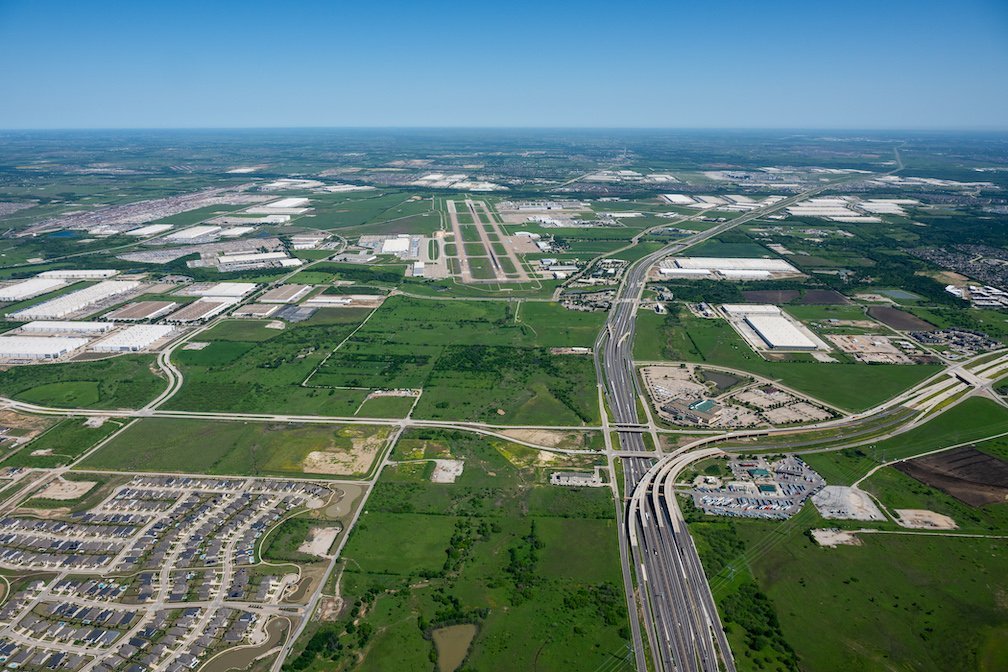
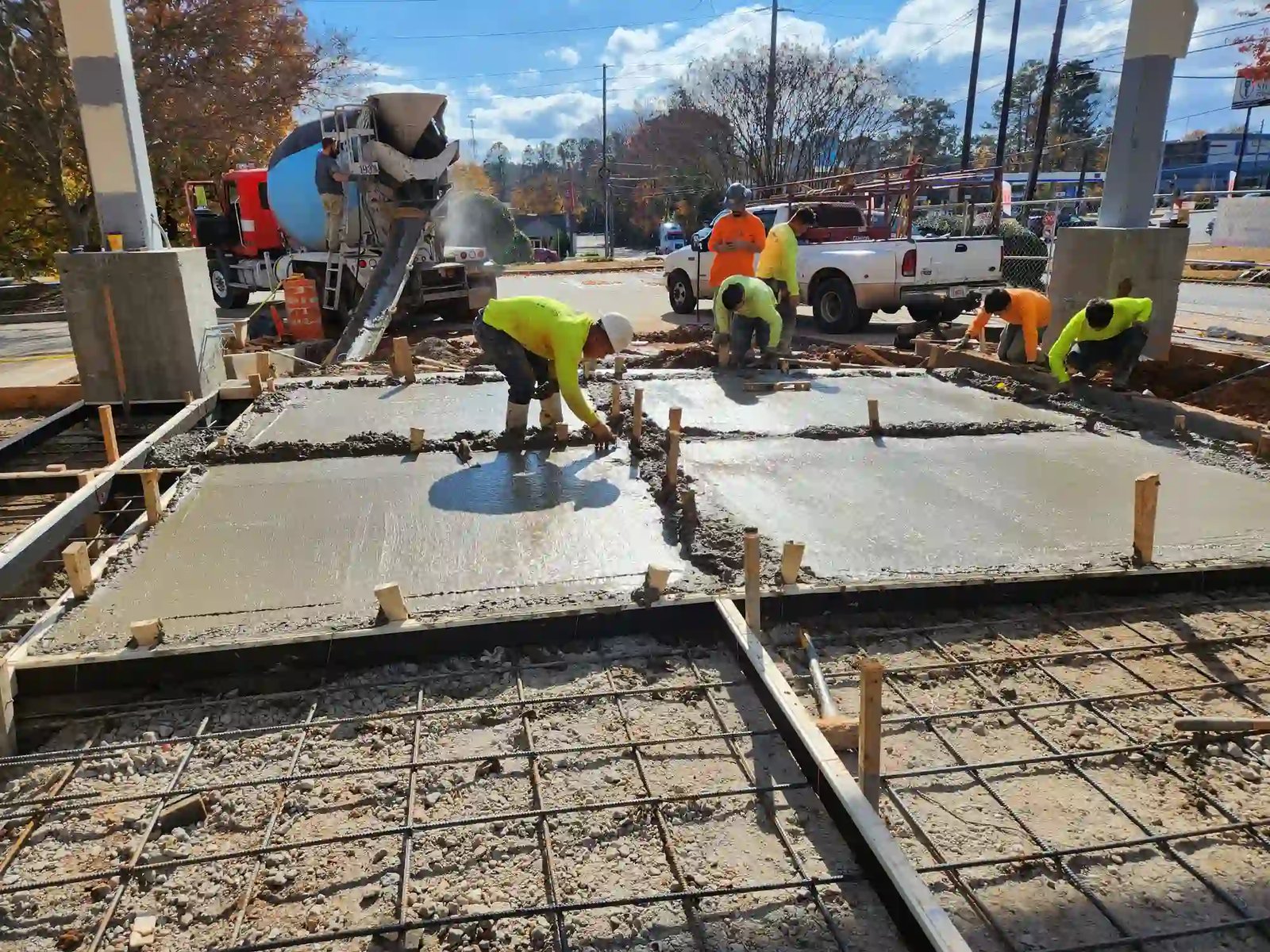
Airfield pavement and big-box logistics floors share one address at Alliance, and we build for both kinds of owner: the apron slab that carries freighter wheel loads and the tilt-up warehouse floor that carries forklifts around the clock. Our trade partners place the concrete, prepare the subgrade and install the underground systems, working around the live traffic that defines this part of Fort Worth.
The scale is the first thing a new contractor notices. Hillwood reports that AllianceTexas, a master-planned development on 27,000 acres, has produced more than 73,000 jobs and an estimated $142.9 billion in regional economic impact since it began, with industrial, logistics, corporate office, retail, aviation and multifamily uses. Those are the developer's own figures, but the physical reality is easy to see: long haul roads, large pads and repeated building types.
For a contractor, scale means repetition, and repetition rewards a crew that has a method. We put a consistent team on a site, build quality checks into every pour and carry lessons from one building to the next so that the fifth floor is better than the first.
Production pours and phased pads
Large logistics pads are usually poured in strips, with a laser screed or a placing machine, and the rate of the pour decides the schedule. A crew that can place several hundred cubic yards a day needs a matching supply of trucks, a flow of rebar and dowels and a place to wash out. We write that into a pour plan with truck counts, cycle times and backup suppliers.
For developers building multiple buildings at once, we stagger crews so pad preparation, utilities and slabs move across the park in order. That keeps each trade working without waiting for the one before it, and it makes the cost of the next building more predictable.
What we run with our trade partners
We manage grading, utility installation, forming, reinforcing, placing, finishing and sawcutting. Grading is trimmed with machine control, and our superintendents check elevations before each pour. Floors are finished to the flatness the specification requires, and cured so they stay flat.
Industrial parks also need things the buildings do not: drainage channels, detention basins, dock aprons and trailer parking. We build those in the same program, so a developer can look at the site as one scope instead of five.
Warehouses, hangars and truck terminals
Opened on December 14, 1989, Fort Worth Alliance Airport spans 1,198 acres with two concrete runways, 16L/34R at 11,000 by 150 feet and 16R/34L at 11,125 by 150 feet; the City of Fort Worth owns it and Alliance Air Services, a subsidiary of Hillwood Development, manages it. Airside concrete in this setting follows aviation standards, and work next to it includes aircraft hangar floors, ramp pavement and cargo aprons.
On the landside, the typical program is warehouse shells, truck terminals and cross-docks and distribution facilities. Cross-docks have the hardest pavement demands because trailers pivot on landing gear all day, and we design details with the engineer to handle that load.
Airport-adjacent rules
At Fort Worth Alliance Airport, FedEx runs a southwest regional sorting hub, the Amazon Air hub began on October 2, 2019, and Bell Helicopter Textron has a customer acceptance center. Work near an airport with cargo hubs carries rules for crane height, lighting, security and foreign object debris. We review these requirements with the owner and the airport operator before mobilizing, and we keep our trade partners briefed.
Four airports sit inside the Fort Worth city limits: Fort Worth Alliance Airport, Meacham International, Spinks and Naval Air Station Joint Reserve Base Fort Worth. Any project near an airfield may need an airspace review, and we tell owners early if a pump boom or a crane could be affected so the design team can plan. Documentation is part of our job, and we keep it ready.
Drainage and base preparation
Large pavements fail from the bottom up, and the base is where we put our attention. We proof roll, test density, treat soft soil with lime or cement when the report calls for it and check grades before the base goes down. We also plan drainage carefully, because water under a pavement is the quickest way to shorten its life.
Joints are the second concern. We follow the engineer's layout, set dowels accurately and saw early. We seal joints where specified and inspect the pavement after the first season so small issues are corrected before they spread.
What shapes the price of a big pavement
Volume is the main driver, but thickness, reinforcement and haul distance follow closely. A modest change in slab thickness across a large yard adds up quickly, so we ask the engineer to confirm the loading before we price an alternative. Our estimates show cost by area, so owners can see which parts of the site carry the most expense.
Mobilization and supply also matter. A large pour needs reliable plant output and enough finishing labor, and we make arrangements early. We tell owners when a long-lead item, such as dowel baskets or special curing compound, needs ordering before the schedule starts, and we link our work to the broader commercial concrete contractor scope on the project.
Talk about your Alliance site
Share the drawings and the loading criteria and we will return a production plan and a price broken out by area. Owners who are comparing contractors can also see how we serve logistics and warehouse developers.
Common Questions
Can you place airfield-quality concrete?
We place concrete to the project specification, including airport pavement specifications when the owner requires them. Mix design, joint layout, grade tolerances and testing are defined by the engineer, and we follow them closely. Airport rules for equipment and personnel on the airfield are handled with the airport operator.
How do you manage production on a large logistics pad?
We use a pour plan with strip widths, truck cycles and finishing crew sizes. A laser screed or a placing machine sets the pace, and a second crew handles sawcutting and curing. We review the plan against the weather forecast each day.
Do you coordinate with the master developer?
Yes. A master developer often has design standards, approved suppliers and sequencing rules. We read those documents before bid and follow them, and we communicate with the developer's project manager when the schedule or the site conditions change.
What testing is typical for a big warehouse floor?
Subgrade density, slump, air content, cylinder breaks and often floor flatness and levelness measurements. We coordinate the lab, share results quickly and keep the records by pour. If a result is outside the specification, we tell the engineer at once.
Are you able to work in more than one park at the same time?
Yes. We maintain separate crews for large simultaneous jobs and rotate equipment as needed. Projects in nearby Fort Worth and Denton can share management and lab relationships.