

A truck manufacturer, two universities and a municipal electric utility pull Denton's concrete work in three directions at once, and we build for all three: heavy industrial floors that carry chassis and press loads, campus slabs and plazas that must be ready before a semester starts, and the pipe, vaults and duct banks that a public utility needs buried correctly the first time.
Our trade partners handle the earthwork, the underground and the concrete on each. We strip and grade, set the utilities, prepare a stable subgrade and then place the structure. That continuity matters in Denton, where soil can change from one end of a large site to the other, and one crew that understands the whole sequence adjusts as the soil changes.
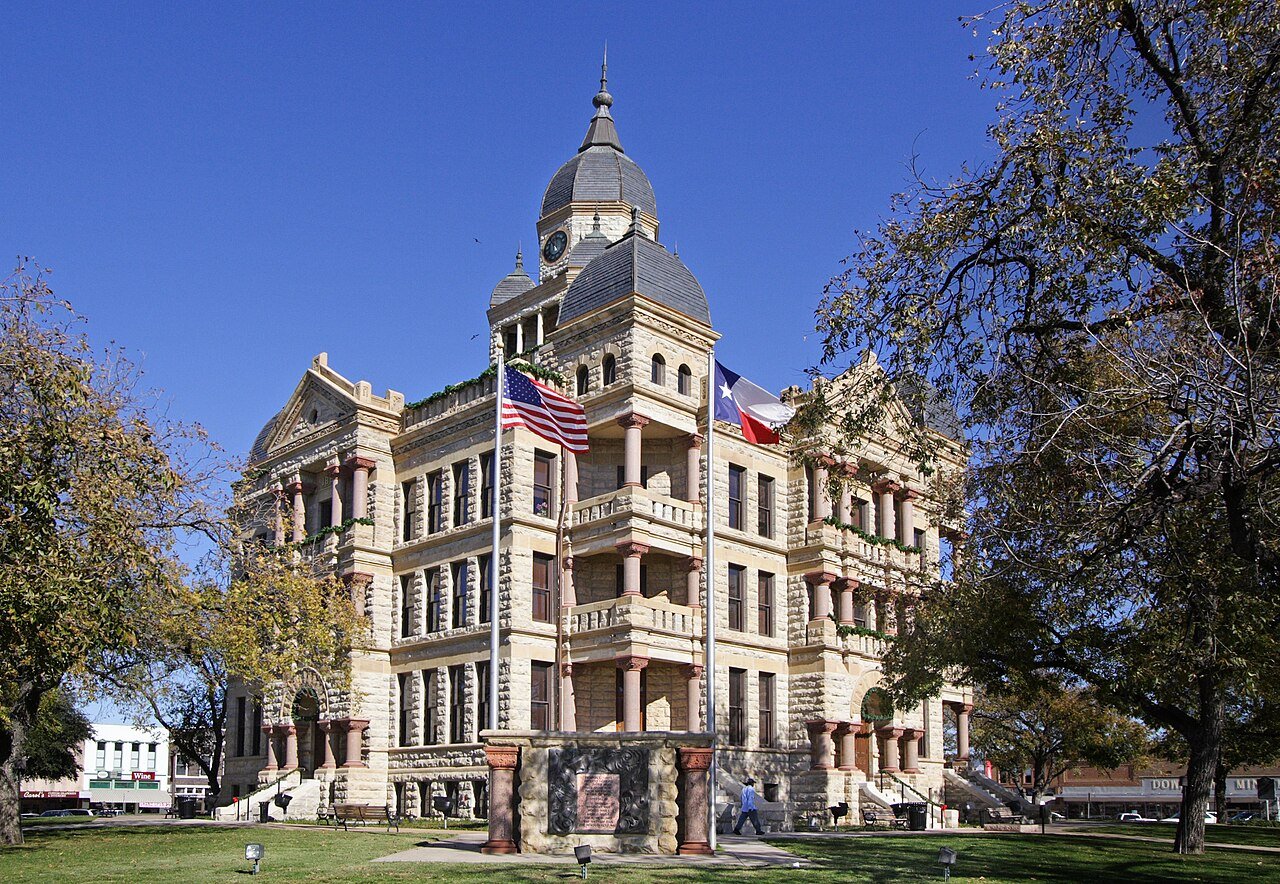
Developers and general contractors bring us to Denton because the city has real demand, but also real constraints: floodplain creeks, university calendars and a downtown square that is still an active place of business. We plan around all of them.
Starting from the soil and ending at the cure
We begin with the geotechnical report and a site walk, then set up a testing plan for subgrade density and moisture. If the report calls for lime or cement treatment of clay, we mix and compact it in lifts and verify it before base is placed. Proof rolling with a loaded truck then shows any soft spots, and we repair those before they become cracks in a finished slab. If it calls for a soil swap, we haul out and bring in engineered fill with documented testing.
After the pad is ready, our forming and rebar trade partners take over. We use chairs, spacers and cover checks on every placement, set joints to the engineer's layout and cure the slab with compound or wet covering as the specification requires. A mat of well-placed steel and a controlled cure give a slab that stays flat and tight for years of forklift and truck traffic. Saw cuts go in early, within hours of finishing, so shrinkage cracks follow the joint instead of the middle of a panel.
Highways, rail and the people who use them
The two branches, I-35E and I-35W, divide at Hillsboro and come back together near the UNT campus in southwest Denton as I-35; Loop 288 curves around part of the city, US 77 and US 377 pass the historic town square, and US 380 ties Denton to Frisco and McKinney on the east and Decatur on the west. That system supports logistics and manufacturing, and it creates a traffic pattern that we need to understand when planning haul routes. A truck that has to cross the square at noon is a bad idea, so we route around it and set delivery windows with the site contact.
Five DCTA A-train stations serve Denton, and the line meets DART's Green Line at Trinity Mills Station; the Downtown Denton Transit Center and Medpark Station both came online in 2011. Station-area projects bring sidewalks, plazas and parking, often with tight right-of-way and rail-agency coordination. We build that kind of sidewalk and flatwork and coordinate the crossing and flagging requirements.
What drives price on a Denton job
Subgrade treatment is often the biggest swing item. A parcel that needs lime stabilization or a deep soil swap costs more than one that can be prepared with ordinary compaction. We carry unit prices for these items so the owner pays for the soil actually found, not for a guess made weeks before bid.
Trucking distance is next. Denton sits at the edge of the metro, so ready-mix hauls can be long in peak traffic, and long hauls call for set retarders and sometimes a second plant. We confirm plant availability before bid and tell you whether a hot-weather admixture or a night pour is likely to be needed. For public owners, we align the bid format with the agency's unit-price sheet and explain how allowances for unsuitable soil or rock work.
Safety around students and traffic
Denton's top employers include Peterbilt Motors (2,000 employees, with its headquarters in Denton) and Sally Beauty Holding (1,000), and the city is also home to the University of North Texas (enrollment over 42,000, fifth-largest in Texas) and Texas Woman's University (more than 13,000 students). A large student and workforce population on foot and bike means that crews work close to the public, so we fence the work area, maintain accessible paths and put flaggers at every truck crossing.
Inside industrial plants, our trade partners follow lockout, forklift and hot-work rules set by the owner. We attend the site safety orientation, submit a written plan for excavations and concrete placement and keep daily logs that record weather, headcount, inspections and any near misses, and we review them with the owner weekly. A clean safety record is a business matter for us, because owners increasingly choose contractors on it.
Plants, labs and public buildings
About 3 miles west of the central business district sits Denton Enterprise Airport, a public airport, and Denton Municipal Electric is a city-run utility. Aviation sites bring aircraft hangar pads and apron slabs, while utility owners need substation pads, switchgear foundations and underground duct systems. Our work for utilities and energy companies and manufacturing plants draws on the same skills: precise anchor bolt layouts, tight tolerances and a careful cure.
For education and public owners, we pour education and school buildings foundations, gymnasium floors and parking. We coordinate the work around breaks and exams, and we keep fire lanes open and signed throughout. Where a laboratory or a clean room is involved, we agree on a dust-control plan before demolition begins and protect adjoining spaces with sealed barriers.
Bring us your Denton site
Send the soil report, drawings and any campus or plant restrictions. We will return a sequence and a price structure that shows the soil risk clearly. Many Denton owners also compare our work in Lewisville and Frisco.
Common Questions
How do you plan for soil that varies across a Denton site?
The geotechnical report for your parcel governs, and borings can differ across a large site. We plan for both ends of the range: lime treatment and moisture control where the clay is expansive, and careful compaction and drainage where the soil is sandy or silty. We tell you early if the borings suggest a split in treatment.
Can you coordinate with the A-train and station projects?
Yes, through the owner or general contractor. We schedule work around rail operations, follow flagging and access rules, and plan deliveries to avoid crossings during peak hours.
Do you build slabs for heavy truck or machine loads?
Yes. We place reinforced slabs and thickened edges for equipment pads and truck lanes, with dowels at joints and a base prepared to the engineer's section. The slab thickness and reinforcement are specified by the engineer, and we build to that design.
What is the best time of year to start a Denton site?
Late summer through autumn is often the most productive window for earthwork because rainfall is lower and temperatures are more workable. Spring is wetter, and mid-summer is hot for concrete, but we can work in any season with the right planning.