
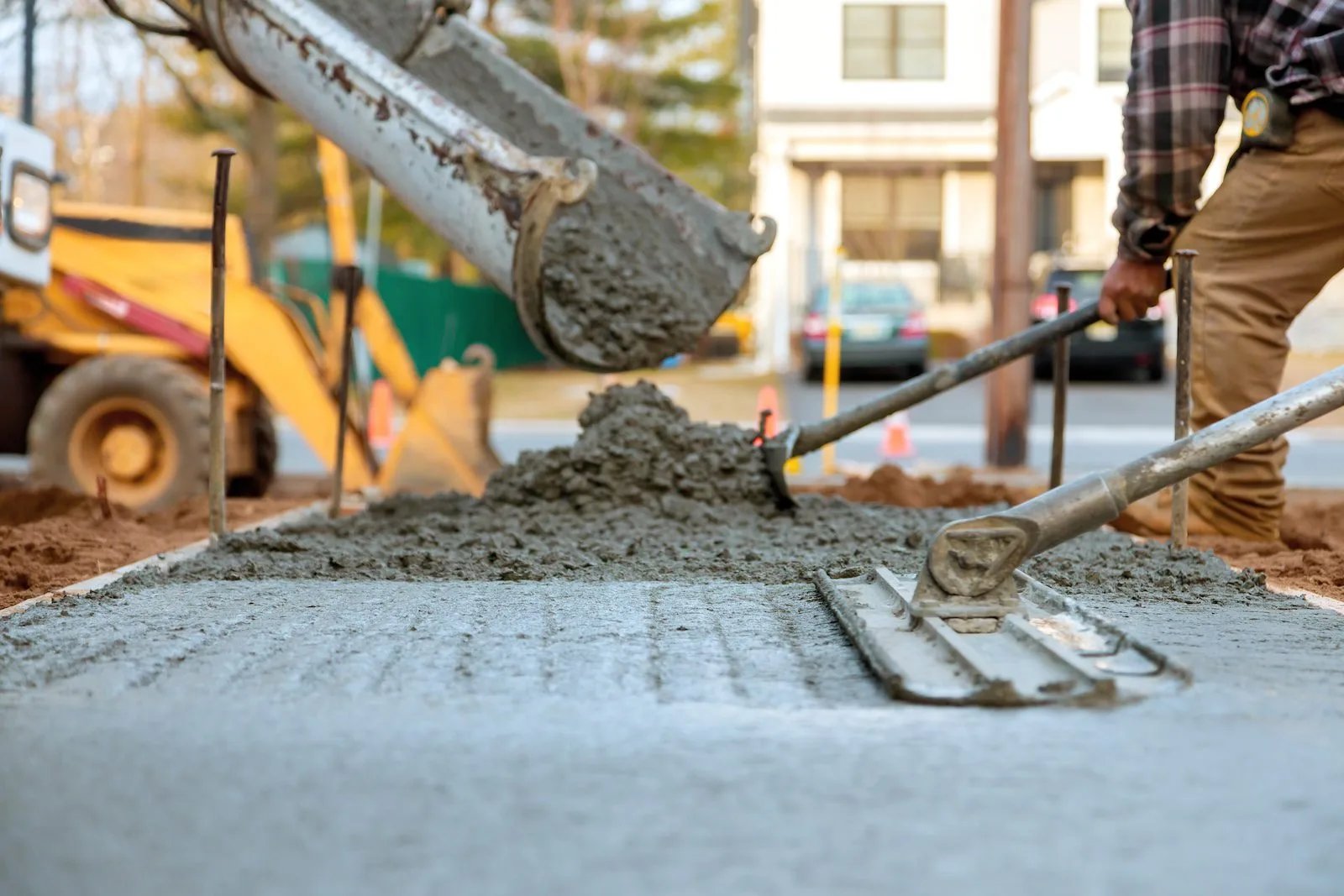

Most flatwork failures trace back to what happened under the concrete, not in it. A sidewalk heaves because the clay beneath it swelled after a wet spring, a patio slab settles where a utility trench was backfilled loose, a walkway ponds because the grade was an eighth of an inch off over thirty feet. The concrete itself is simple, and the skill is in preparing the ground, laying out the joints and finishing a surface that sheds water and holds a person's weight and footing.
We pour sidewalks, aprons, entry pads, patios, trash enclosures, curb returns and similar flatwork on commercial, institutional and municipal projects across Texas. These are the pieces of a project most people touch, and they are the first place an owner will see cracks, puddles and trip hazards. We build them to last through hot summers, flash rain and clay movement, and we plan each pour so that accessibility and drainage are settled before the concrete arrives.
Flatwork in a state that keeps growing
Public streetscape and street projects are steady work in Texas cities. New Braunfels, for example, has a $6 million project at the I-35 and FM 725 intersection and a $24.78 million improvement to Loop 337 along Common Street funded by a May 2023 bond, according to local reporting, and street projects of that scale typically carry new sidewalks, curb ramps and driveway aprons with them. The same is true in every fast-growing metro, where new roads, schools and commercial lots all need walkways that meet local standards.
The Gulf Coast adds its own problem. Houston is described as flat and marshy, with low-permeability clay-silt soils and an extensive drainage system built to cope with recurring flooding, so flatwork there is graded to shed water and tie into storm inlets rather than collect it. The details we choose in Houston differ from those in the dry west, even for the same four-inch sidewalk.
What we pour and how
Our flatwork includes sidewalks, ADA curb ramps and landings, driveway aprons, building entry pads, patios, dumpster pads, utility pads and small plazas. We prepare the subgrade, add base material where the design calls for it, set forms to line and grade, place reinforcement or fibers, and finish to a broom or light-texture surface for traction. Joints are laid out in a regular pattern, with control joints spaced to keep panels roughly square and expansion joints where concrete meets buildings, curbs and fixed objects.
Edges are tooled, expansion material is set below the surface, and the finished slab is cured with a compound or a wet method. On projects with curbs, we coordinate with curb and gutter crews so that sidewalk elevations, ramp slopes and drainage lines meet cleanly, and for ramps we follow the guidance in ADA ramps and accessible routes.
Getting the grade right the first time
We begin by checking the plan grades against the existing site. A sidewalk can only be as level as the ground around it allows, and if a drive entrance, a tree root zone or a manhole lid forces a different elevation, it is better to solve it at the survey stage than after concrete is in. Forms are set with a level and string, and crews check slopes at every ramp and landing, since a cross slope of roughly two percent is the ceiling for accessible routes.
Subgrade matters most on clay. We proof-roll the subgrade, remove soft areas, compact in lifts and keep the base from drying out or taking on water before the pour. On expansive soils, control joints are spaced closely and slabs are tied to adjacent structures so they move with them. We also keep irrigation and roof drains in view, because a slab that sits in saturated clay will shift no matter how well it was poured.
What changes the price of flatwork
Flatwork prices are driven more by access and preparation than by yardage. A long straight sidewalk with open access is inexpensive per foot, while a short walk with many curved edges, tree wells, cross slopes and utility lids costs more. Demolition of old concrete, haul-off, base material and irrigation repair are separate lines, and curb ramps with detectable warning surfaces require more labor than plain panels.
Public work adds paperwork. State and local agencies buy flatwork through formal channels, including the state's Electronic State Business Daily and the centralized master bidders list kept by the comptroller, and cities run their own solicitations. Municipal and public works buyers often want unit prices by the linear foot, and we price that way so the quantity can change without a new negotiation.
Trip hazards, traffic and protection
Public flatwork has to be safe on the day it opens and ten years later. We keep panel edges flush, grind high spots where specifications allow, and use expansion material and dowels where needed to prevent offsets. Pedestrian detours, barricades and lighting are set up during construction so that the public is kept off wet concrete and open excavations, and trucks are kept off new slabs until they have cured.
For homebuilders and multifamily developers, we plan flatwork in phases that follow the building schedule, because a sidewalk poured too early will be damaged by delivery trucks. We pour entry walks and self storage drive aisles late in the sequence, after heavy equipment has left.
Have a walk or pad to pour?
Send a site plan or photos and tell us where the work is. We will give you a unit-priced proposal for the flatwork, including preparation, joints, curing and any ramp or drainage detail the site needs.
Common Questions
What thickness should a commercial sidewalk be?
Four inches is common for pedestrian-only walks, while driveway aprons and areas used by service vehicles are thicker, with reinforcement. The plans or the city standard details specify it, and we build to them.
How often should control joints be spaced in a sidewalk?
Panel length is typically close to the width of the walk, so joints in a five-foot sidewalk often fall about every five feet, and the plans or local standards govern. Joints are tooled or sawn soon after finishing so cracks occur at them rather than randomly.
Why do sidewalks crack near trees and buildings?
Roots lift slabs, clay soil near a building swells and shrinks and rigid connections prevent slabs from moving. Isolation joints, root barriers and proper subgrade preparation reduce the problem, and we flag trees and structures at the survey stage.
Can sidewalks be poured in winter or very hot weather?
Yes, with changes. In heat we use retarders, shade and curing compounds, and in cold we use blankets and delay stripping and saw cutting. We do not pour on frozen subgrade or when freezing is likely overnight before the concrete has gained strength.
Who is responsible for repairing a damaged sidewalk?
That depends on the owner of the property or the right-of-way, and on local ordinance. We can assess the damage, recommend repair or replacement and coordinate permits and inspections when the work is in a public right-of-way.