

Building near water changes how we dig, drain and pour in Lewisville. A big lake, a river fork and an interstate share the same few square miles, so a concrete contractor here spends as much time on groundwater, floodplain limits and stormwater as on the slab itself. We build foundations, flatwork, paving and underground utilities with that in mind, and we plan the drainage before we plan the formwork.
Our trade partners handle the full ground-up sequence: clearing, erosion control, mass grading, utilities, subgrade preparation, forming, reinforcing, placement and curing. That means one party is accountable for the grade from the first stake to the last sawcut. It also means that when rain arrives, as it will, we already have inlet protection, pumps and a stable haul road in place.
Developers, general contractors and public owners bring us in when a site needs both civil and concrete experience. We bring both, and we put the sequence on a one-page schedule so everyone can see where the risk sits. Weather days, inspection holds and utility shutdowns are shown as separate bars, which makes it easier to explain a delay to a lender or an owner's board.
Water, floodplain and soft ground
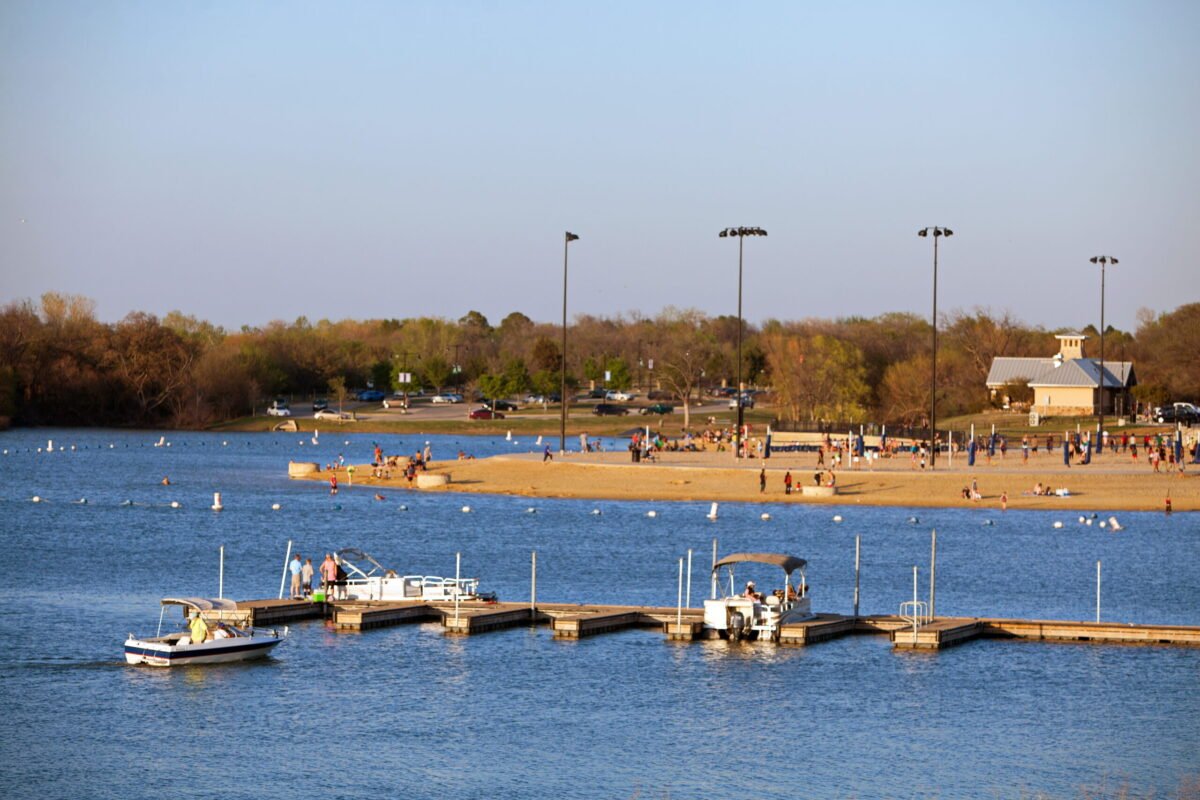
The Garza-Little Elm Dam, finished in 1954, enlarged Lewisville Lake; Lewisville Lake Park spans 662 acres leased from the U.S. Army Corps of Engineers, and about 14% of the city's total area is water, counting the lake and the Elm Fork of the Trinity River. With that much water, sites near the shoreline or the creek corridors often have high groundwater, low spots and seasonal wetness.
We plan for it. Dewatering may be needed for deeper footings or utilities, so we carry pumps, filter bags and discharge plans. We time excavations for drier periods when the schedule allows, and we avoid leaving open excavations before a storm. Where federal or city floodplain rules apply, we leave the review to the engineer and the owner, and we build exactly to the approved plans. Wet ground also affects haul roads. We build temporary rock or stabilized roads where needed, so loaded trucks do not rut the site or track mud onto the public street, and we remove them when they are no longer required.
Freeway, tollway and employers
North to south through Lewisville the main freeway is I-35E, SH 121 along the Sam Rayburn Tollway joins it at the southeastern edge of the city, and FM 1171 (Main Street) crosses the middle of town from east to west. Those corridors carry office, retail and light-industrial development, and the intersections are busy enough that deliveries need a plan.
Major employers named for the city include JPMorgan Chase, Lewisville ISD and Nationstar Mortgage, and Vista Ridge Mall, at I-35E and Round Grove Road (FM 3040), dates to 1989. A mix of financial offices, schools and older retail leads to work such as campus parking, school additions and the redevelopment of aging retail pads, which we handle for commercial developers and school owners. Older retail pads often need new storm connections, because the original systems were sized for less pavement than the redevelopment will place, and we review that capacity with the engineer before the slab is demolished.
Stormwater, erosion control and inspections
Near a lake and a river corridor, stormwater compliance is closely watched. We prepare and maintain erosion control measures, update the stormwater plan as the site changes and keep inspection logs. Silt fence, inlet protection, stabilized entrances and concrete washout are installed before grading starts and repaired after rains.
For permits and inspections, we provide the contractor-side documents the city expects: utility sequences, traffic control and testing reports. When something about the plans is unclear, we ask the engineer in writing and log the answer. Details on erosion control and SWPPP are part of every bid we submit for a site of any size. Disturbed soil is stabilized with seed, mulch or cover as soon as grading ends, and we photograph the controls on a regular schedule so the record is complete if an inspector asks.
Sequencing earthwork before concrete
We prepare the ground so the concrete has little to complain about. Stripping and grading come first, then utilities, then subgrade stabilization, then base. We test density along the way and again just before the pour. If the subgrade is wet or pumping, we do not place concrete on it; we dry it, treat it or replace it.
Once the base is ready, our forming and rebar trade partners set up. Edge forms, dowels and reinforcing are checked against the drawings, and the pour begins only when the engineer's inspector releases the area. Curing starts as soon as finishing ends, with compound, wet cover or both. For wide slabs, we use temperature monitoring and test cylinders to confirm strength before the owner loads the slab or removes the forms.
Services that fit this ground
Many Lewisville sites call for detention and retention ponds, culverts and headwalls and dewatering in addition to the building and paving work. Combining them with the concrete means one schedule and fewer gaps between trades.
In 2011 the DCTA A-train added the Hebron station, along with the Old Town and Highland Village/Lewisville Lake stations. Station-area projects add sidewalks, bus bays and parking, and we have crews ready to serve that work. We also work in nearby Denton and Irving, so owners with sites in several cities can use a single contractor. Equipment travels between those markets on the same day, which cuts mobilization costs for small repeat work such as drive-lane repairs and curb ramps.
Tell us what is on your Lewisville site
Send the plans and any drainage or floodplain information. We will mark the water risks and price the work as a series of packages, so you can see how each part affects the schedule and budget.
Common Questions
What if my Lewisville site has high groundwater?
We dewater the excavation with pumps or well points when the plan allows, discharge through filtered, approved locations and keep the work moving. In some cases, the engineer may change the depth or add a drainage layer. We coordinate that early, so the schedule is not a surprise.
Do you provide erosion control and SWPPP support?
Yes. We install and maintain the controls shown on the plan, inspect them on the schedule the permit requires and repair them after rainfall. We keep the log up to date and hand it to the owner at closeout.
Can you build detention ponds along with the building?
Yes. We excavate the basin, shape the slopes, place outlet structures and headwalls, and stabilize the surface with vegetation or concrete as specified. Ponds are often built early, because they also serve as sediment traps during construction.
How do you handle trucks entering from an interstate service road?
We plan the entrance, lay out the approach and use flaggers when needed. Mixer trucks queue on site, not on the road, and we schedule deliveries in smaller groups when the entrance is tight.