
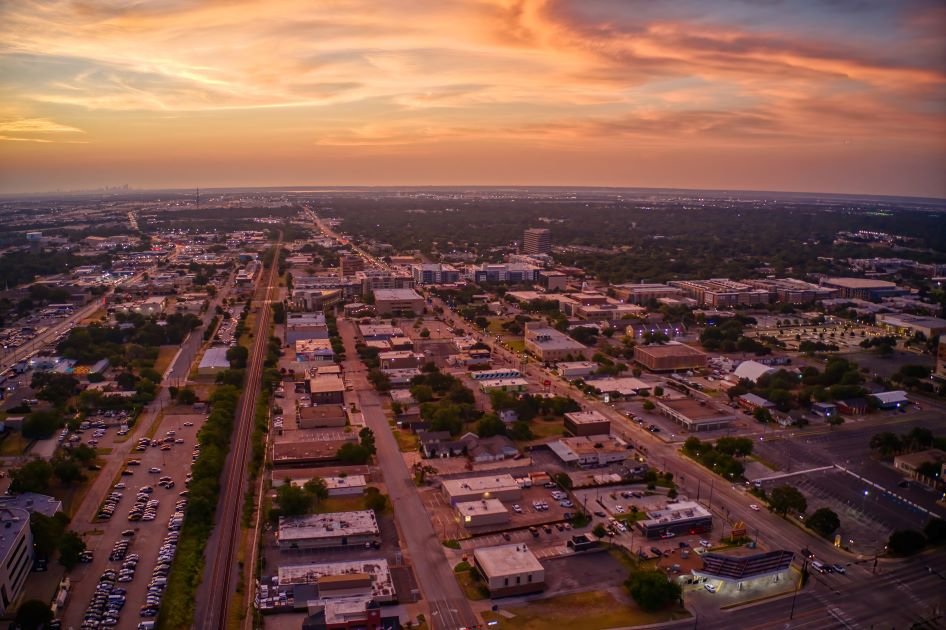

Pouring concrete in Arlington means planning around event traffic as much as around weather. The entertainment district, the university and the manufacturing plants all share the same arterial streets, and a ready-mix truck that arrives on the wrong afternoon can be stuck for an hour. We build the schedule backward from the traffic, then fit the slabs, paving and utilities into the quiet windows.
Our trade partners place foundations, flatwork and heavy paving, trench utilities and grade pads for owners across Arlington, from industrial yards near the Bell helicopter operation to parking fields and plazas close to the stadiums. We schedule forming, rebar placement and finishing trade partners together, so a short window is a plan rather than a gamble.
General contractors who call us usually have one of two problems. Either the site is cramped and the delivery route is political, or the owner wants the work done while the facility stays open. Both are solvable with phasing, and both start with a clear picture of who else is on the road that day.
What we build here
Arlington's reputation rests on two stadiums: AT&T Stadium, a $1.3 billion stadium completed in 2009, and Globe Life Field, which cost $1.1 billion, with construction beginning in 2017 after residents approved it in 2016. Projects like those drive nearby hotel, parking, restaurant and retail work, where concrete is plazas, ramps, ADA routes and parking structure decks. We handle the flatwork and structural placements for that kind of mixed-use and hospitality work.
The university adds another category. The University of Texas at Arlington has over 40,000 students, so education buildings, labs and campus utility upgrades are a steady need, with the extra requirement that crews work while classes run. We stage deliveries, fence lanes and maintain walkways so students and staff keep moving. Tie-ins to campus water, storm and electrical duct banks are scheduled for breaks between terms when possible, and every open trench is plated or fenced at the end of the day.
Working beside live crowds
We treat the surrounding public as part of the site. That means signed pedestrian detours, plated trench crossings, flaggers when trucks turn, and a pour plan that avoids game-day mornings and large campus events. When a major event is scheduled, we shift the placement date instead of arguing with the traffic.
Pump setups are planned with the same care. A boom over a sidewalk needs a closed lane or a crossing guard, so we ask the city for the lane closure at the same time as the pour permit, and we keep the pump crew's start time flexible if the first truck is delayed.
Matching pours to the manufacturing calendar
In the city's 2024 annual financial report, the largest Arlington employer is General Motors at 8,919 employees, with Arlington ISD (8,646), UT Arlington (8,636), Texas Health Resources (4,062) and Six Flags Over Texas (3,900) following. Industrial and institutional owners at that scale have shift schedules and shutdown windows that rarely bend. We ask for the calendar early, then set pours, saw cutting and curing around it.
On plant work, the concrete is often an equipment pad or a floor patch that has to cure over a weekend, with the line starting up again on Monday. We use high-early mixes where the engineer allows, test cylinders on a schedule that matches the restart, and keep a backup plan for a batch plant outage. If the weather turns, we bring tarps, blankets or windbreaks so the cure is not left to chance.
Safety around people and machinery
Arlington Municipal Airport (GKY) is city-owned, located entirely within Arlington, and serves as a reliever airport for DFW International and Dallas Love Field, with Bell Helicopter, a division of Textron, operating there. Work near an airport carries height limits for cranes and pumps, restricted areas and badge requirements, and we handle those through a pre-job briefing and a written equipment list. Concrete trucks and pump booms are tracked by height and swing radius, and operators are briefed on where they may and may not set up.
The Trinity River and its tributary Johnson Creek flow through Arlington, so many sites sit near drainage corridors. We build erosion control and inlet protection before grading starts, keep fuel and concrete washout away from flow paths, and coordinate with the engineer on any work near a creek easement. After a storm, we inspect silt fence, inlet protection and construction entrances and repair them before the next rain, because a failed control is the quickest way to draw an inspector's attention.
Services that tie a project together
Most Arlington owners combine several scopes: slab on grade for the building, sidewalks and flatwork for the entries, and detention and retention ponds for the stormwater. Bundling those under one contractor lets us sequence the pad, the pipe and the pond so none of them waits on another. When the pad and the underground pipe are built by one crew, a change on one side is caught before it surprises the other.
We also work for commercial developers who need predictable pricing on a spec building. Our estimates break out grading, utilities, structural concrete and flatwork so you can value-engineer line by line, and our work in nearby Grand Prairie and Fort Worth keeps equipment close.
Plan the Arlington pour with us
Give us the site address, the event or shift calendar that affects it and the scope you want priced. We will return a phased plan with delivery windows and a clear list of what we need from the owner and the city.
Common Questions
How do you handle concrete deliveries near a stadium event?
We avoid pouring on event days when we can. If a schedule leaves no choice, we ask for an early start, stage trucks away from the arterial roads and give the batch plant a firm departure time. A large pour can finish before the crowds arrive if the plan is tight.
Can you work in occupied campus or plant buildings?
Yes. We isolate the work zone with barriers, control dust and noise, and coordinate deliveries with the facility manager. Concrete demolition and sawcutting are scheduled for low-occupancy hours, and cores are protected from the weather until patched.
Do you provide dewatering near creek corridors?
When groundwater or shallow flow is expected, we plan dewatering pumps with filtered discharge and keep the work in line with the stormwater plan. The engineer or the city may require a permit for discharge, and we help prepare the paperwork.
What does a parking field cost compared to asphalt?
Concrete usually costs more at the start but carries wheel loads and standing water with less maintenance. We price both when the owner is undecided, and we include joint sealing and the first-year inspection in the concrete bid so the comparison is honest. Over a long ownership period, the cost of patching, sealing and restriping asphalt can narrow the gap, and concrete also resists the rutting that heavy parked vehicles leave in hot weather.