
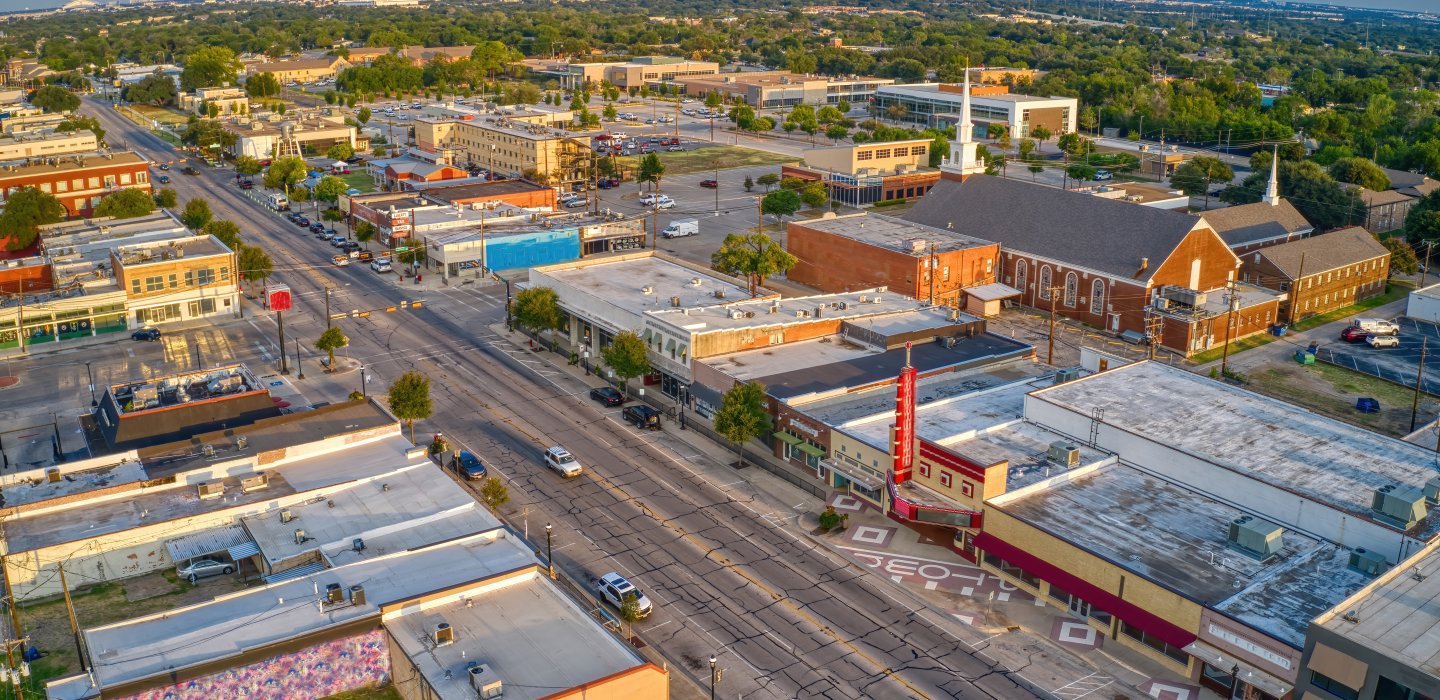

Aerospace and defense plants set the bar for slab flatness and equipment foundations in Grand Prairie, and the ordinary warehouse and commercial work around them benefits from that standard. We pour industrial floors, machine foundations, heavy paving and the underground systems that serve them, and we hold tolerances that precision manufacturing owners recognize.
Grand Prairie spreads across a lot of ground. Interstates 20 and 30 run east to west through the northern and southern parts of the city, SH 161 (President Bush Turnpike) runs north to south through western Grand Prairie, and SH 360 runs for almost three miles in the northwestern portion. A site can be on a freeway frontage road, a lake edge or open land waiting for services, and each calls for a different earthwork and utility plan.
Our trade partners handle the work from first grading to final cure. We bring survey-controlled grading, tested subgrade, rebar and form crews and finishers with floor-flatness experience, and we document each step so owners and engineers can see the build record. Photos, survey checks and test results are organized by area and date, which makes later warranty or modification work easier.
Where industrial concrete budgets go
On a manufacturing or aerospace-related job, the largest cost lines are usually reinforcement, subgrade treatment and the precision finishing of floors. A floor with a tight flatness requirement needs laser screeds, controlled mix designs and the right placement weather, and it costs more per square foot than ordinary slab on grade. We tell owners where the tolerance truly matters and where an ordinary finish is enough.
Equipment foundations are another driver. A press, a test stand or a large machine can need deep footings, vibration isolation or embedded plates that must be set within a tight tolerance. We price these as separate packages with a detailed list of embeds, anchor bolts and cure times, so there are no surprises when the equipment vendor arrives. Grout pads, sleeves for conduit and trench drains in the floor are coordinated with the mechanical and electrical trades at the same time, since coring a finished floor is slower and more expensive than setting the sleeve before the pour.
Who we build for in the city
The 2023 annual financial report lists Lockheed Martin Missiles and Fire Control (5,000 employees), Grand Prairie ISD (3,800), Poly-America (2,000) and the City of Grand Prairie (1,706) as major local employers, and Airbus Helicopters has its headquarters in the city. That points to industrial and manufacturing owners, a large school district and municipal work, as well as the logistics operators that serve them.
We do not claim to have built for any of those organizations. What we offer is the skill set their kind of project requires: clean, flat floors, secure site procedures, careful coordination of shutdowns and testing documentation that matches the specification. When a plant must keep running, we phase the work and communicate every day. Security and badge rules are handled with the owner's team before mobilization, and we keep crew lists and equipment lists current.
Crews, equipment and control
Close coordination is a quality tool on precision work. Our forming trade partners build edge forms and keyways that hold their lines. Our rebar trade partners place mats with correct chairs and cover. Our finishing trade partners know how to float, trowel and cure to a flatness number, and the grading partners we schedule trim subgrade to a tolerance that a paver or screed can follow.
On a large job, we use grade control: lasers or GPS on the machines, stakes checked by the foreman and as-built surveys at key steps. The result is a base that matches the plan, a slab that has uniform thickness and a drainage pattern that works. Where concrete testing and quality control is required, we schedule the lab so the tests are performed at the right time. Joint layout is checked against the racking and equipment plan, so saw cuts do not land under a machine leg or a rack upright.
Schedules for growing parcels
Nearly 900 acres along the southern boundary were annexed by Grand Prairie in 2025 for the Goodland master-planned community. Land that is newly added to a city often needs roads, water, sewer and storm drainage before a single building can be built, and the earthwork contractor sets the pace. Developers should expect long lead times for mass grading, utility extensions and the first lots, and we plan for a staged release of pads.
We help with that kind of schedule by building the underground first in phases, stabilizing finished pads against erosion and handing over completed lots in a way that lets vertical builders start. For large grading packages, we track earthwork balance weekly and tell the owner early if import or export will be needed. We also keep a stockpile plan so topsoil and suitable fill are kept apart, which saves cost when the finished-grade landscaping is installed.
Lakes, tracks and surrounding cities
The city has a total area of about 81.1 square miles, of which about 9.0 square miles is water, and Joe Pool Lake is a nearby landmark. Lone Star Park dates to 1997, and Epic Waters, an indoor waterpark, followed in January 2018. Entertainment and retail around those destinations create demand for parking, plazas and drainage work, and the water nearby means stormwater and erosion control need constant attention.
We serve Grand Prairie along with neighboring Arlington, Mesquite and the Southern Dallas inland port area, so an owner with sites in more than one of them can use a single contractor. Our work for distribution centers in those areas uses the same truck-court and dock-apron methods.
Start your Grand Prairie project with us
Send the plans, the geotechnical report and your tolerance requirements. We will give you a plan that identifies the critical steps and a price you can compare with confidence.
Common Questions
How flat can you make an industrial floor?
We can build to specified flatness and levelness numbers using laser screeds, controlled mixes and experienced finishers. The achievable result depends on the design, the base and the weather. We discuss targets with the engineer before the pour and measure afterward with the method the specification names.
What is involved in a machine foundation?
Excavation to the design depth, a stable base, reinforcing steel, embedded plates or anchor bolts set by survey, and a controlled placement with vibration. Cure and protection times are set by the engineer. We coordinate with the equipment vendor so bolt patterns match.
Can you build roads and utilities for a master-planned area?
Yes, under a land-development contract. We grade, install storm, sewer and water, prepare subgrade and place curbs and paving to the engineer's plans and the city's specifications. Phasing is planned with the developer so that lots can be released in order.
How do you control erosion on large grading jobs?
We install perimeter controls first, phase the disturbance so open areas are small, stabilize finished areas quickly and inspect after rain. Sediment basins are built early where the plans call for them. Records are kept for the owner and the permit.