
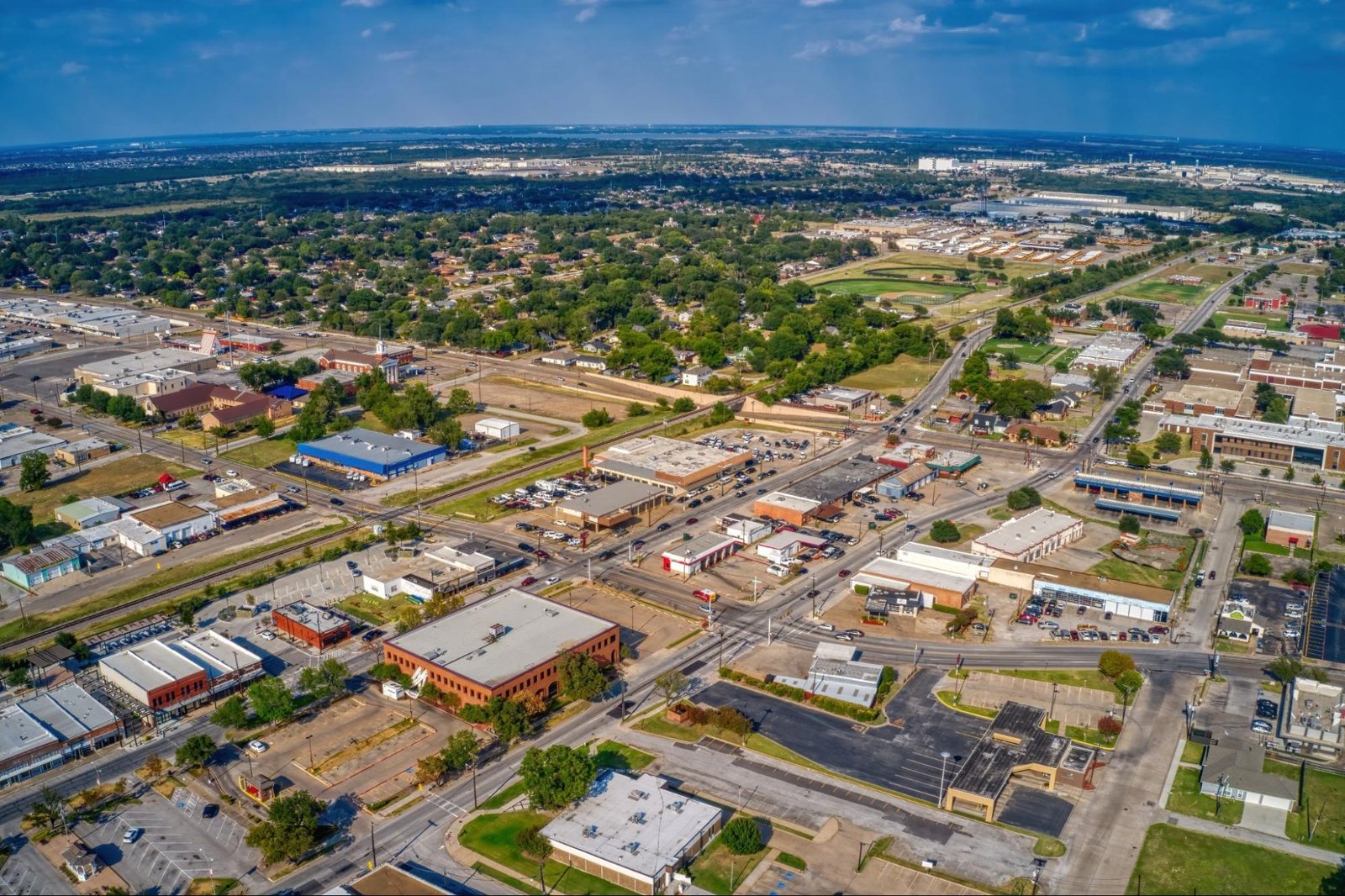

Container traffic ruins thin pavement, and Mesquite has a lot of container traffic. We build heavy concrete for the trucks, chassis and lift equipment that move freight around the intermodal and industrial areas, and we grade, drain and sew the utilities under it so the pavement has a stable base. Owners who have already replaced a failed lot once tend to ask us about subgrade and joints before they ask about price.
Mesquite's position makes it practical for freight. I-635 (LBJ Freeway) bisects the city and is its main freeway, I-30 runs along the north side, I-20 along the south side, and U.S. Highway 80 is an east to west freeway through north Mesquite. A site with that much freeway frontage lives or dies on its truck circulation, and so does the concrete, since turning movements and braking loads concentrate in a few places.
We work for logistics developers, industrial tenants, general contractors and the public owners that serve them. Our usual deliverable is a finished pad or yard that takes loaded trucks the week it opens, with tested subgrade, documented concrete strength and a drainage plan that works in a hard storm. We also keep a short list of questions for every yard: where does the loaded chassis turn, where does the trailer sit overnight and where does water go when the inlet clogs.
Pavement, docks and yards
Typical packages combine truck courts and dock aprons, trailer parking, concrete drive lanes and heavy-duty entrances. Dock aprons carry the harshest loads because trailer landing gear sits on one small area, so we use thicker sections or reinforced pads where the design calls for them, and we keep the slab flat so doors seal properly.
We also place tilt-up floors, loading dock pits and equipment pads for owners who need conveyors or sorters. Slab edges, dowels and joints are laid out to the structural drawings, and saw cuts follow quickly so the concrete cracks where it was designed to. Subgrade work comes first: we proof roll, treat or replace soft areas and test density before the base goes down, because a perfect slab on a poor base still fails.
Keeping a rail-served site moving
Freight rail moves through a Union Pacific intermodal facility in Mesquite that is part of the Skyline Industrial Park. Neighboring tenants depend on rail schedules, drayage and gate hours, so pavement work is phased lane by lane or bay by bay to keep trucks moving. We submit a pour sequence that shows which areas are closed on which day and where trucks will be rerouted.
Weather planning matters on big yards. We watch forecasts for rain and heat, split large pours at planned construction joints and hold a backup plan when a batch plant has an issue. High-volume pours also need enough finishing labor to keep up with trucks, and we staff accordingly. Curing compound is applied immediately after finishing, and large yards are sawcut in a planned order so stresses are relieved before cracks form.
Warehouse, flex and airport-side buildings
Most of our Mesquite building work is warehouse, flex and light industrial and truck-terminal space. Floors in those buildings need joints, dowels and flatness suited to forklift traffic, and we coordinate with the racking installer when the layout is known.
The public Mesquite Metro Airport has a 6,000-foot lighted runway with ILS, and about 75% of its daily operations are general aviation. Aviation-adjacent land can host hangars and light-industrial buildings, and our experience with aircraft hangar floors, which need smooth, level slabs and door tracks set precisely, applies here. When an airport tenant needs ramp access, we coordinate the connection between the building slab and the apron so the grade break is smooth and drainage runs away from the doors.
What we do with our trade partners
In the 2023 annual financial report, Mesquite ISD, Town East Mall, United Parcel Service, Canadian Solar and the City of Mesquite each had 1,000 or more employees, and Dallas Regional Medical Center and Eastfield College fell between 500 and 999. That list covers logistics, solar equipment, retail, healthcare, education and local government, and we coordinate the grading, forming, reinforcing, placing and finishing that all of them use.
Coordinating the work through one team keeps responsibility in one place. If a joint curls or a drain holds water, the owner calls us, not a chain of subcontractors. We keep testing records and walk the finished work with the owner before turnover. Warranty responses come from the same people who built the job, which is the practical benefit of one coordinated team.
Heavy equipment around live traffic
A yard with trucks, yard dogs and forklifts in motion is dangerous for a construction crew. We separate work zones with barriers, assign spotters for backing trucks and require high-visibility gear on every worker. Daily briefings list that day's truck routes and any closed gates.
Concrete placement also has its own hazards: pump line pressure, overhead booms, burns from wet cement and slips on a damp slab. Every worker is trained on those hazards, and we keep eyewash and first-aid supplies at the pour. Safety records and training documents are available to owners before we start.
Send us your Mesquite yard or building plan
Provide the civil drawings and the geotechnical report and we will price the grading, drainage and pavement as a package. We also build in Dallas, Garland and the Southern Dallas inland port area, and our work for logistics and warehouse developers is a good place to start.
Common Questions
How thick does a container yard slab need to be?
Thickness depends on the container stacking, the lift equipment and the subgrade. The engineer sets the section, and heavy yards often use thicker slabs with dowels and tie bars. We build to the design and focus on getting the base uniform, since weak or wet subgrade is the usual cause of early failures.
Can you work next to an operating rail facility?
Yes, with coordination. We follow the owner's safety rules for railroad proximity, keep equipment outside restricted zones and schedule deliveries around gate traffic. Anything that crosses a rail line needs the owner's permission and, often, a flagger.
What is the benefit of concrete over asphalt for trailer parking?
Concrete resists rutting under parked trailers and fuel or oil spills, and it needs less maintenance. It costs more up front, so we price both and describe the lifecycle tradeoffs. For landing-gear areas, many owners choose concrete even when the rest of the yard is asphalt.
How do you prevent standing water on a large lot?
We set slopes to the design, check them with laser grading and stake inlet elevations before paving. After the first rain, we walk the lot and mark any low spots. Minor issues are corrected during the warranty period at no cost to the owner.
How early should I order concrete for a large yard pour?
As early as the schedule is firm. A large placement can use hundreds of cubic yards a day, and plants need notice for materials and trucks. We agree on a delivery rate with the supplier and put it in the pour plan.