
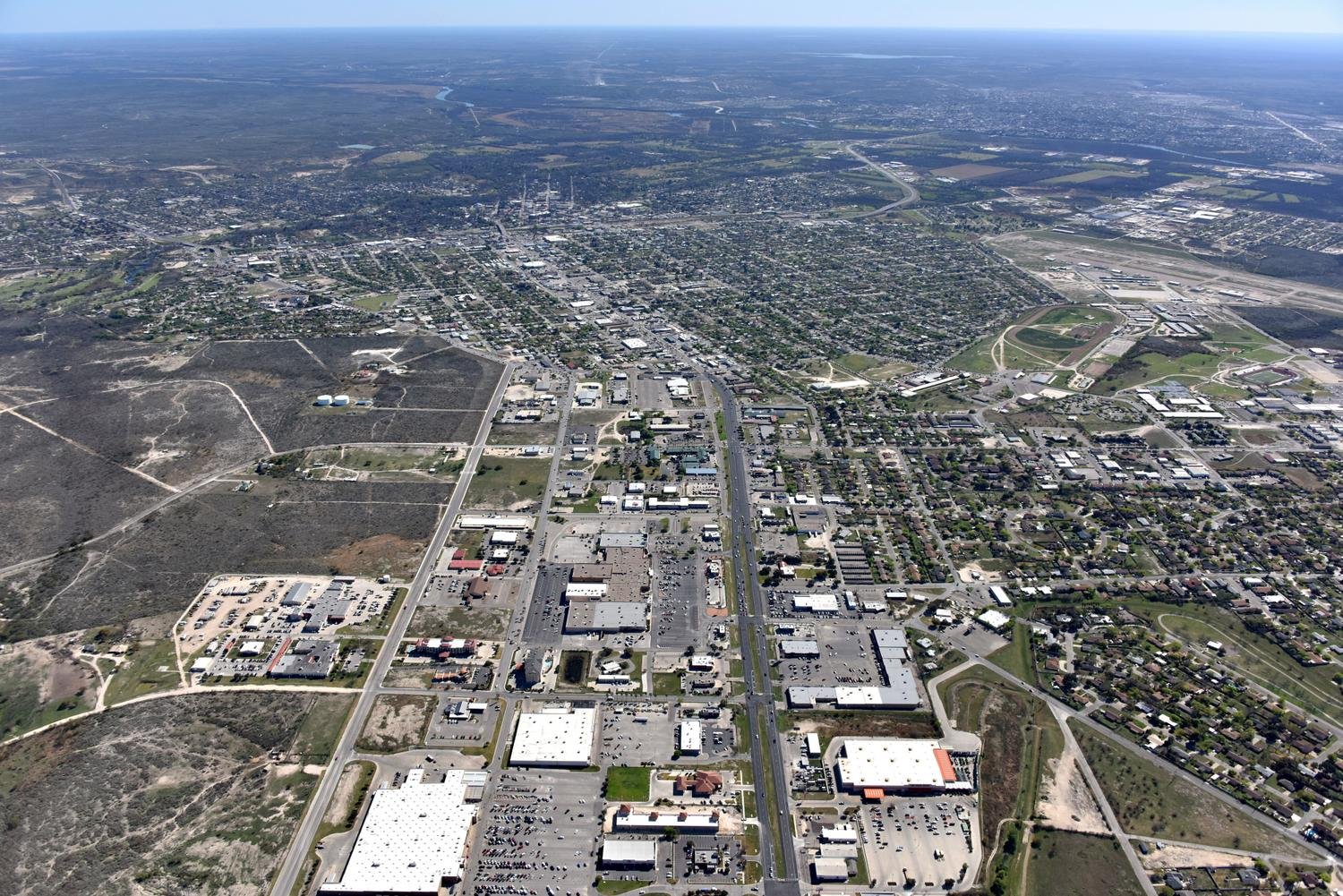

A 1,761-acre industrial park with Rio Grande frontage does not come with a finished lot on every acre, and the first buyer in a raw section of it ends up paying for the road, the utilities and the grade. We work for those first buyers in Eagle Pass and in Del Rio, clearing brush, cutting caliche and clay, setting building pads and laying the water, sewer and storm lines that make a parcel something a lender can finance. The notes below describe how we go about it.
A broker report from February 2025 describes the Empire Industrial Park in Eagle Pass as having seven warehouse land parcels under contract, a 136,000 square foot speculative warehouse expected within months and a 10-acre truck stop sale fronting El Indio Highway. Broker material is a marketing source, so we treat the numbers as a sign of activity rather than a commitment, but the types of buildings it names are the ones we build for: speculative warehouses, truck-oriented commercial sites and yards. Trade volumes support them. A May 2026 freight article citing a trade data service said Eagle Pass handled $3.77 billion in total trade in March 2026 and was the nation's tenth-largest border crossing by trade volume that month.
Over in Del Rio, the largest pilot-training base in the Air Force is described in a public reference as the area's largest employer, and the base shapes the demand for housing, retail, schools and clinics that need concrete and utilities just as industrial users do.
Rock, caliche and river-bottom soils
The ground changes quickly from river-bottom silt and clay to caliche and limestone ledges on the higher terraces. A boring log that finds hard material at four feet changes the unit price for every trench and footing nearby, so we ask for the geotechnical report and walk the line of the proposed utilities before bidding. The rock and hard ground excavation crews we coordinate use hydraulic hammers and ripping equipment where needed, and we price removal by the cubic yard with a clear definition of what counts as rock.
Frontage on a river also raises floodplain questions. We check the flood maps with the engineer and pad elevations are set above the design flood level when the plans require it. Erosion control along the bank is part of the permit package, and we build and maintain it as the plan shows, because a silty runoff event on a river frontage site has consequences beyond the project.
Warehouse pads, truck yards and fuel-island concrete
A speculative warehouse needs a building pad compacted in lifts, a slab-on-grade with a joint pattern that anticipates racking loads, dock aprons and a truck court. A truck stop needs heavy concrete at the fuel islands, the scale and the parking lanes, plus drainage that moves spilled fluids to separators. We pour concrete paving designed for slow, heavy wheel loads, and we form islands and curbs to fixed dimensions so fuel equipment can be set accurately.
The warehouse crews we coordinate can deliver the pad and slab for a shell building and then stay on to build the yard once steel is erected, which protects the paving from construction traffic. If you need a phased approach so the first tenant can open before the whole park is done, we can plan it that way.
A proposed crossing and why it matters to a contractor
In July 2026 a public radio report described a proposed trade crossing near Eagle Pass with one span for trucks and one for trains, saying the county intended to buy up to 65 percent of the developer's stake and the developer expected groundbreaking by year end. The project has drawn local opposition, and it may change before anything is built. For a site owner, it is a reason to keep an eye on road access and rail corridors, not a reason to assume a schedule.
What we can do now is keep options open. A lot designed with room for a future rail spur, an extended access road or a larger detention basin is cheaper to expand than one boxed in by development. When we price a parcel near a possible crossing, we ask the owner whether to build for the present need or reserve space for growth, and we show the cost difference.
Permits, utilities and public coordination
Border-county projects often involve several agencies: the city, the county, the state highway department and sometimes federal offices, depending on the location. We prepare the site package, traffic control plans and erosion control documents, and we track permits so the schedule does not stall on one missing signature. Water and sewer connections follow the utility's standards, and we test pipe and manholes as the utility specifies.
Projects of $50,000 or more are registered with the state accessibility program, and we make sure ramps, curb cuts and parking meet those standards before final inspection.
Hot summers and long supply lines
Summer heat on the border is severe, and we plan concrete work around it: early starts, cooled mixes, shade for curing materials and extra water for the crew. Heavy equipment is serviced on site so a hydraulic hose failure does not cost a day of travel. Ready-mix supply can be limited in smaller markets, so we confirm batch plant capacity and backup before a large pour and pour in sections if the plant cannot keep up.
We also advise owners to order long-lead items early. Precast structures, special fittings and reinforcing steel for a remote site can take longer to arrive, and the schedule should show those dates. We give a written look-ahead every week so the owner and the general contractor can see what is coming.
Developers, public owners and base-related work
Logistics and warehouse developers and truck stop owners are our most frequent customers in Eagle Pass, while municipal and public works agencies, school districts and developers drive demand in Del Rio. We also build for businesses that serve military families and for contractors that need a local sitework subcontractor.
Our trade partners can also support projects in Laredo and San Angelo, which helps owners who operate across the western and southern parts of the state.
Tell us which side of the river
Send the parcel location, the geotechnical report and your timeline. We will give you a price for the sitework and a list of conditions that could change it. You may also want to read about our site utilities work.
Common Questions
Do you provide a separate price for rock?
Yes. We carry a unit price for rock excavation with a clear definition based on the geotechnical report or a test pit, so the owner pays only for what is encountered.
Can you build a warehouse pad before a tenant is chosen?
Yes. We build a compacted pad to a standard elevation and leave stubs for water, sewer and storm. We document tests so the future tenant's engineer can rely on them.
How do you handle floodplain questions?
We follow the civil engineer's plans and verify elevations against benchmarks. If a plan seems inconsistent with the flood map, we flag it early so the engineer can resolve it.
What equipment do you have for caliche and limestone?
We use excavators with hydraulic hammers, rippers on dozers and compaction equipment suited to rocky fill. The method is chosen to keep blasting and off-site hauling to a minimum.
Do you work near the air base in Del Rio?
We can, with proper credentials and notice. Access rules, delivery windows and background checks vary by gate, so we ask early and plan around them.