
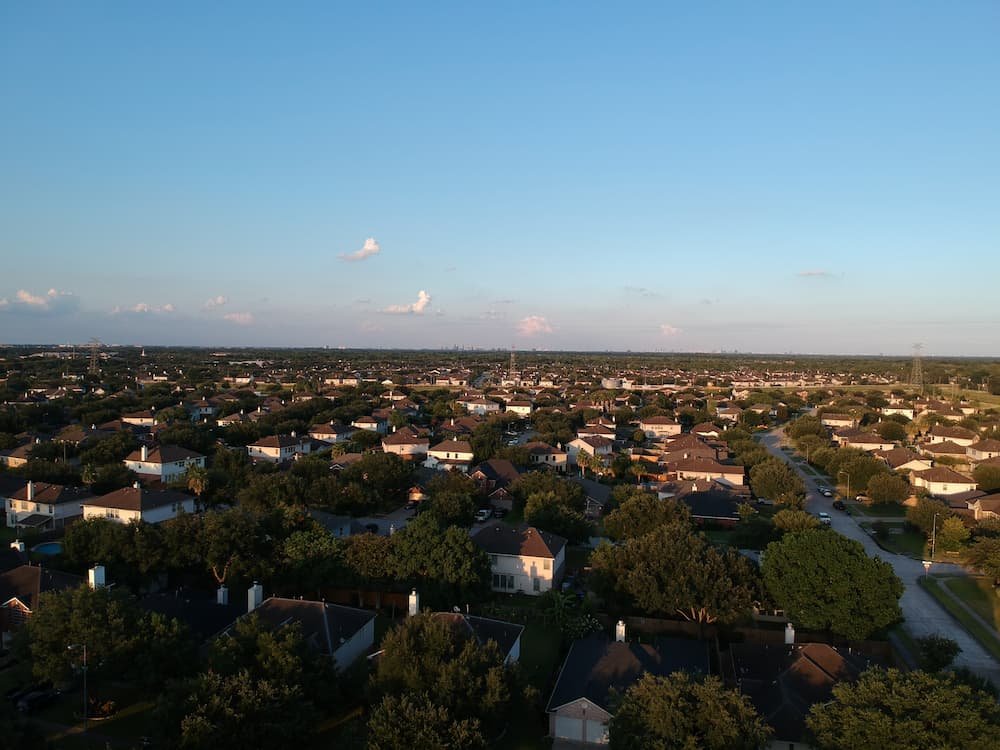

Pads in Katy have to be built with the knowledge that the ground itself is moving, and we build industrial slabs, dock aprons, truck courts and underground utilities with that in mind. Our trade partners work for developers and general contractors on warehouse and flex projects along the Grand Parkway and Interstate 10, and we start every job by checking elevations, drainage outfalls and the soil report.
A news report in May 2026 citing the Harris-Galveston Subsidence District said parts of the Katy area have sunk about 14 inches over the period from 2007 on, with one monitoring station recording more than 14 inches between 2007 and 2025. The practical meaning is that a site must be graded to current conditions, that detention and outfall elevations deserve a second look, and that utilities should be designed with settlement in mind. We raise those questions with owners and engineers at the outset.
Proposals separate earthwork, utilities and concrete, and show unit prices for the items most likely to change.
Buildings along the Grand Parkway
The Grand Parkway Segment E is a 15.2-mile, four-lane controlled-access toll road from Interstate 10 West (the Katy Freeway) near Katy to U.S. 290 near Cypress, and it opened to traffic in 2013. That road created an industrial corridor. A developer began construction in December 2019 on a 433,300-square-foot building at the Grand Parkway and Clay Road, with plans for five buildings from 165,100 to 433,200 square feet on roughly 78 acres. In 2025 another developer was reported ahead of schedule on a 97,000-square-foot warehouse along Highway 99 that could be divided into spaces as small as 9,500 square feet.
We did not build those projects. They show the building mix we know: large cross-dock shells, small-bay flex space and the paving that serves both. Our flex and light industrial work covers the second type.
Small bays and divisible buildings
A building divisible into small spaces has distinct concrete needs. Each bay needs its own overhead door apron, floor drains where tenants use water, utility stub-outs and a slab that can handle forklifts as well as vans. Joint layout should match demising walls so tenant changes do not fight the slab. We discuss that with the architect early.
Truck courts and parking are the other half. Smaller tenants generate more car and van traffic than large distribution users, so parking, drives and sidewalks matter. The slab on grade crews we coordinate pour the interior, and our paving trade partners handle the exterior in the same sequence.
Tenants arriving from other regions
A wind turbine maker leased a 131,300-square-foot warehouse and office facility at a 17-acre property about a mile south of Interstate 10 and Woods Road, according to a report from August 2026. That kind of tenant improvement can involve special slab loads, heavy equipment pads and crane access. For logistics and warehouse developers, the lesson is to design slabs with some margin for unusual tenants.
We help owners evaluate options: thicker slabs, heavier reinforcing and added pad areas. These add cost but make a building easier to lease.
Coastal prairie clay and water
West of Houston the soil is again clay and silt, with poor drainage and a high water table in wet years. We use stabilized haul roads, temporary drainage, lime or cement treatment where designed and prompt sealing of the subgrade. After rain, we dry, retest and only then place concrete.
The detention and retention ponds crews we coordinate often start a project, because ponds supply fill for the pad and give the site a place for water from the first rain.
Planning for settlement
If land sinks unevenly, pipes can lose slope and slabs can tilt. Designers handle most of that, but a contractor can help. We use flexible joints and proper bedding on pipe, verify slopes by survey before backfill and document inverts. At slabs, we check that dowels and joints are placed to the drawing.
Owners should expect surveys to be repeated. We cooperate with surveyors and engineers to keep as-built records accurate.
What changes a Katy budget
Fill volume is the first driver, because raising a pad above flood levels takes many truckloads. Detention is the second, since excavation of ponds is large. Pavement thickness is third. We provide unit prices for each.
Fast shells, wet grounds
Speculative industrial buildings are built to lease, and every week of delay costs the developer rent. The dirt phase is where most weeks are lost, so we put the most effort there: pump and dry the pad quickly, keep proof-roll and density tests booked, and start utilities as soon as the grade allows. When the pad is released, forming and steel start the next morning.
For the slab itself, we plan the pour sequence so that dock-side strips and the main floor are placed in an order that allows the tilt or metal shell crews in without damaging the floor. We protect finished slabs with curing compound and plywood where needed. In humid weather, curing is forgiving, but we still apply compound promptly, and in summer we pour early.
Drainage districts and approvals
Development west of Houston touches many authorities: the city or county, drainage districts, utility districts and TxDOT for any driveway that connects to a state highway. Each reviews different pieces of the plan. We read the approval conditions and put required inspections on the schedule, so that a missed sign-off does not hold up a pour.
For stormwater, we keep the pollution prevention plan current, inspect controls weekly and after rain, and fix breaches the same day. With projects near the erosion control and SWPPP inspector's eye, a clean site is the cheapest insurance.
Heat, traffic and trenches
Katy summers are hot and humid, and long days on bare ground are a safety issue. We provide water, shade and rest, move heavy tasks to cooler hours and train supervisors to spot early signs of heat illness. Haul traffic on public roads near a project is also a concern, so we use flaggers and keep roads swept.
Trenches follow shoring and sloping rules and are inspected daily by a competent person. Utility locates are verified before digging, and open excavations are fenced or covered at night.
Next markets over
Katy owners also work in Houston and in Sugar Land, connected by the Grand Parkway. We serve all three.
Plan your Katy project
Send the drawings, soil report and survey. We will tell you how we would handle the elevations and the water.
Common Questions
What should I ask about subsidence before buying a pad?
Ask the civil engineer how outfall and detention elevations were set, and whether the design allows for further settlement. Request a current survey.
Can you build divisible warehouse space?
Yes. We coordinate slab joints, door aprons, drains and utility stub-outs with the tenant layout.
How do you keep wet clay from delaying work?
With stabilized haul roads, drainage, pumps and a sequence that switches to work that can proceed. We retest the subgrade before placing.
Do you price fill separately?
Yes. Fill, treatment and detention excavation are separate lines, because they swing the most.