
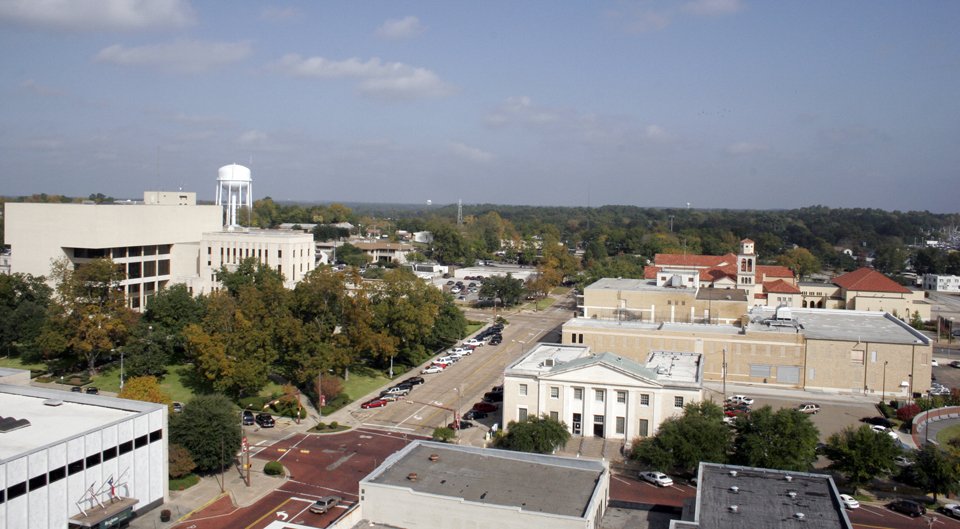
Chemical plants, rail equipment makers and logistics buyers all need slabs that handle abuse, and Longview has all three. We build heavy industrial concrete: equipment foundations, containment pads, truck courts, rail-adjacent aprons and the grading and underground utilities that surround them. Interstate 20 runs east to west through the city and ties it to Dallas about 125 miles west, while U.S. 259, State Highway 31 and Loop 281 give trucks a choice of routes.
A large chemical manufacturer is the second-largest employer with 1,510 employees (1.64 percent of city employment), and a rail car builder follows with 450. Those proportions tell a contractor that industrial work is a real but not dominant share of the economy, and that smaller, well-planned industrial projects are common: expansions, new process areas, maintenance upgrades and secondary containment. We approach each as its own project with a clear scope and a firm schedule.
Soil reports come first, and we quote earthwork, utilities and concrete separately.
Industrial slabs that survive
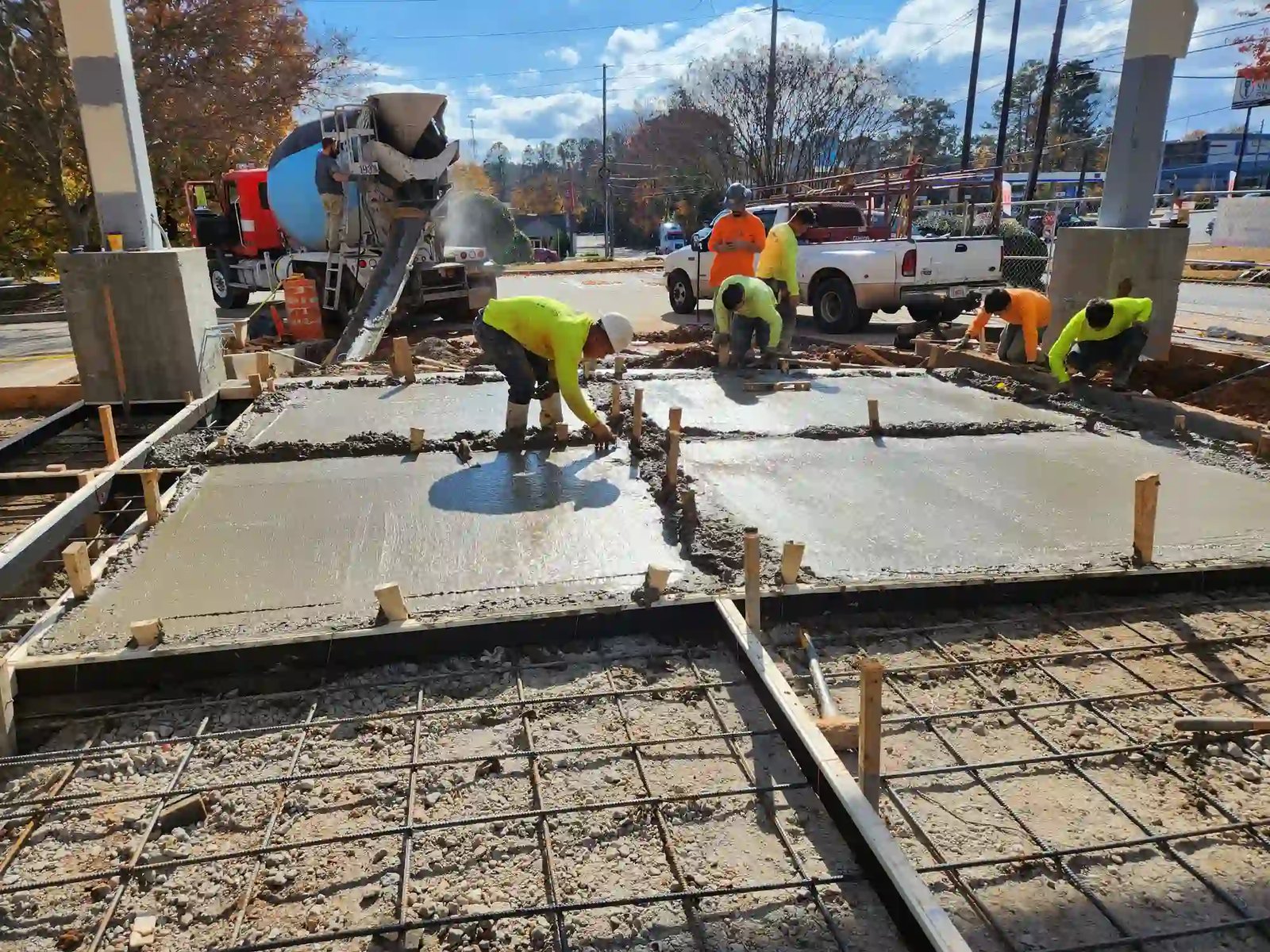
Industrial floors break at joints, at edges and where subgrade support varies. We detail joints with the owner's forklift traffic in mind, using dowels, saw cuts at the right time and edge reinforcement. For floors that will see chemicals, we coordinate surface treatments and sealants. The industrial concrete floors and containment pads and secondary containment crews we coordinate bring that detail to each job.
Equipment foundations follow the manufacturer's drawings. We set templates, check elevations by survey and place concrete in a sequence that avoids cold joints. Mass pours get thermal control, with mix design and temperature monitoring planned in advance.
Rail, highway and airport
Longview is served by Amtrak, BNSF Railway and Union Pacific Railroad, and East Texas Regional Airport lies south of the city. Rail makes sense of the transload and storage yards that industrial and logistics buyers often want. We build the paved aprons, drainage and concrete pads that go with them. Highway access shapes truck terminal and cross-dock work, which depends on dock aprons, driveways and trailer parking.
State Highway 31 runs 143.3 miles between Longview and Waco, and U.S. 259 is a 250-mile north-south route that serves as an alternate to U.S. 59. These roads make Longview a regional crossroads, and logistics buyers choose it for that reason.
Process, rail and energy buyers
Industrial owners buy differently from developers. They care about uptime, safety records and the quality of the supervisor on site. Industrial and manufacturing owners usually ask for safety documentation, orientation requirements and a clear plan for working inside an operating plant. We provide them, along with hot work, confined space and lockout coordination where required.
Energy companies in East Texas also need pads, access roads and pipeline-adjacent civil work. Oil, gas and midstream owners can use our trade partners for location pads, equipment foundations and graded access roads.
Wet ground and East Texas weather
Rain days are a real factor in the eastern half of the state, and a soft subgrade makes haul roads break down. We build stabilized construction entrances, use geotextile and base on temporary roads where needed and shape the pad so water leaves. If the schedule stretches into summer, we adjust pour times to keep temperatures in range.
After storms, we fix first and ask questions later: pump, regrade, retest, and resume only when the subgrade passes.
From borings to cure
The first step is reading the borings and the civil plans together, because a chemical plant expansion often crosses old utility alignments and fill. The second is potholing and locating, so that buried lines are known before an excavator touches them. Third, we strip, grade and proof-roll the pad, treating soft areas as the engineer directs. Fourth, we set forms and steel, pass the inspection and place concrete with cylinders and field tests recorded. Last, we cure and protect the slab until it reaches strength.
The steps are routine, but the discipline is what separates a floor that lasts from one that needs repair. We would rather lose a day at the inspection than a month at the repair.
What shapes industrial budgets here
Industrial budgets are driven by thickness, reinforcement and the special treatments that chemical or heavy-load areas require. A containment pad with a coating costs far more than a simple apron, and a mass foundation costs more per cubic yard than a sidewalk. Add the cost of working in an operating plant, and the base concrete price is only part of the story.
We are open about each element in the proposal. If an owner wants to see how a thicker section or a coating affects the price, we run the numbers and let them choose. When the specification is silent on a detail, we ask, and we price the answer.
Nearby cities
Longview owners often compare sites with Tyler to the southwest and with Texarkana to the northeast. We have crews and equipment ready for any of them, and we can share information about local plants and suppliers.
Higher education and public projects
LeTourneau University is one of three higher-education institutions in the city, and Longview is the seat of Gregg County, with a small area on its east side in Harrison County. Colleges and county offices buy through different processes, and some of their work falls to public bidding. We prepare bid documents, bonds and submittals, and we comply with prevailing procedures for each owner.
Permits and inspections vary by jurisdiction, and a site that crosses a county line can involve more than one set of rules. We ask the engineer which agencies have authority and map inspection dates onto the schedule so a missed approval does not hold a pour.
Planning around operating plants
Many Longview jobs are expansions of an operating facility, which shapes the schedule. We work with the owner's operations team to find shutdown windows, pre-stage forms and rebar off-site, and build the work in sections to limit downtime. Safety orientation takes time, so we schedule it before the crew's first day.
We send a two-week look-ahead and update it daily when work is tight.
Send us your Longview project
Share the drawings, the soil report and your shutdown or opening dates. We will answer with a scope and schedule.
Common Questions
Can you work inside an operating plant?
Yes. We follow the plant's safety rules, take the required orientations and coordinate lockout, hot work and traffic with the owner's staff.
How do you detail a floor for forklift traffic?
With a joint layout designed for the loads, dowels at construction joints, timely saw cuts and a floor flatness target set in the specification.
What goes into a containment pad?
A reinforced slab with raised edges, a sloped surface to a sump, compatible joint sealant and a coating where the chemical requires one. We build to the engineer's design.
Is rail access a design factor?
Yes. Track clearances, apron loads and drainage all change. We coordinate with the railroad or the owner's rail contractor early.