
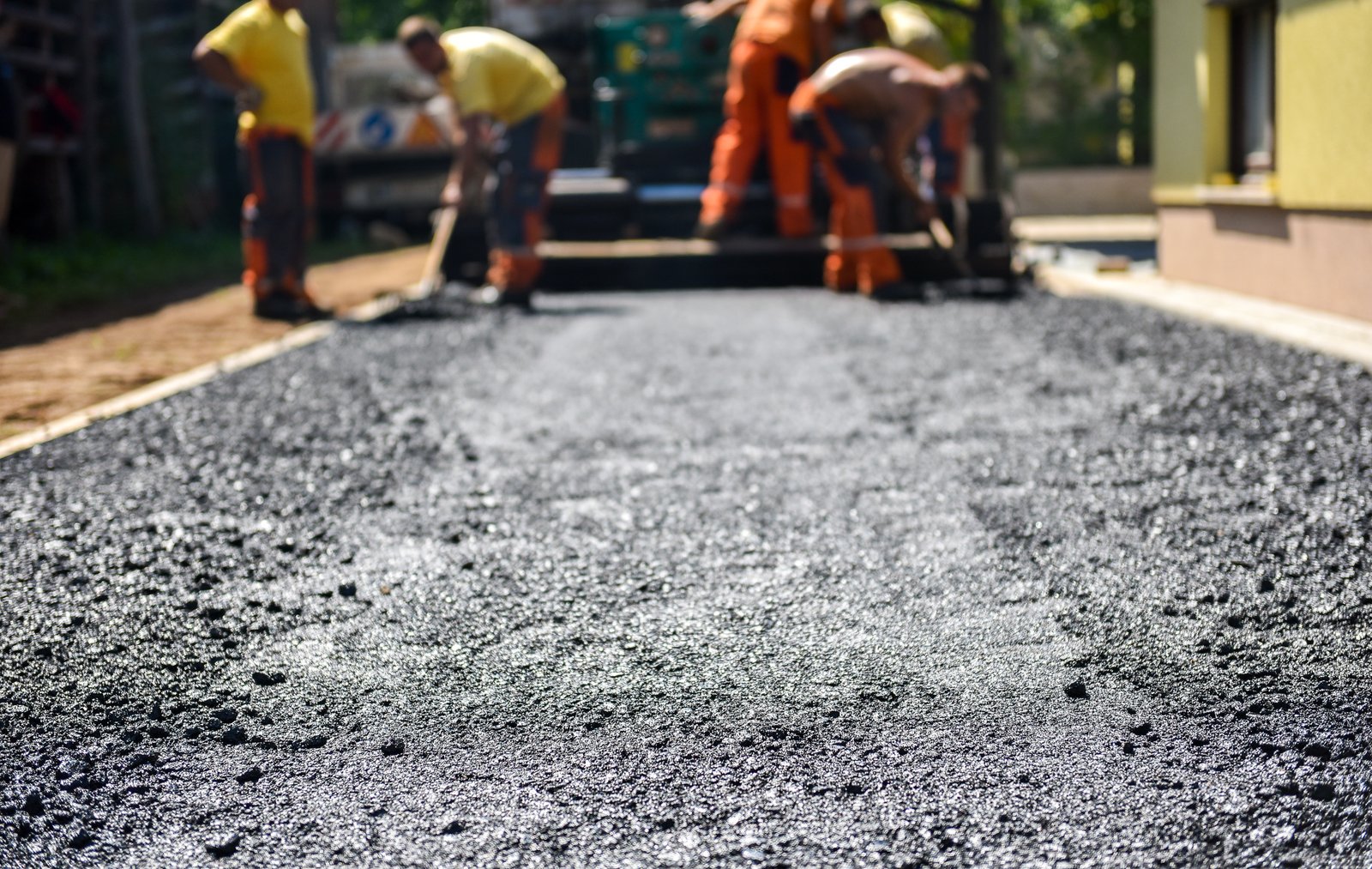

Flexible pavement bends before it breaks, and the base under it is what decides how much bending it can take. An asphalt surface a few inches thick spreads a wheel load over the stone beneath it, which spreads it again over the subgrade. If the base is thin, wet, poorly graded or loosely compacted, the asphalt carries the difference, and it fails by rutting, alligator cracking and potholes. Asphalt paving base preparation is the work that makes the surface course a surface and not a structural member it was never designed to be.
We prepare the base for parking lots, drive aisles, truck courts, access roads and street sections that will be paved in asphalt. The work includes trimming the subgrade, hauling and spreading flexible base, shaping it to grade and cross-slope, compacting it to specified density, and applying a prime coat or tack where the design requires. We do not pave, but we build what the paving contractor needs: a uniform, tight, correctly graded surface that will take hot mix without sinking under the roller.
Lots and drives for different owners
A retail or office lot sees passenger cars and delivery vans, so the base can be modest and the economy is in the quantity. A distribution or manufacturing site sees loaded trucks, and drive lanes and turning areas need a thicker base or a stabilized layer. Industrial owners often choose a hybrid: concrete in the high-traffic aprons and dock areas, asphalt over base in the car parks and perimeter drives.
We prepare bases for retail shopping centers, office buildings, schools and hospitals alike, and we tailor the thickness and material to the traffic and the soil. Where an owner is weighing asphalt against concrete for a heavy-duty area, we are happy to price both, because we also build parking lot concrete and can give an honest comparison.
Where truck traffic and widening projects set the bar
Large public projects tell us how heavy the demand is. In a notice posted June 18, 2024, TxDOT proposed building Loop 250 main lanes in Midland County between Fairgrounds Road and CR 1150, with an overpass at Todd Drive, an at-grade intersection beneath it and turnaround lanes. Turnarounds, frontage roads and ramps are exactly the places where base performance is tested, because trucks brake and turn on them.
Border trade shows the stress on the other end. A March 7, 2021 FreightWaves report said a city study found the World Trade Bridge in Laredo could reach capacity by 2030, and that planned widening would take it from eight to 16 lanes, with a fifth international commercial bridge also proposed. Where thousands of trucks pass each day, the pavements leading to and from them need a stout base. In the Rio Grande Valley, a planned State Highway 68, described in an October 2025 trade report as a 22-mile corridor from I-69C/US 281 in Edinburg to I-2 with no completion date or cost given, shows how much new roadway is on the drawing board, though we treat that description as a general reference only.
Trim, spread, compact and prime
The first step is trimming the accepted subgrade to the design elevation, so the base is a uniform thickness. Flexible base is delivered, spread with a paver, a grader or a spreader box, moisture conditioned and rolled to density. In a typical section, the base goes down in one or two lifts, and the final lift is shaped, tested and rolled smooth with a steel drum.
If the design calls for a prime coat, we coordinate with the paving contractor so it is sprayed when the base is dry and firm. We check final elevation with a rover at a grid, because a base that is a half inch off in thickness or cross-slope becomes an inch of extra asphalt or a ponding area. After acceptance we keep the base free of traffic and dust until paving, and the same grading trade partner handles the fine grading immediately before paving.
Gradation, moisture and density
Base material is only as good as its gradation and its fines. We test the delivered stone for gradation and plasticity, and we reject loads that are contaminated with clay or too coarse to compact. During placement, we add water so the material is at the optimum moisture, because dry base will not seat and wet base will rut.
Density testing follows each lift, and the testing agency reports results before paving. If a test fails, we recompact or add water and retest. We also keep the base graded for drainage during placement, since water that sits in a base layer can soften the subgrade beneath it. Where the subgrade needed help, the road subgrade preparation we did earlier is part of the same documentation.
Thickness, material and haul
Base thickness is the largest cost factor, followed by the price and the distance of the stone. A few inches of added thickness across a large lot is a big tonnage, so we help owners and engineers check whether the design is conservative or tight. Where a source of recycled concrete or reclaimed asphalt is nearby and permitted, it can lower the price without hurting performance.
Compaction effort and testing add cost, but cutting them is false economy, because pavement failures cost many times more than testing. For commercial developers building shopping centers and offices, we offer unit prices per square yard at a stated thickness, with alternates for thicker sections at the truck lanes.
Timing the base and the paving crew
The base should not sit for long. Once the base is accepted, the paving crew should follow within days, because rain, traffic and dust degrade a finished base. We plan with the paving contractor so that the base ends the day before the asphalt starts, and we avoid placing base on a Friday if the asphalt plant is closed on the weekend.
Cold and wet seasons limit paving as well, since asphalt plants slow down and cold mix is less durable. If the owner needs to be open before winter, we advise starting the base early and finishing the surface in the first warm window. That sequence keeps the owner from paying for the base twice.
Get the base ready before the paver
Get the base ready before the paver arrives. Send the paving plans and the soil report, and we will price the base by the square yard with alternates for heavier sections.
We coordinate with your paving contractor so the surface goes on the day the base is ready.
Common Questions
How thick should the base be under a parking lot?
It depends on traffic and soil. A lot with cars and light vans may need six to eight inches, while truck areas often need twelve inches or more, or a stabilized layer. The engineer sets the design, and we build it.
What is flexible base?
A crushed stone or similar granular material, graded so it compacts tightly, used under asphalt and concrete pavements. In Texas it is usually crushed limestone, although recycled concrete is also used.
Why prime coat the base?
A prime coat seals the surface, binds loose material and helps the asphalt bond. It is sprayed on a dry, firm base and left to cure before paving.
Can the base be placed in cold weather?
Yes, but the moisture and compaction have to be managed carefully. Frozen material cannot be compacted, so we avoid placing base when the ground is frozen.
Who tests the base?
A testing laboratory hired by the owner or the contractor takes density and gradation tests. We work with the lab and fix any failures right away.