
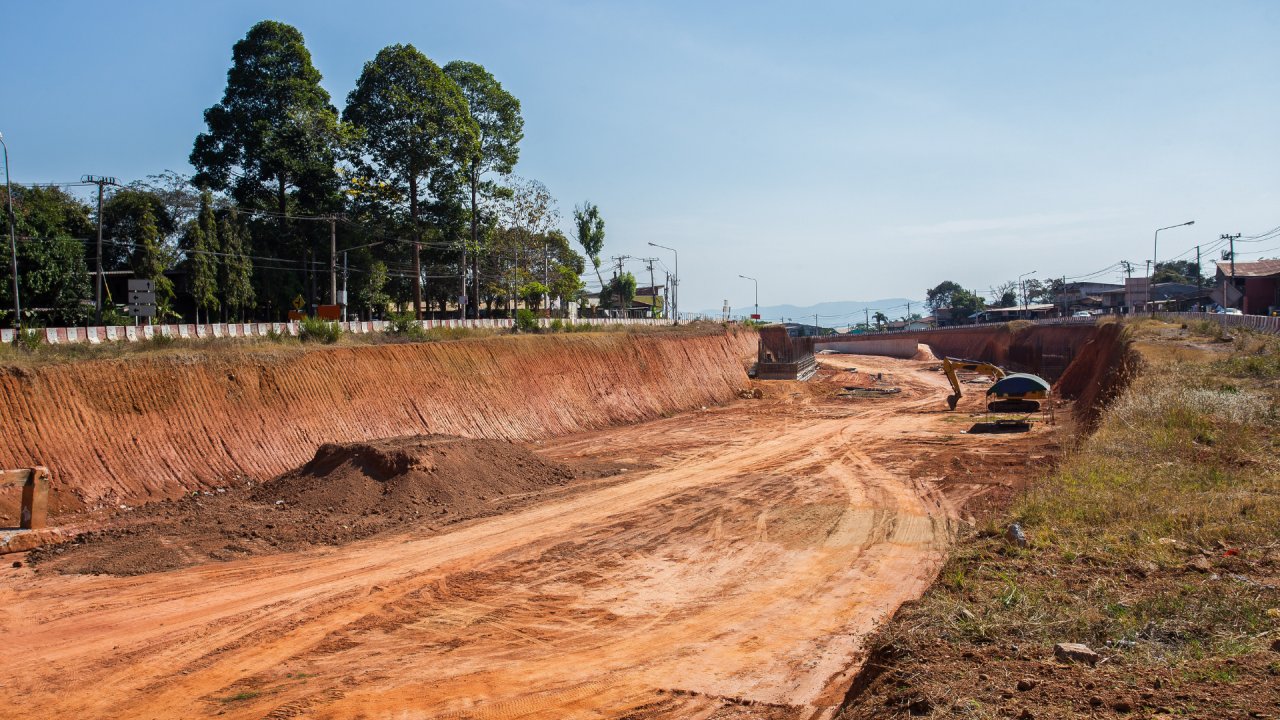

Half an inch is a small number until it is the difference between a slab that drains and one that holds a puddle against the dock door. Fine grading is the last pass over a prepared subgrade, the step between the rough dirt work and the base rock, vapor barrier or form setters who come after it. We trim the surface to the elevations on the plans, check it against a laser or GPS-guided blade, and leave it so the next trade is building on a surface that matches the drawings instead of correcting it.
Most of what makes fine grading hard is decided earlier. A pad that was rough graded wet and left to bake, or cut into clay one week and rained on the next, will not trim cleanly no matter how good the blade operator is. That is why we like to see the work before and after it: the mass grading that sets the bulk elevations, and the moisture and compaction conditions that the final trim has to preserve.
Texas sites are rarely uniform. A pad in the Panhandle can be hard and dry in July, while a pad on the coast can be soft by the next morning. We plan the final pass around what the soil is doing that week, not around a fixed recipe.
What the final trim covers
Fine grading is a tolerance operation. On a building pad we are bringing the surface to the plan elevation within a narrow band, usually a few hundredths of a foot, so the aggregate base can go down at a uniform thickness. On a parking field or a truck court we are also setting the slopes that move water to the inlets, which means the trim has to hold a crown or a cross-fall, not simply a flat plane.
The scope normally includes setting and checking the control points, cutting the high spots and filling the low ones in thin lifts, rolling the result, and verifying with a rover or a string line. We also trim the shoulders, the dish of a basin or the bottom of a swale when the drawings call for it. Where the plans include building pad preparation, the fine trim is the last line item in that sequence, and we price and schedule it as part of the same package.
Working the surface in the order the soil allows
We trim from the high side to the low side wherever the site allows, so that we are always cutting into firm ground and filling into the next pass, never driving over a surface we have just finished. Machine control does most of the precision work, but a grade checker on foot with a rod still catches what the model cannot, such as a soft spot, a buried obstruction or a stake that was knocked over.
Moisture decides how many passes we make. In expansive clay the surface can heave or crust between the trim and the next operation, so we keep the interval short and protect the finished surface with a lime or cement cap if the weather will not cooperate. Where that is the plan, lime and cement soil treatment is scheduled so the treated layer is cut to grade before it cures, not after, when it is hard to cut.
Business parks that are graded in phases
Phased sites make fine grading a repeated task, not a single event. Reese Technology Center started construction in 2025 on East 90 Business Park, a 90-acre site west of Lubbock, with the first phase covering about a third of the property, and the first-portion roads and infrastructure were expected by the end of fall 2025. A site developed that way is graded, trimmed and paved in pieces, and each piece has to meet the elevations of the roads and utilities already in the ground.
Ground-leased land adds a different discipline. Midland International Air and Space Port describes Phase 1 of its Spaceport Business Park as 50 acres on the southeast side of the airport, offered on ground leases negotiated by the Midland Development Corporation. Tenants build on pads that must tie to a master drainage plan they did not draw, so the trim has to match the grading plan exactly and the as-built survey has to prove it.
Fitting a short window into a long schedule
Fine grading is a small block on a long schedule, and it is easy to lose. A warehouse listed with the state's accessibility registration program in Pharr, for example, shows a 71,530 square foot building registered in April 2026, with construction starting at the end of that month and completion in November 2026. On a job that runs about six months, the pad trim might be a week or two, and a rain delay in that week pushes the base rock, the slab and every trade behind it.
We keep a trim crew ready to move the day the subgrade is signed off, and we avoid starting on a forecast that shows rain in the following twenty-four hours. When a surface has to sit exposed, we seal it with a smooth drum roller before the storm so water runs off instead of soaking in. The related work of excavation and trenching ahead of the trim is sequenced so those open cuts are backfilled and compacted before the final pass.
What moves the price of a fine-grade pass
Pad area and tolerance are the main drivers, followed by how much correction the surface needs. A pad that arrives within an inch of grade takes a fraction of the time of one that needs several hundred yards of cut and fill in the trim. Unsuitable or wet material found during the pass adds cost too, because it has to be removed or treated, not trimmed over.
Access and control matter as well. A tight site with active trades on it slows the blade, and a site without good survey control costs time in re-staking. We ask for the grading plan, the geotechnical report and the control file at bid time, because those three documents tell us more about the price than the square footage does. Where a pad needs deeper correction, our over-excavation and recompaction work is priced separately so the trim number stays honest.
Work that surrounds the final trim
Fine grading touches almost every other phase of a concrete and site job. It follows the earthwork, precedes the base and the slab, and sets the line that curbs and paving will follow. On industrial and distribution projects we tie it to the warehouse slab package, so the same crew that trims the subgrade understands the flatness requirement it is feeding.
For owners who are developing a larger parcel, the pad trim sits inside a broader infrastructure scope. Developers weighing a park or a subdivision can see how that fits in our land development infrastructure work, and a logistics and warehouse developer will find the same crews handling roads, pads and utilities in one sequence.
Send us the grading plan
Send us the grading plan, the geotechnical report and the control file, and we will tell you what the final trim involves on your site. We price pads, parking and paving as one sequence so the surface is ready when the next trade arrives.
Call our estimating line or use the quote form and we will respond with a scope you can compare against the rest of your bids.
Common Questions
How close to grade should the subgrade be before you start the final trim?
Ideally within about two inches of final elevation, with compaction already accepted. Trimming more than that takes extra passes, and the added cut or fill needs to be compacted in its own lift. If the surface is further off, we would rather correct it as earthwork first.
Can you fine grade in wet weather?
We can in light conditions, but we usually will not. Clay that is wet pumps under equipment and leaves ruts that have to be redone, and a trimmed surface that takes rain overnight can need to be reworked. We would rather hold a day than pay for it twice.
What tolerance do you hold on a building pad?
We work to the tolerance in the specifications, which is commonly a few hundredths of a foot on the elevation of the pad. The structural engineer or the slab floor requirements set the number, and we verify it with a rover before the base is placed.
Who checks the final grade, you or the surveyor?
Both. Our grade checker verifies as we trim, and the owner's surveyor or testing agency usually confirms the finished surface before base material is delivered. We keep our own records so any discrepancy can be traced to the stake or the pass that caused it.
Does fine grading include the base rock?
Not on its own. The trim is priced as a separate operation, and the base is placed, compacted and tested after it. On pad and paving packages we often price them together so the sequence is handled by one crew.