
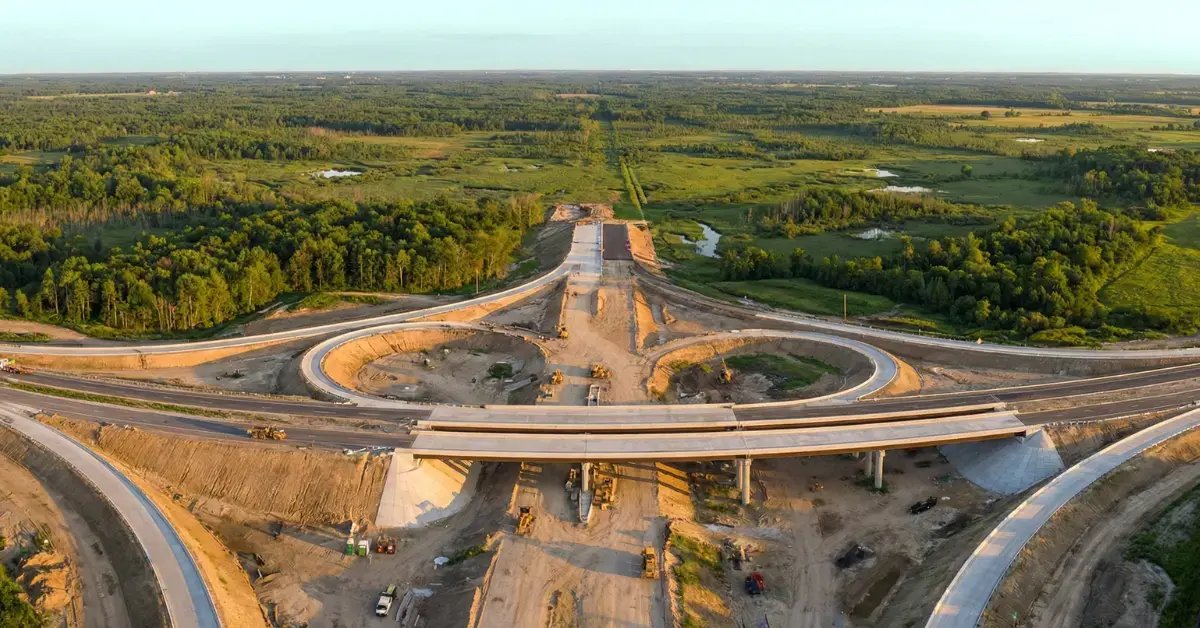
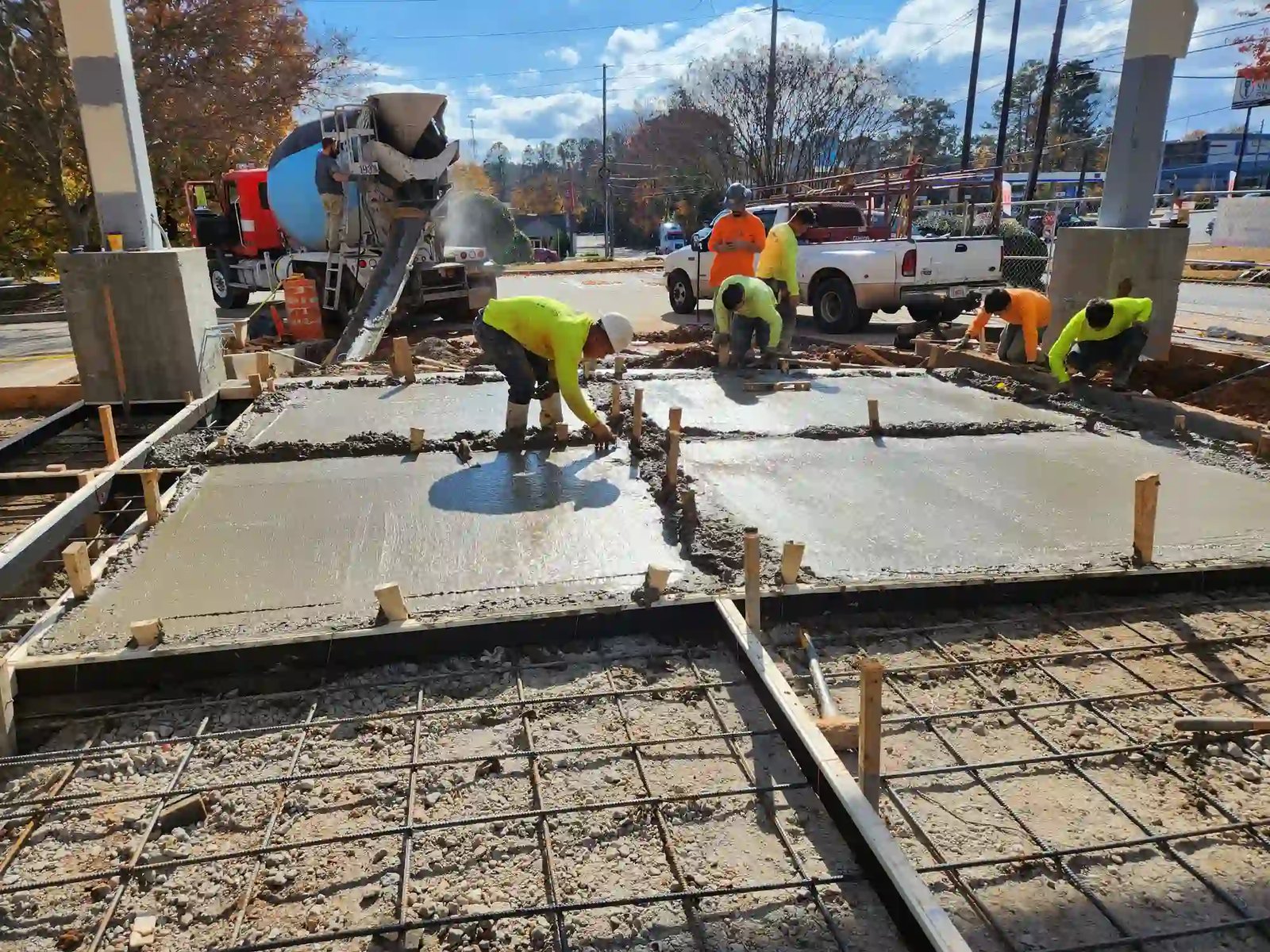
Raw land becomes a site a builder can use only after someone has put in the roads, the water, the sewer, the drainage and the graded pads in the right order. Land development infrastructure is that order: the first phase of work on a commercial park, an industrial campus or a master-planned tract, before any vertical construction begins. It is also where most of the developer's schedule and budget risk lives, because everything that follows depends on it, and it is hard to change once the pipe is buried and the curb is poured.
We build the horizontal work for developers and the contractors who serve them: mass grading, utilities, storm drainage and detention, street subgrade and paving, curbs, sidewalks and the concrete that goes with them. We can carry the whole package or the pieces that suit the owner's plan, and we coordinate with the engineer on sequence so that no crew has to dig up another's work. Because we are a concrete contractor as well as an earthwork one, the street, curb and flatwork phases come from the same company.
Large parks are being planned in phases
Near Seguin, Realty News Report said on July 14, 2026 that Lovett Industrial and NewQuest are developing the 164-acre Seguin Exchange Commerce Park at the northwest corner of Interstate 10 and Highway 46, planned for more than 2 million square feet of industrial space in buildings from 30,000 SF to 1.3 million SF. A range of building sizes on a single park means a range of pad sizes, truck court depths and utility demands, and the infrastructure has to be sized for the largest while serving the smallest.
Land is also being assembled by public bodies. A Community Impact article reported that on June 24, 2024, the New Braunfels City Council approved $20 million for the New Braunfels Economic Development Corporation to buy up to 100 acres of a 240-acre tract at Kohlenberg Road and FM 1101 for future industrial, commercial or institutional development. We read that report as a snapshot, not a project schedule, but it shows how much acreage is being prepared for tenants, and each acre needs infrastructure before it is marketable.
The horizontal package from rough grade to final street
A typical package starts with clearing, stripping and mass grading to the drainage plan. Utilities follow: water mains, sanitary sewer, storm drains, and dry utility conduit, often installed in a common corridor under the future pavement. Detention and water quality ponds are excavated early, because they serve as sediment basins during construction. Street subgrade is then prepared, curbs and gutters are formed, base and paving are placed, and sidewalks, ramps and driveway aprons complete the street section.
Everything is staked from the engineer's plans and verified with as-builts at each stage. We keep the sequence tight, so that the utility trenches are backfilled and compacted before the subgrade is finished, and the curb is poured before the base goes down, so that paving crews do not have to work around a rough edge. The earthwork connects to our mass grading and our site utilities scopes, which share crews and equipment.
Phasing, financing and the buyer at the end
Developers sell or lease finished lots, so the schedule is tied to a closing or a tenant's date. Phasing is how risk is managed: build the first phase, prove the market, and move on. That means leaving each phase in a stable, stormwater-compliant condition, and stubbing utilities to the next. Cash flow shapes the plan as well, because infrastructure is expensive, and the owner may want a bid with alternates by phase.
We also consider what the end user needs. A manufacturer who will build a large plant may want a pad delivered, not just a lot, and a logistics tenant may need a truck court and a trailer park in the design. We discuss the intended buildings with the developer and the engineer early. A commercial developer who knows the likely tenants can avoid rework and sell faster.
Plats, approvals and public procurement
Subdivision and site development go through the city or county's platting and construction plan review, and they require approved plans before work begins. Many jurisdictions require a pre-construction meeting, an inspector for the public improvements, and acceptance by the city or the utility district at the end of the warranty period. We follow the city's standard details for pipe, bedding, manholes, curb and street sections, and we keep the inspector in the loop.
Public development follows procurement rules. The Texas Comptroller's Statewide Procurement Division connects vendors with state purchasers and contract opportunities, and its vendor resources include the Electronic State Business Daily, the Centralized Master Bidders List and the TxSmartBuy ordering system. For municipal and public works owners and for state-funded work, those resources are part of how bids are found and contracts are let, and we are set up to respond to that process.
Where development budgets move
Earthwork balance, utility depth and length, and the amount of pavement are the largest cost drivers. A site that balances saves the owner hundreds of thousands in haul, and a site with deep sewer or rock costs more per foot. Streets and curbs are priced by the foot, and wider sections for truck traffic or fire lanes raise the numbers quickly.
Change orders cluster around utility conflicts, unsuitable soil and weather delays. We recommend a thorough survey and potholing at the outset, a geotechnical investigation sized to the project and a contingency that reflects the risk. Erosion control and SWPPP is a smaller line that, if neglected, produces the largest penalties.
Where we develop sites
We take on land development across Texas, adapting to the region. In the clay belt, we plan for lime treatment and the long drying times that come with it. On the coast, we plan around high water tables and storm drainage. In the west, we plan around caliche, wind and long hauls, and in the south, around sand and flat ground that needs careful grading to drain.
If you are comparing sites for flex and light industrial buildings or any other product, we are glad to tell you what the horizontal cost looks like in each region.
Walk the tract with us
Walk the tract with us. Send the master plan, the utility layout and the geotechnical report, and we will price the horizontal package by phase with alternates for the owner's schedule.
We would rather solve conflicts on paper than find them in the trench.
Common Questions
Can you build the whole infrastructure package?
Yes. We carry the earthwork, utilities, drainage, subgrade, curb and paving coordination as one package or in parts. The owner and the engineer choose how it is divided, and we price each piece clearly.
How do you phase infrastructure?
We build the first phase to a complete, stable and drainable condition, with utilities stubbed to the next phase. Each phase has its own erosion controls, and the schedule is set to match the owner's sales or leasing plan.
Who handles the city inspections and acceptance?
We coordinate with the city inspector during construction, keep records of tests and as-builts, and support the owner through the warranty and acceptance process.
What if we find rock or poor soil during development?
We document it, notify the owner and the engineer, and price the change by unit rates. Early borings and a contingency in the budget help keep surprises manageable.
Do you build the pads for buildings too?
Yes. We prepare building pads to the tenant's requirements as part of the package or as a separate scope, and we coordinate with the foundation contractor.