
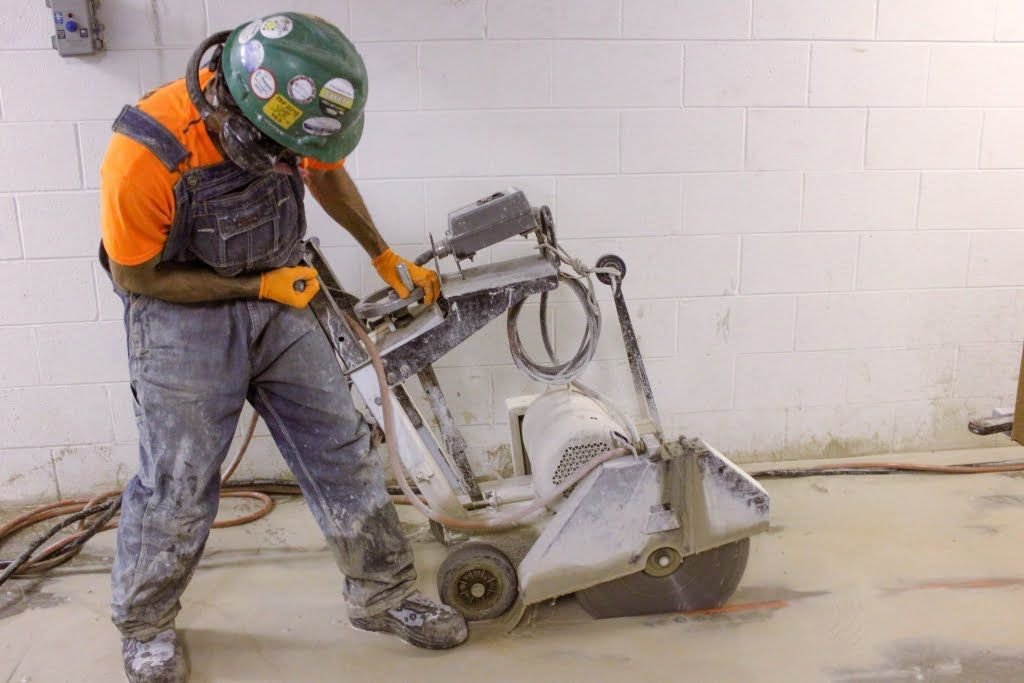

Every cut in a slab is a decision about what you are willing to lose. Cut the wrong place and you sever a post-tension tendon, nick a conduit, open a sprinkler line or leave a ragged edge that the next trade has to hide. Cut the right place cleanly and a trench for new plumbing, a new dock door or a column opening disappears into the finished building as if it had always been there. That difference is what sawing and coring are about.
We cut and core concrete for building owners, contractors and utility crews across Texas. The tools are well known: slab saws that run on rails or wheels, hand saws for tight work, wall saws mounted on tracks, wire saws for thick sections and core drills that leave round, clean holes. What separates a good crew from a risky one is the preparation, which is scanning, marking, planning the order of cuts and managing water, slurry and dust.
Most of the cutting we do supports other work: opening a floor so a plumber can set a new drain, carving out a loading dock slab, or making space for a new equipment pad. Because the work happens in occupied buildings as often as in empty ones, we plan to keep everything else running.
Scanning, silica and slurry
Before a blade touches concrete, we locate what is inside it. Ground-penetrating radar or electromagnetic scanning shows reinforcing steel, conduit and post-tension tendons, and we mark the results directly on the surface. Where a slab is post-tensioned, the owner should expect us to ask for the tendon layout and to refuse to cut where it is unknown, because a broken tendon can release a great deal of stored energy.
Cutting also raises respirable dust, so we use wet cutting wherever the building allows it, with vacuum recovery of slurry, and local exhaust and respirators when dry cutting is unavoidable. Slurry is contained and removed, not washed into a storm drain. We bring the equipment, the water and the cleanup so the facility does not have to, and we keep daily logs of cut locations for the owner.
Choosing the right saw for the opening
Flat sawing handles slab trenches, control joints, expansion joint cuts and removal panels. Wall sawing is for doorways, window openings and vertical cuts in tilt panels or foundation walls, where the cut section needs to be controlled as it comes free. Wire sawing reaches thick or awkward members that a blade cannot, such as columns, piers and massive footings. Core drilling makes round holes for pipes, conduit, anchor bolts and rebar dowels, from a one-inch penetration to a large-diameter pass-through.
We lay out the cuts so each piece is a size the crew can handle, and we plan lifting and removal at the same time. A section that comes free in an awkward spot, without a plan to carry it out, is a hazard. For bigger removals we pair the cutting with the concrete demolition and removal crews we coordinate so a single team controls the sequence from scan to haul-off.
Healthcare, industrial and military buildings
Hospitals and clinics are the most demanding clients. Temple, for instance, is described as a regional medical center with four major hospitals, and work in buildings like those means cutting around active departments, imaging suites and infection-control barriers. We plan negative-air enclosures, work hours and cleanup with the facility, and for hospital and medical office work we confirm vibration limits before the first core.
Large industrial and government campuses present a different kind of demand. In Amarillo, the Pantex site manager said in July 2024 that employment had grown past 4,600 and that a 25-year master plan includes reconstructing 250 buildings. In Corpus Christi, the Army Depot is described as the largest industrial employer in South Texas. Large campuses like these generate years of tie-ins, openings and penetrations through slabs and walls, and cutters who can work within security and safety rules are valuable. We badge crews, submit equipment lists ahead of time and keep tools and slurry inside the controlled area so the site security officer is never surprised.
Planning around an operating building
Most cutting is scheduled around somebody else. That might mean nights and weekends in a retail center, a few hours between shifts in a plant or a controlled window in a hospital. We agree the plan with the facility manager and the general contractor, set access routes for equipment, and stage the work so each area is cut, cleared and released before we move to the next.
Lead time is usually short once scanning is done, but the scanning and engineering review often set the pace, especially on a post-tensioned floor or a structure with unknown reinforcing. We build that time into the schedule. If a trench has to be open before a plumber arrives, we cut it ahead and protect it, so the trades behind us are not waiting on concrete. A short written cut plan goes to the superintendent before mobilization, listing each opening, its size, the saw method and the day it will be cut.
Cutting that leads into other site work
Cuts rarely stand alone. An opened trench leads into trenching and backfill, a new utility connection may need potholing and locating beyond the slab, and a new opening for a door is followed by a patch or a new apron. Because we do the concrete work before and after the cut, the handoff is clean and the finished surface matches.
For general contractors on renovation work, we are often the first call before the schedule is set, since the cutting method changes the sequence of every trade behind us. General contractors and construction managers use that early input to avoid rework.
Ask us for a scan and a cut plan
Tell us what you need opened, removed or drilled, and where. We will scan, mark and quote the work with a cut sequence, dust and slurry plan and a schedule that fits your building.
Common Questions
Can you cut a post-tensioned slab?
Only after the tendons are located and marked, and usually only with engineer approval. We scan, mark the tendon and stressing-end positions, and plan cuts that stay clear of them. If an opening has to cross a tendon, the engineer designs the detail, which may include detensioning or a new support.
How much dust and noise should we expect?
Wet cutting keeps dust low, and slurry is vacuumed as we go. Noise from a slab saw is significant, so we schedule loud cuts for off hours in occupied buildings and use core drills for small penetrations.
How deep can you cut?
Slab saws cut a few inches to well over a foot depending on the blade, and wall saws and wire saws go through much thicker sections. The question is usually not depth but what is inside and what you want to keep, which is why we scan first.
Do you remove the cut pieces?
Yes, if you want us to. We size each piece for the equipment on site and handle lifting, loading and haul-off, and recycle the concrete where a local facility accepts it.
What do you need from us before we start?
Drawings if you have them, the locations of known utilities and a point of contact for access. Tell us what the opening is for, so we can recommend a tolerance and a finish for the edges.