
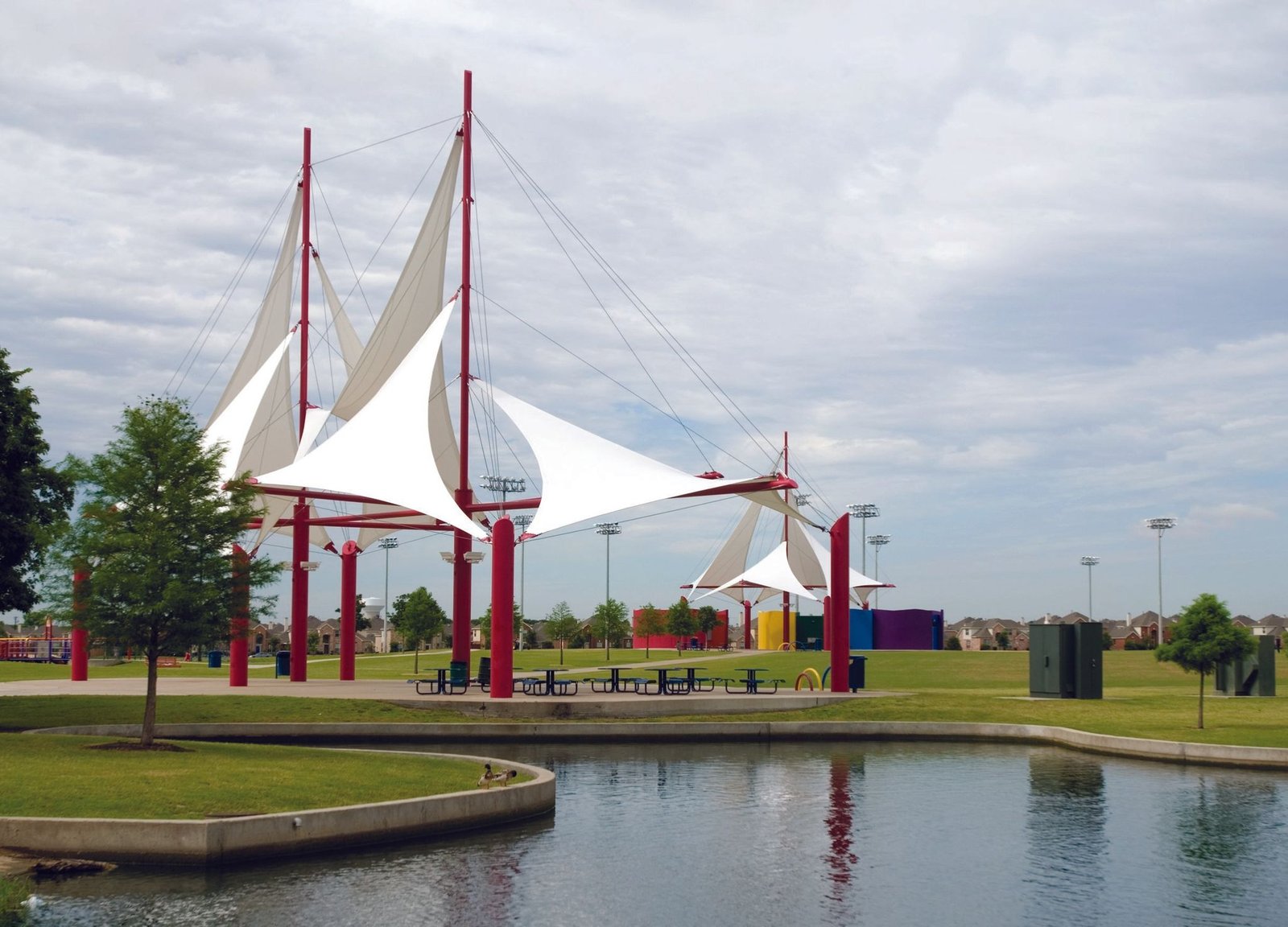

Venue plazas, school campuses and beverage distribution yards make up most of the concrete we pour in Allen, and each asks for something different from the slab. A plaza has to drain and look good in photographs, a campus has to open on the first day of school, and a distribution yard has to take trucks that do not care about either. We build all three, and we price them separately so an owner can see the choices.
Allen is compact and well planned. U.S. Highway 75 (Central Expressway) runs north to south through the city and State Highway 121 (the Sam Rayburn Tollway) runs along its northwestern edge near the McKinney border, which puts most sites within a short haul of a batch plant and a freeway. The tradeoff is that few parcels are large and undeveloped, so work is usually infill, redevelopment or careful expansion beside occupied buildings.
We bring a full set of trades to that kind of work: demolition and sawcutting for the existing slab, utility relocation, grading, forms, steel, placement and finishing. One accountable crew keeps the dust, the noise and the traffic under control, and reduces the number of people your facility manager has to call.
Services that arrive together
Most Allen scopes include several services at once. A new restaurant pad may need demolition and site prep, new grease interceptor vaults, a storm tie-in and a drive lane. A school expansion may need fine grading, a fire line and ADA ramps and accessible routes to connect old and new buildings.
Bundling these scopes under one contract lowers the cost of mobilization and reduces the chance of gaps between trades. It also lets us sequence the underground first, so no new pavement is cut for a pipe that should have gone in earlier. On a retail or restaurant pad, the order is usually demolition, utilities, subgrade, curb, paving and then sidewalks, with the ADA route checked for slope at each stage instead of only at the end.
Infill sites and shared walls
Because Allen has few untouched parcels, we plan for neighbors. We photograph adjoining structures before work begins, monitor vibration where compaction equipment runs close to an existing wall and protect adjacent landscaping and parking. Haul routes are chosen to avoid residential streets when possible.
Allen has no fixed-route public transit and does not belong to DART; the city says membership would call for a 1% sales tax dedicated to DART, ending sales tax funding for the AEDC and ACDC. For a contractor, the practical point is that everyone arrives by car and truck, so parking and drive-lane concrete carries more weight here than in transit-served suburbs, and a site's circulation plan is worth reading closely before we price the paving. We look at where delivery trucks turn, where cars queue at a drive-through and where water leaves the lot, because those three questions decide thickness, joint layout and slope more than any other.
Permits and inspections
Our permit-side work is routine but careful. We prepare traffic-control plans, erosion control plans and utility tie-in sequences, and we make sure the city's inspection requests follow the order of construction. Footing and rebar inspections come before the pour, underground inspections come before the backfill and final paving inspections come before the striping.
If an owner wants to confirm which requirements apply, we leave that to the design team and city staff, and the local building department reviews the permit set, so we build to what the approved plans state. We review plan notes for inspection, testing and special-inspection requirements before bidding, because they can add days that a schedule has to absorb. Special inspections for reinforcing steel, post-installed fasteners and concrete strength are scheduled with the lab ahead of time, so an inspector is on site when the forms are ready and not the following morning.
Working around school calendars and events
The city-owned Credit Union of Texas Event Center, a 7,500-seat arena, opened in November 2009, and Watters Creek at Montgomery Farm has a 79,000-square-foot convention center run together with a Marriott hotel. Venues like those have event calendars that make weekend work tricky and parking a premium. We coordinate with the owner's operations staff and schedule concrete and paving so that large events are not interrupted.
The fiscal 2023 report names Allen ISD (2,755), the City of Allen (937), Experian (817), Andrews Distributing (487) and Jack Henry & Associates (450) as the leading employers. School and municipal buildings must finish before term begins or an election date, and corporate offices need minimal disruption, so we publish a three-week lookahead and update it daily when the weather or deliveries change. For arena-style venues, we also plan around load-in days and tournaments, so a loading dock is never closed when a truck is due.
How we place concrete when there is no room
When a site has no room for a pump and a truck queue, we use two or three smaller loads, a conveyor or a line pump from the street, and we lay out the pour in strips that can be finished before the next truck arrives. A well-planned small pour is often better quality than a big one rushed.
Where a pad adjoins existing pavement, we saw clean joints, doweled where required, and match the new surface to the old with a controlled slope. Cold joints are avoided, and surface tolerances are checked with a straightedge before the finishers leave. In hot weather, we start early, cool the mix when allowed and cover finished sections quickly. In cool or damp weather, we protect the surface from rain and keep the cure moist but not flooded.
Get an Allen paving or slab plan
Give us the site plan and the calendar constraints and we will return a phased approach with unit prices. Owners in nearby Plano and McKinney often combine sites with us, and our commercial developers clients like seeing the options priced side by side.
Common Questions
Can you work beside an operating business without shutting it down?
Yes, in most cases. We phase the work, build temporary walkways and maintain access to doors, loading and parking. Noisy or dusty tasks are scheduled for off-hours, and we agree on a communication method with the manager so surprises are rare. A weekly walk with the facility manager catches small issues, such as a blocked fire lane or a missing sign, before they become complaints.
What should I know about parking lot concrete in this area?
Concrete lots last longer under heavy traffic but need a stable subgrade and accurate joint spacing. We build to the engineer's section, use proper curing and seal joints where specified. We price asphalt and concrete when an owner is undecided and explain the lifecycle difference.
How do you handle grease interceptors and utility vaults?
We set precast or cast-in-place vaults on a prepared base, coordinate pipe invert elevations with the plumber, and test for watertightness before backfill. Access lids are set to final grade after paving elevations are known, and we record the vault locations on the as-built drawings for the next contractor.
Do you supply testing and inspection reports?
We coordinate third-party testing for soil density and concrete strength and share reports promptly. Cylinder breaks, slump records and compaction results are organized by date and location so inspectors and owners find what they need quickly.