
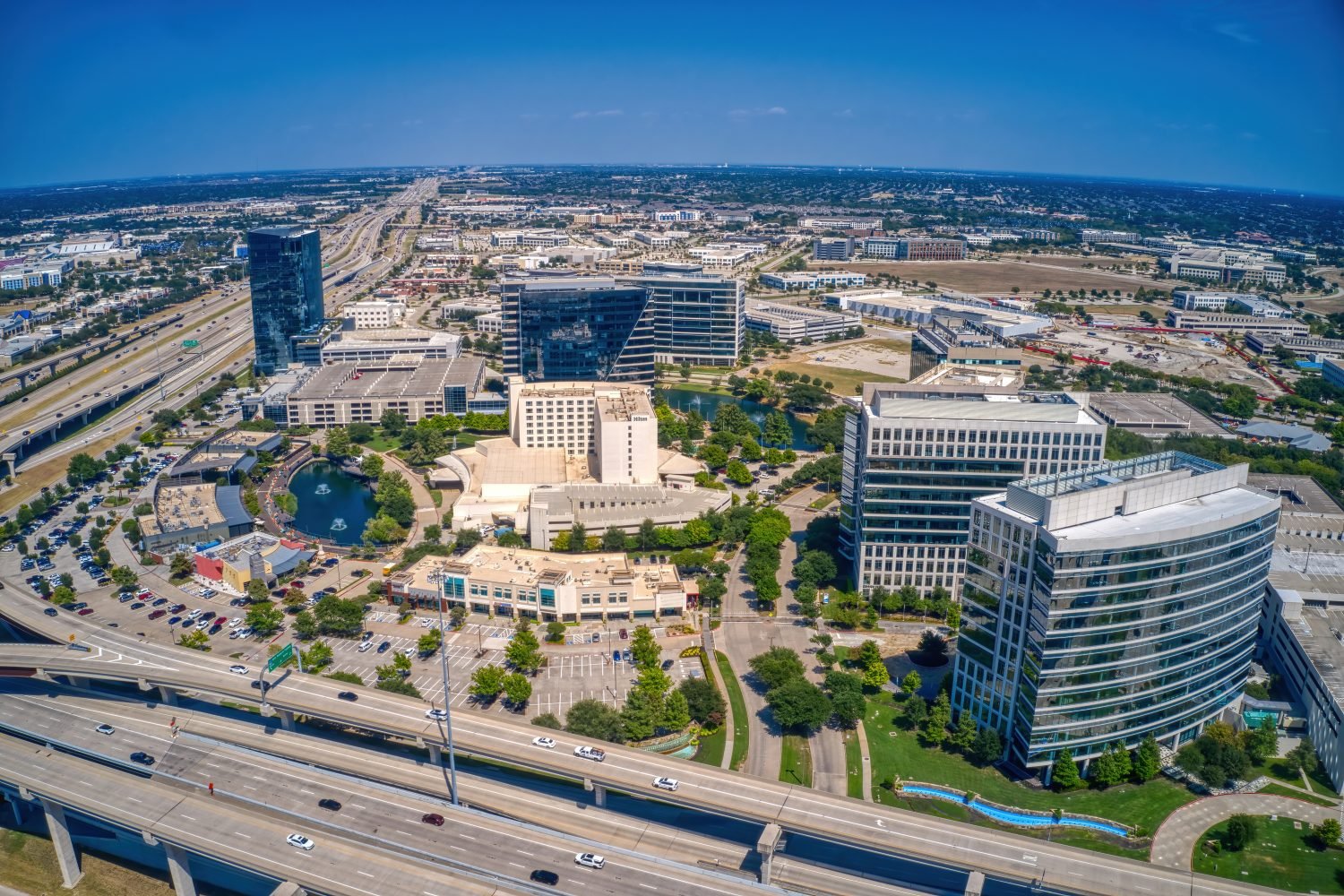

Corporate campus owners in Plano expect concrete that disappears into the landscape: flat plazas, crisp curbs, ADA routes that meet the slope on the first inspection, and parking decks that do not leak into the level below. We build that quality of flatwork and structure, along with the underground pipe, grading and subgrade that sit beneath it.
The city is boxed in by tollroads and a freeway. The Dallas North Tollway forms the western border of central Plano, the Sam Rayburn Tollway (SH 121) the northern border, U.S. 75 the eastern border and the President George Bush Turnpike (SH 190) the southern border, and published accounts call Plano Texas's largest city without an interstate highway. For a contractor, that means finished streets on every side of a site, so deliveries are timed, haul routes are chosen with care and nearly every utility tie-in is a street cut.
We work with general contractors, developers and owner-operators on office, medical, retail and mixed-use projects here. Our approach is short and practical: read the soil report, set the grades, pour what the drawings call for and hand over testing records that match the pour log.
Drawings, reviews and inspections
Plano is mature, which shapes how permits move. Most parcels are infill, so the civil plan is mostly about connecting to existing mains, storm inlets and curb lines. We prepare utility tie-in sequences, traffic-control plans and pavement restoration details with the permit set, so the review comments come back about design and not about missing paperwork.
Texas law sets the municipal commercial building code at the International Building Code, and allows cities to adopt local amendments after a public hearing; we confirm which edition and amendments govern each project with the design team and do not assume. Inspections for footings, rebar, underground work and final flatwork are requested in order, and our superintendents keep the inspection log current so a missed release never delays a pour. Before backfill, we also confirm that pipe bedding, tracer wire and thrust restraints have been signed off, since a buried item that failed review is the most expensive thing to expose again.
Offices, retail and mixed-use
Legacy West, at 5905 Legacy Drive, is a $2 billion project that welcomed the public on June 2, 2017, and it includes a North American automaker headquarters on 100 acres plus financial and insurance tenants. Corporate campuses of that type demand office building podiums, structured parking, pedestrian plazas and heavy loading areas for deliveries. We build the concrete in each of those, and we can phase a campus expansion so existing tenants keep working.
Smaller owners are just as important: medical office pads that need vibration-limited floors, retail pads with truck turning areas and retail shopping center parking that has to hold up to trash trucks. We price each of those as its own package so a developer can compare them against the budget.
Where the money goes on infill sites
On an infill parcel, access costs more than materials. Pump setups on a narrow street, night work to avoid daytime traffic, and extra time to cut and patch roadways can outweigh the cost of the concrete itself. We list those items separately in the estimate, so an owner can see what an extra-day lane closure or a second pump actually costs.
Underground conflicts are the next cost driver. In developed areas, old gas, telecom and irrigation lines can be where no drawing shows them. We pothole before we dig, mark what we find and carry an allowance for relocating small lines. That is cheaper than a strike on a live main. Where a street cut is unavoidable, we ask early about the city's moratorium periods and restoration standards, because the patch size and the base thickness can change the cost of a simple water tap more than the pipe does. A contractor who has priced a few of these knows to ask before the bid is due, and we do.
Sequence, curing and finish
A Plano flatwork job has a rhythm: subgrade and base first, forms and rebar next, then the pour, finish, curing compound and saw cutting in the same day. We schedule so that the sawcut crew does not wait for the finishers and the finishers do not wait for the trucks. Cooperation inside the crew is what keeps color and texture consistent across a long plaza. Placement order matters too: we pour toward the finished edge, keep the working face moving and add control joints at the layout the architect has approved, so crack lines land where the design intended.
For exposed finishes, we build a small sample panel on-site for the owner or architect to approve. We hold the mix, the finish tool and the curing method constant for the rest of the job, so the first and last panels read as one surface. Weather is monitored on the morning of the pour, and the finishing crew carries evaporation retarder and wind screens for the days when a dry front moves through.
Plano and the surrounding corridor
Among the 12 Dallas suburbs in DART, Plano has the Red Line, which opened in 2002 with stations at Downtown Plano and Parker Road, while the Silver Line reaches southern Plano with stops at Shiloh Road and 12th Street. Transit-oriented projects near those stations bring concrete sidewalks and flatwork, platform-adjacent paving and utility relocations that must be coordinated with the transit agency.
We also serve the adjoining markets of Frisco, Allen and McKinney, and developers who build in more than one of them can keep one contractor and one set of unit prices. For a school or healthcare owner, our schools and healthcare owners experience applies directly here.
Tell us about your Plano site
Send the plan set and the geotechnical report, and tell us which street cuts, tie-ins and tenant constraints apply. We will price the work in packages you can compare and give you a schedule that fits the site.
Common Questions
Can you work on a Plano site with no laydown space?
Yes. We plan deliveries just-in-time, use a pump instead of a chute truck so concrete is placed without staging, and arrange a nearby offsite spot for rebar and forms. The scheduling is tighter, but it is common on infill parcels.
Do you coordinate with DART on station-adjacent work?
We coordinate through the owner or the general contractor. Work near transit property needs agency approval for access, flagging and utility conflicts, and we include the lead time in our schedule so the pour is not held up.
What finish can I expect on exposed plaza concrete?
We offer broom, light-broom, salt-finish or decorative treatments, and we build a sample panel before the production pour. Color and texture are controlled by holding the mix, the finishing method and the curing process steady.
How do you control cracking in a large parking deck?
Joint spacing, reinforcement placement and prompt curing control cracking. We follow the engineer's joint layout, saw as soon as the concrete can take it without raveling, and keep curing moisture on the slab during the first days.