
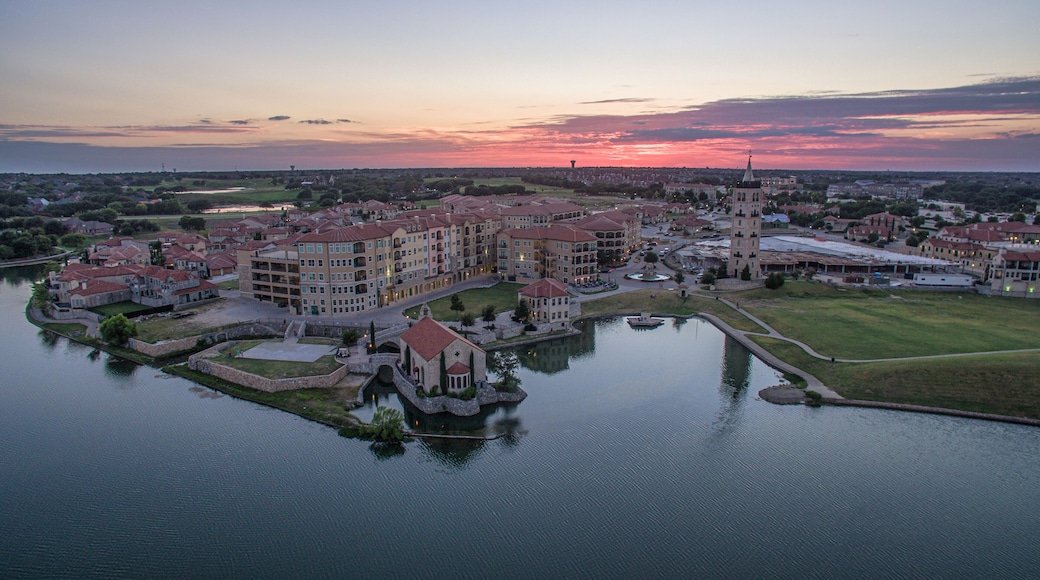

Concrete schedules in McKinney bend around May, the wettest month of a 41-inch rainfall year, and the contractors who deliver on time are the ones who plan the earthwork for mud before they plan it for dry ground. We build foundations, slabs, paving and utility systems here with that rule in mind: protect the subgrade, keep water moving off the pad and never place concrete on a surface that has been soaked and not retested.
About 32 miles north of Dallas and 577 feet above sea level, McKinney has a humid subtropical climate and recorded a high of 118 F in 1936. That swing, from soggy spring to punishing summer, is exactly what our trade partners are set up for. We carry cooling and curing equipment for hot afternoons, and pumps, covers and compaction gear for the wet weeks.
Our work in the city runs from small commercial pads to industrial buildings and airport-side development. Whether you are a developer, a general contractor or a public owner, we start with the geotechnical report and a plan for where the water will go.
Highways, an airport and an employer base
Traffic moves through McKinney on U.S. 75 (north to south) and U.S. 380 (east to west), SH 5 passes north to south through Downtown McKinney, and the Sam Rayburn Tollway branches from SH 121 along the McKinney-Allen border. Those corridors give industrial and commercial developers choices of site, and they also define where trucks can turn and where utilities are already in the ground. We read the road system as part of the site plan.
The city's 2024 annual financial report puts Raytheon Intelligence & Space (4,200) first among McKinney employers, followed by McKinney ISD (2,920), Collin County (2,000), Globe Life (1,700) and Medical City McKinney Hospital (1,424). A defense-electronics employer, a hospital, a school district and county government point to the work that is ahead: clean-floor slabs for technical buildings, medical office and hospital-adjacent pads, school paving and county road and drainage projects.
The scope we cover on a typical site
On a new McKinney parcel we usually begin with clearing and mass grading, then move to detention and storm drainage, water and sewer lines, building pad preparation and finally the concrete. The pieces are tied together by mass grading and erosion control and SWPPP, which have to be in place before the first storm. A pad that drains poorly will cost you weeks, so we shape and test it carefully. Detention basins are excavated early where the schedule allows, because the same ponds that hold stormwater later can serve as sediment traps during construction, and the spoil is often usable as engineered fill elsewhere on the site.
For concrete itself, we build footings, slabs on grade, tilt-up bases, aprons and parking. Joint layout, rebar placement and curing method are chosen to match the building use. A warehouse floor and a patient-care corridor floor do not get the same treatment, and we ask the design team early what the floor will be asked to do. Moisture-sensitive flooring, forklift traffic, wash-down and static control all change the mix, the vapor retarder and the finishing schedule, so those decisions are made before the slab is poured, not after the flooring contractor complains.
Planning around wet springs and hot summers
We schedule earthwork-heavy tasks for the drier part of the year when we can and build in weather days when we cannot. Open trenches are backfilled by day end, stockpiles are shaped to shed water and silt fences are checked after every storm. When rain delays a subgrade, we retest density and moisture before concrete is allowed on it.
In summer, our pours start early. We monitor concrete temperature, use retarders when the engineer allows and place curing compound immediately after finishing. If the forecast shows wind and heat together, we reduce the placement size, so the surface never gets ahead of the finishers. Water for finishing is never added at the truck without engineer approval, and we reject loads that arrive outside the mix's allowed time.
Permitting for a growing city
In southeast McKinney, the city purchased McKinney National Airport, a general aviation field, in 1979; published accounts report a 2023 GA terminal expansion, city approval in January 2025 of a $72 million commercial airline terminal on the east side, and Avelo Airlines service starting in November 2026. Airport-adjacent development brings height restrictions, drainage coordination with the airport and sometimes federal review, depending on the site. We plan for that review and let the designer and city staff tell us which rules apply.
For ordinary commercial permits, we provide the contractor-side items the city needs: erosion control plans, utility sequencing, traffic control and inspection requests. Where the project follows state law on municipal codes, we confirm with the design team which edition and local amendments the city is applying, and we do not assume. Reviewers in a fast-growing city are busy, so a complete submittal with clear sheets and a named contact moves faster than a thin one, and we check ours against the city's checklist before sending.
Services we often combine
Owners frequently bundle sanitary sewer installation, water main installation and paving into one contract, which cuts the number of trades that must be coordinated. One crew leaves the trench, and the next sets forms in the same footprint. Industrial owners in Plano use the same approach when their sites cross city limits, and we keep a crew in those markets as well.
Developers on the highway corridors, including commercial developers working in Allen, also call on us for programs that require predictable unit pricing. We provide a unit price list for common items so change orders do not turn into negotiations.
Get a McKinney site plan reviewed
Send us the civil drawings and the soil report. We will tell you where the water and the utilities will be the hardest parts of the job and how to schedule them.
Common Questions
How do you handle a site that stays wet after spring rain?
We drain the area, aerate or lime-treat the subgrade if the soil report allows it, and retest density and moisture before building the pad. Concrete is never placed on a pumping or saturated subgrade. We also add temporary swales and sump pits to keep rainwater off the work.
Can you build near the airport?
Yes. We work with the owner and designer on height limits, drainage and any required review, and we plan crane and pump locations so nothing violates the airport's restrictions. Notices and approvals are the owner's responsibility, but we supply the equipment data.
What is a realistic schedule for a 100,000-square-foot slab and site package?
It depends on the soil and the weather, but a typical sequence is a few weeks of grading and utilities, then pad preparation, then pours spread over several weeks to allow curing and saw cutting. We give a day-by-day schedule at bid and update it weekly.
Do you provide as-built drawings for utilities?
Yes. We record pipe locations, inverts, valve positions and manhole elevations as the work proceeds, and provide as-builts to the engineer in the format the city requires. Accurate as-builts speed the final acceptance and reduce future dig hazards.